
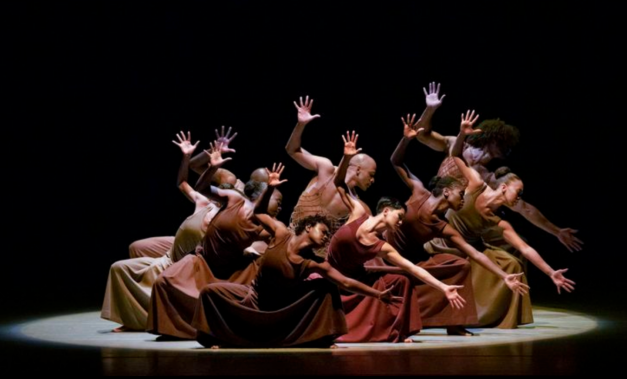
Alvin Ailey American Dance Theater in Alvin Ailey’s Revelations (Photo: Paul Kolnik)
Alvin Ailey American Dance Theater
By Joel Benjamin
Just as the Mission at Capistrano hosts swarms of swallows every March, New York City Center is where the Alvin Ailey American Dance Theater makes its nest every December. This exciting troupe has weathered many ups and downs to become the modern dance icon it now is. How many dance companies can sell out the enormous New York City Center? The Company is in good shape under Alicia Graf Mack in this, her inaugural season as director.
The program on December 12 comprised four Ailey classics: Memoria, A Case of You, Cry, and Revelations.
When dance pioneer Joyce Trisler passed away, Ailey lost his closest friend and confidant. Both studied with Lester Horton in Los Angeles and grew up artistically together. Losing Trisler way too early distressed Ailey. His deep sadness coalesced into Memoria, (1979) his tribute to his pal and muse. Memoria is clearly a work close to Ailey’s heart. Choreographed to a score by Keith Jarrett that went from meditative to blissful, it isn’t one of Ailey’s finest works but the passion with which his dancers and students imbue his movements make up for any minor problems with the work.

Alvin Ailey American Dance Theater in Alvin Ailey’s Memoria with Ailey II and students of The Ailey School (Photo: Paul Kolnik)
Memoria is choreographed in sections which introduce the stand-in for Trisler (a luminous Sarah Daley-Perdomo), a sad, lonely central figure surrounded by a worshipful group of dancers (the large cast was filled out by students from the Ailey School, all beautifully rehearsed and exuberant). Wearing long, flowing dresses for the ladies and dark pants for the men (costume design by A. Christina Giannini), their costumes morphed into brighter colors as Daley-Perdomo was joined by a crowd who formed joyous circles around her, now dressed in bright red to indicate that her path led to happiness.
Judith Jamison’s A Case of You (2004) is a duet that sensitively reduces the relationship between two people—Samantha Figgins and Isaiah Day—into a ten-minute dance to music by Joni Mitchell. The two dancers dressed in street wear by Jon Taylor and dramatically lit by Al Crawford entered along a diagonal, at first affectionate and even passionate. Jamison’s inspired movement palette sometimes veered towards mime, arms swinging angrily, sensual touching and simple walking and running. In A Case of You, Jamison, who was one of Ailey’s muses and probably his most famous dancer, produced a complex portrait of love turned to hate and back to love again. It is no wonder that Jamison took over the AAADT after Ailey’s death. Jamison passed away a few years ago, but with works like A Case of You her talents weren’t limited to her luminous dancing and her organizational skills.
Cry (1971) was Ailey’s gift to Jamison. The unforgiving solo was dedicated to “all Black women everywhere—especially our mothers.” Constance Stamatiou was the soloist who jumped into Jamison’s iconic, beautiful white costume, and served this three-part dance beautifully.

Constance Stamatiou in Cry (Photo: Paul Kolnik)
Set to music by Alice Coltrane, Laura Nyro and Chuck Griffin and performed in the sensitive lighting by Chenault Spence, Cry follows this everywoman in her journey from sadness to deliverance. Sculpted on Jamison’s unique physique, Stamatiou’s interpretation was softer than Jamison’s but just as powerful. When she rose from the floor-bound first part to express her glee in full-bodied movements, she shone just as brightly as Jamison. Stamatiou received a standing ovation for her well-focused efforts.
The program ended with the Ailey’s best-known masterpiece, Revelations, (1960) which he choreographed to traditional Black music ranging from gospel to calypso. Revelations is divided into three sections: “Pilgrim of Sorrow” (the suffering of slaves); “Take Me to the Water” (the Caribbean influence); and “Move, Members, Move” (a quaint look at a close community).
Each section had its highlight. In the first, Miranda Quinn and James Gilmer were particularly moving in the slow, intense “Fix Me, Jesus”. In the second, Yannick Lebrun performed “I Want to Be Ready” with almost frightening intensity. In the third section, “Sinner Man” was performed by three virtuosos: Jesse Obremski, Sebastian Garcia and Mason Evens.
As has become a ritual, the finale, “Rocka My Soul” was given an encore, which delighted the sold-out audience.
Alvin Ailey American Dance Theater
At The New York City Center
131 West 55th Street
Running time: 2 hours 30 minutes including two intermissions
Through January 4, 2026