
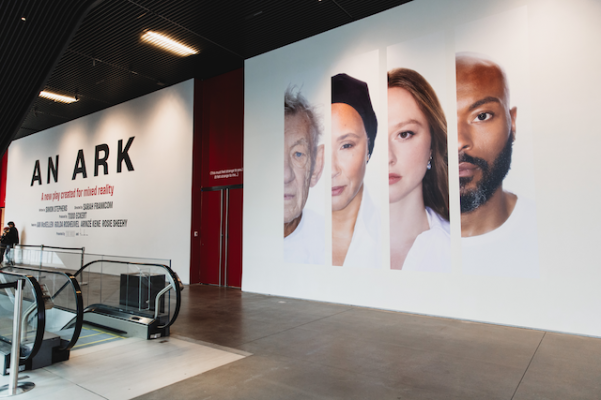
An Ark at The Shed (Photo: Marc J. Franklin)
An Ark
By Deirdre Donovan on February 2, 2026
With An Ark, The Shed and Tin Drum unveil the world premiere of what they describe as the first play created for and in mixed reality, a work that replaces physical presence with one-to-one digital intimacy. Written by Simon Stephens, directed by Sarah Frankcom, and starring Ian McKellen alongside Golda Rosheuvel, Arinzé Kene, and Rosie Sheehy, the production asks whether theatrical communion can survive—and even flourish—inside a headset.
The answer, of course, resides in the mind and heart of each theatergoer willing to enter The Shed’s Level 2 Gallery and don the headset that serves as this production’s threshold. To experience An Ark fully requires relinquishing fixed ideas of what theater must be and embracing what American Theatre suggested in its January 22, 2026 issue might be the form’s “afterlife.”
Before entering the Level 2 Gallery, audience members are asked to check their coats and bags, remove their shoes, and place them in cubbies outside the performance space. This deliberate prelude functions as a gentle rite of passage, signaling that An Ark invites its audience into something approaching a sacred space—one where shedding a few worldly accoutrements helps attune the mind to a more contemplative state.
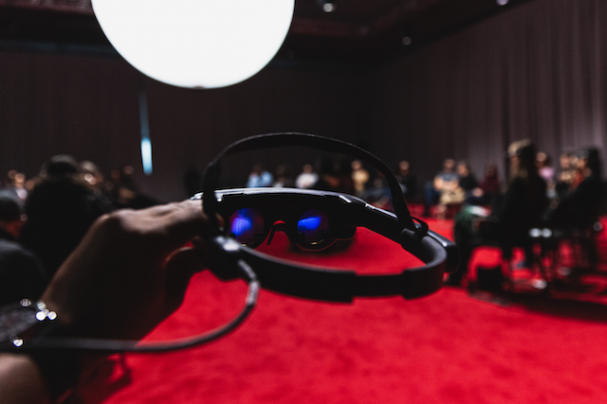
The headset worn by viewers at An Ark (Photo: Marc J. Franklin)
The Shed’s Level 2 Gallery accommodates up to 180 audience members for An Ark, seated in concentric circles and outfitted with mixed-reality headsets that project the play into the virtual space before each viewer’s eyes. One by one, four nameless figures—identified simply as A, B, C, and D—appear and settle into an unadorned chair, gazing outward before addressing each theatergoer directly, in the second person, as if ushering us toward an unnamed threshold. Rotating through the ensemble, the performers speak the play’s opening incantation:
A: Don’t panic.
B: Don’t panic.
A: Don’t be scared.
C: This must feel strange to you.
D: It felt strange to me—I still remember it now, like it was—
A: You must have known this was going to happen.
B: We all know this moment is going to happen.
C: Most people choose to pretend that it won’t.
A: When this is all over, you’ll go through the doorway at the end of the room. On the other side of the doorway things will have changed forever.
This opening sequence initiates the audience into a guided descent through its own remembered life, a cradle-to-grave reckoning that begins with the violent wonder of birth—the moment one leaves the maternal womb and gulps that first, exhilarating breath of air. Rather than treating birth as a generalized abstraction, the ensemble conjures a range of possible origins—a coastal town, a suburb, the rural heartlands, even a desert—collapsing geography into a shared point of entry. What unites these beginnings, the performers insist, is the shock of arrival: birth may be “the most normal thing in the world,” yet it remains terrifying for both infant and mother. There are warm blankets, skin against skin, first recognition through scent—but An Ark reminds us that birth is no idyll. It is the first rupture, and merely the opening threshold of a life defined by successive passages.
Stephens’s text is exquisitely shaped and meticulously orchestrated, a quality that may feel either bracing or burdensome depending on the viewer’s temperament. Some will welcome his firm authorial hand as a doorway into self-recognition, while more skeptical souls may bristle at what can feel like emotional overdetermination—insights delivered with a precision that leaves little room for resistance. An Ark ultimately asks for an uncommon level of surrender: not only a suspension of disbelief, but a willingness to relinquish inherited ideas of theatrical form and trust a work operating at the frontier of technology.
In a program note, Stephens explains that he began writing An Ark at the height of the pandemic, repeatedly circling the question, “How do we live when we know that we die?” What might sound morbid becomes, in his telling, an invitation to “look fearlessly into the heart of what it is to die for a while”—an encounter he hopes will not only make audiences wiser, but newly attentive to their own lives. Remarkably, within just 47 minutes, the play attempts precisely that, ushering the viewer through infancy and childhood, first friendships and first love, disappointment, despair, and finally the stubborn human capacity for resilience.
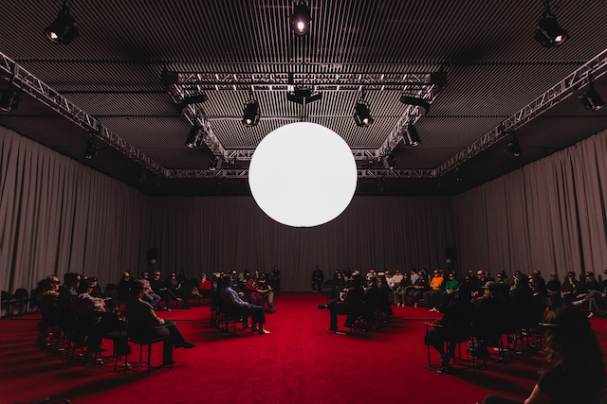
An Ark plays at The Shed’s Level 2 Gallery (Photo: Marc J. Franklin)
When the experience ends, the headset comes off, and the viewer is returned—shoes still absent, body still seated—to The Shed’s Level 2 Gallery, subtly altered by what has just unfolded. An Ark ultimately functions less as a play than as a passage, asking its audience to step through a carefully constructed doorway, confront the fact of mortality, and then reemerge into the world with sharpened awareness. Whether that passage feels like profound communion or a beautifully engineered provocation may depend on how willingly one surrendered—but the seriousness of its invitation, and the quiet weight it leaves behind, are unmistakable.
At The Shed
545 W 30th St, Manhattan
Running time: 47 minutes with no intermission.
Through March 1