
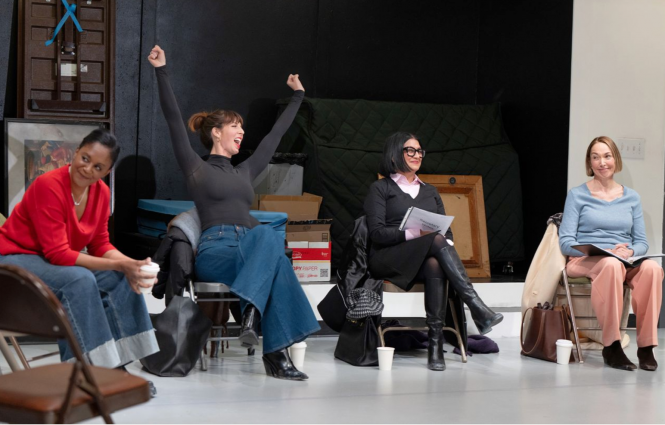
April Matthis, Mallory Portnoy, Maria Elena Ramirez, Elizabeth Marvel (Photo: Julieta Cervantes)
The Dinosaurs
By Carol Rocamora on February 17, 2026
The scene is an empty, nondescript room, with fluorescent lighting and a pile of random items (painting, furniture). It could be anywhere (someone’s basement, a room in an office building, a school?).
One by one, a number of women enter, apparently preparing for a meeting of some kind. First to arrive is Jane (April Matthis), setting up the chairs. Next, there’s Joan (Elizabeth Marvel), carrying the coffee. Then comes Jolly (Kathleen Chalfant), bringing a box of pastries. Next to appear: Joane (Maria Elena Ramirez), followed by Janet (Mallory Portnoy). There’s talk of donuts and scones, and who prefers what.
Where are they? What’s happening? Are we in the existential world of Samuel Beckett, where “nothing happens,” as Gogo says in Waiting for Godot?
It takes almost half-way through this seventy-minute-long play to answer the above questions. “Welcome to Saturday Survivors!” Joan declares finally, introducing the weekly gathering of alcoholics (all women) about to celebrate the AA group’s 52nd anniversary.
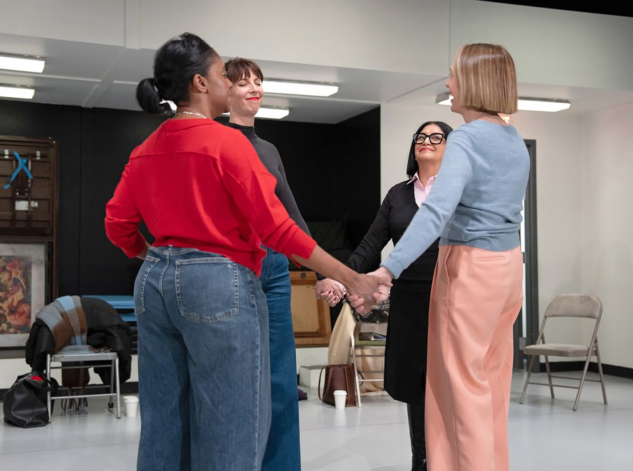
April Matthis, Mallory Portnoy, Maria Elena Ramirez, Elizabeth Marvel (Photo: Julieta Cervantes)
Now that we know the terrain, we’re prepared for an emotional ride. But we don’t get one. Instead, the octogenarian Jolly (who has been in the group for decades) reads from the group’s by-lines of rules and regulations, while Jane (the de facto leader) announces the topic for the day, “Coming Back,’ soliciting stories from those who wish to share. Janet tells a dream-like tale of a car trip she imagines taking, where she throws the contents of her duffel bag out the window that include clothing and body parts of an unidentified man. Joan talks of her lifelong affliction from anxiety that led to her drinking. Only Joane’s story – her graphic discovery of her son’s homosexuality – is realistic and specific. The meeting ends before Jane can share at all.
What distinguishes this play from others about a group of women (the recent Liberation, for example) are its non-realistic, surreal elements. The first sign, as you may have already noted, features all the members of the group having names beginning with “J”; two members even have the same name (Joan, Joane), although spelled differently.
There’s yet another character named Raina, aka Buddy (Kelly McQuail), who appears sporadically throughout the play. We meet her in the opening scene, before the others arrive, as Jane is setting up for the meeting. After a brief discussion about the etymology of the word “cupcake,” she suddenly flees (Why? Does she have the wrong address? It isn’t explained.). She next appears in the middle of the play, suddenly, inexplicably, speaking to Jane while the ensemble is conversing simultaneously, not hearing her. At the end, after everyone leaves, Buddy enters for the third time, where she encounters a new character named June, who is also played by Kathleen Chalfant. Apparently, Buddy has already been in the group for a while, but the playwright has separated her journey from the other.
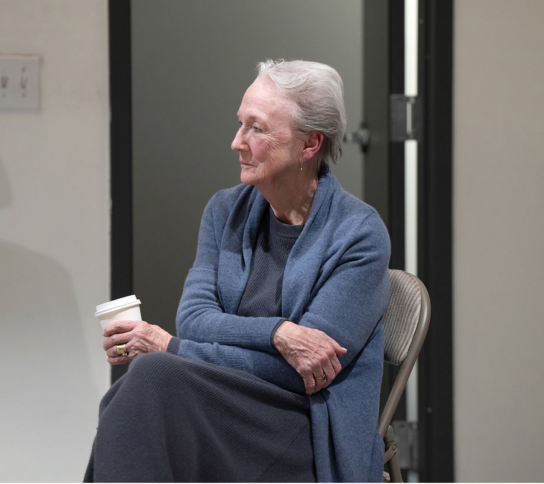
Kathleen Chalfant (Photo: Julieta Cervantes)
What I find striking about this play is its lack of emotionality that one might expect from such a serious topic. As Beckett says in Waiting for Godot, “people come, people go.” That’s it. But in The Dinosaurs there is a continuum. The character of Jolly has become June, and so the process continues. As Joane says, “The tides keep on coming in and out and I don’t really know what else I have to give, how much more I can lose, but I’ll keep coming back.”
Could that explain the play’s title? As Joan says, “At the core of it all we just wanted to be seen and heard and loved…” Does that title express the fundamental, timeless, universal need of the human condition? Directed with unadorned simplicity by Les Waters, designed by dots, this production lets the play speaks for itself.
Reading the program notes, I was deeply moved by the message from Jacob Perkins, the playwright, revealing the autobiographical source of this play. In a sense, it clarifies the impression that this is an incomplete, unfinished work. Life goes on, and people’s needs “to be seen and heard and loved” go on, too.
At Playwrights Horizons
416 W. 42nd St
Running time: 1 hour 15 minutes
Through March 1