
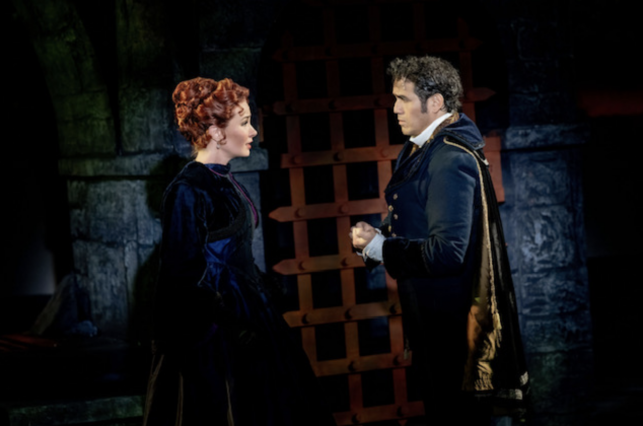
Sierra Boggess, Adam Jacobs (Photo: Shawn Salley)
Monte Cristo
By Marc Miller on March 28, 2026
The ladies’ dresses are long and flouncy, the men’s vests bright and ornate, the cello and viola are sawing away in the pit, the lyricist is rhyming “reign” with “a-gain,” and the chorus is singing about injustice, class distinction, and, oh yes, love. Hooray, operetta’s back in town!
The form’s been considered obsolete for nearly a century, but it pops up now and then: Candide, The Scarlet Pimpernel, A Gentleman’s Guide to Love and Murder. And now the York Theatre’s Monte Cristo, adapted by Peter Kellogg (book and lyrics) and Stephen Weiner (music) from Alexandre Dumas’ The Count of Monte Cristo, and employing all the staples of the genre: sweeping romance, haves-vs.-have-nots social comment, songs in venerable forms. It’s less than ingenious in its execution of these, but Weiner and Kellogg, author of the recent good musicals Desperate Measures and Penelope, or How the Odyssey Was Really Written (Weiner collaborated on the latter), know what they’re about. The opening chorus is a bang-up job, with the minions of 19th century Paris decrying “Desperate Times”: “Someone is writing down who your friends are, someone is recording how you vote… Journalists are being charged with treason, and politicians swallow their own lies.” Whoa! Is this 1815 or 2026?
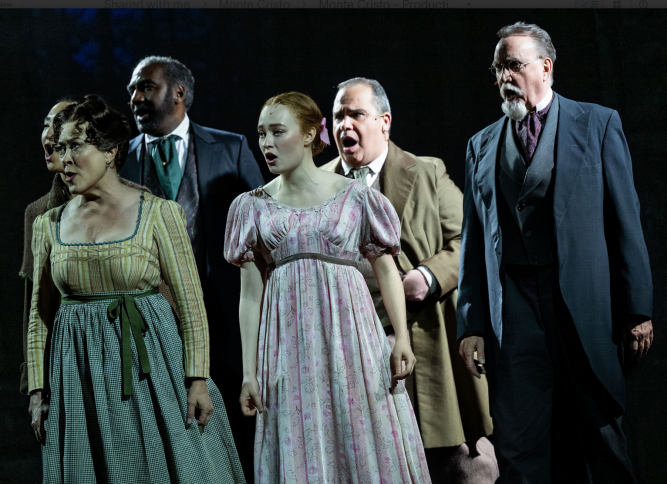
The Cast (Photo: Shawn Salley)
But no, it’s 1815, and the lowly but rising seaman Edmund (Adam Jacobs) is delivering a message to the defeated Napoleon, an act that will quickly land him in prison for 18 years. That’s due to the evil machinations of Danglars (James Judy), who resents Edmund’s imminent ascent to captain of their ship, and Fernand (Daniel Yearwood), who craves Edmund’s fiancée, Mercedes (Sierra Boggess, beneath acres of Caitlin Molloy’s wigs, or is that her hair?). They frame him for treason, with Villefort (Norm Lewis), the procureur du roi, reluctantly sentencing him; he’s afraid that letting Edmund off would link his family to a Bonapartist plot, though that’s one of several plot points Kellogg, having over-trimmed the Dumas, doesn’t make sufficiently clear.
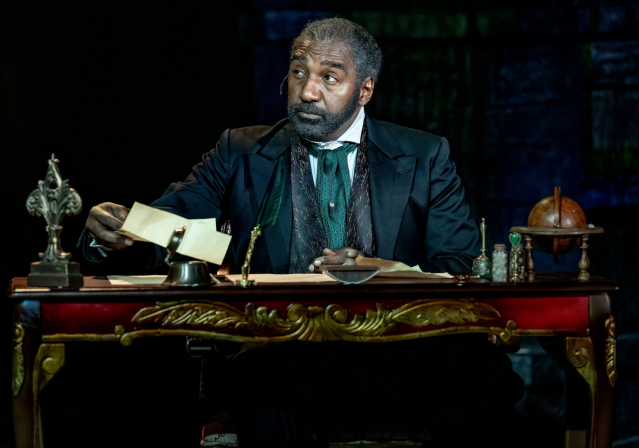
Norm Lewis (Photo: Shawn Salley)
Despairing over the unlikelihood of ever seeing Edmund again, Mercedes marries Fernand, while Edmund becomes worldlier in prison, thanks to the tutoring of a fellow prisoner, Abbe Faria (Danny Rutigliano). Rutigliano also plays Caderousse, an innkeeper and Edmund right-hand man who might as well have “comic relief” stapled to his forehead, who’s married to Carconte (Karen Ziemba), who functions roughly as Mme. Thernardier does in Les Miz. Keeping all this straight?
With Abbe Faria’s aid, Edmund escapes and seeks a secret fortune on the island of Monte Cristo, while the Act 1 finale, dutiful to the operetta form, has various characters restating previous snatches of song. Act Two zooms almost two decades ahead, with Mercedes’ and Fernand’s son Albert (Jadon Lopez) unenthusiastically engaged to Danglars’ daughter Eugenie (Kate Fitzgerald, with a chirpy Lisa Simpson soprano), and Edmund, crushed upon learning of the Mercedes-Fernand alliance, coupled with Haydee (Stephanie Jae Park), a former princess whose family was also wronged by Fernand. I’ll spare you the rest, except to note that this is the only operetta I can think of whose happy ending is spurred by a suicide.
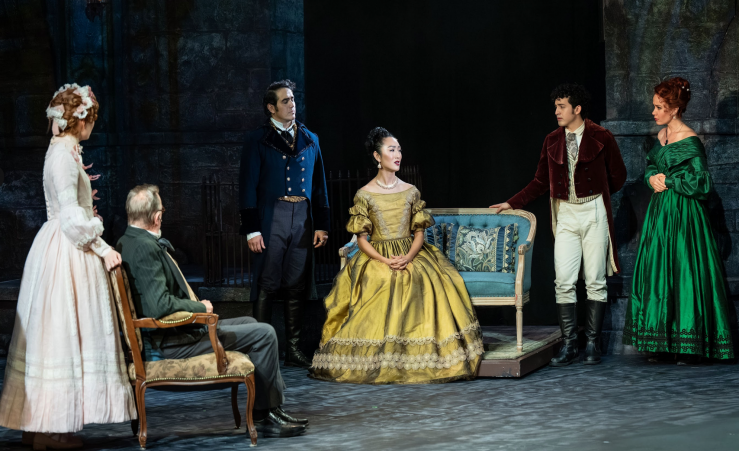
Kate Fitzgerald, James Judy, Adam Jacobs, Stephanie Jae Park, Jadon Lopez, Sierra Boggess (Photo: Shawn Salley)
You may have noticed: For a York Theatre presentation, this is an unusually starry company. It’s also uncommonly lavish, with a wide Anne Mundell set helped by rooms sweeping in and out on casters, many colorful yards of costumes by Siena Zoë Allen and Amanda Roberge, and David Hancock Turner orchestrating and leading a seven-piece orchestra. Weiner’s music doesn’t rise to Naughty Marietta or Desert Song heights, but it’s tuneful, and the occasional inclusion of more modern rhythms doesn’t compromise its integrity. Kellogg’s lyrics can be predictable: “I poured through every tome/ Of ancient Greece and…” any guesses? But they’re expressive and neatly rhymed, and a couple of comic numbers, “You Have the Wrong Man” and “You Sent Me This,” generate genuine merriment.
Adam Jacobs, like Boggess a veteran of Disney musicals, sings well, moves well, makes no mistakes, is perfectly competent. He doesn’t exude star quality, and this role needs that, a young Kevin Kline or Douglas Sills or Stokes. That leaves Boggess somewhat stranded, though she’s very lovely and makes a fine moment of “This Stupid Heart of Mine,” Mercedes’ self-rebuke over being unable to forget Edmund. Yearwood is a suitably oily villain, Rutigliano and Ziemba—a stage treasure since the original 42nd Street—enliven every scene they’re in, and Lewis, in an uncharacteristic supporting role, maintains his dignity as he bravely negotiates over two octaves of Weiner; we don’t blame him for occasionally lapsing into head voice. The others—Eliseo Roman, Madison Claire Parks, and Travis Keith Battle—are kept busy in a variety of roles, and even some of the principals sometimes have to leap into the ensemble; it’s disconcerting to see Yearwood, having radiated moustache-twirling villainy a scene ago, suddenly doing chorus. But a work like this demands a big chorus, and a big sound, which it gets. Joanna Lynne Staub’s sound design could be dialed down a notch or two, but it keeps the words clear, and these days that’s all we ask.
Peter Flynn directed, with a keen sense of pace and a willingness to let the large emotions fly, and Marcos Santana choreographed, though I didn’t see much in the way of choreography. About the ending: Evidently it differs from the Dumas original, and that gave the Times critic a hissy. But it’s the same ending as virtually every adaptation of the material (there have been many), and it complements everything that precedes it. Monte Cristo could rightfully be accused of being recherché; its refined characters swanning about the streets of Paris and Marseilles may look passé and, to use another out-of-fashion word, corny to some contemporary audiences. But some of us are traditionalists, and we’re very happy this morning.
Monte Cristo
At the Theatre at St. Jeans
150 E. 76th St.
Running time: 2 hours 15 minutes, one intermission
Through April 5, 2026