
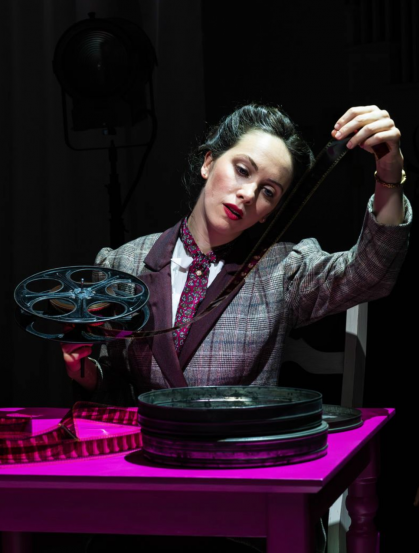
Baize Buzan (Photo: Alexia Haick)
Beauty Freak
By Julia Polinsky
James Clements has given us a new play about Leni Riefenstahl. She was one of the more fascinating and polarizing people of the 20th century. Unquestionably a feminist pioneer, she was also a monster of pragmatism, using concentration-camp inmates as extras in her film, then sending them back to the camps to die. She removed the names of her Jewish collaborators from her films. She was a genius of a sort; she pioneered moviemaking techniques like extreme closeups, smash cuts, unusual camera angles, all in service to propaganda films about the Third Reich, the Nazi Party, and yes, she was Hitler’s favorite filmmaker. To say that makes her complex is an understatement.
Directed by Danilo Gambini, Beauty Freak takes place in the 1930s. The Nazis are in power, but it’s before WWII. Times and places in the play include Berlin in 1935, 36, and 38; New York in 1938 and 39, Washington, DC in 1938, and Hollywood in 38 and 39. In the course of Beauty Freak, Leni (Baize Buzan) goes from super-confidently confronting Joseph Goebbels (Peter Coleman), taunting him with Hitler’s approval of her filmmaking, to trying to get distribution for her film in the US – unsuccessfully. By the time she leaves the US, she has met with the German ambassador in Washington, DC, and such well-known anti-Semites as Walt Disney (played by the author, James Clements). Leni is stymied: why will nobody in the US distribute her film? It’s unfathomable to her that no one in America will publicly go along with the Nazification of beauty, no matter their private views.
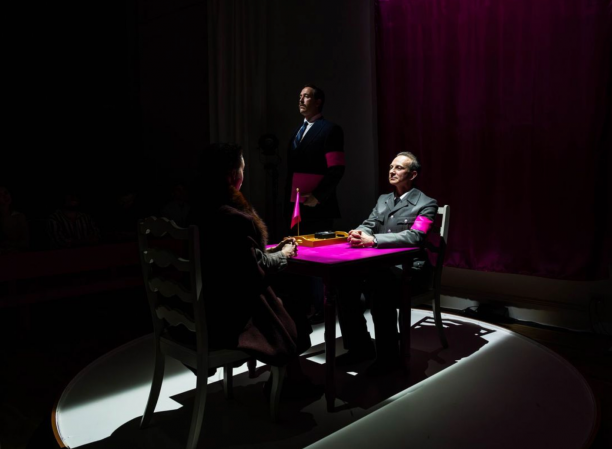
Baize Buzan, Sam Hood Adrain, and Peter Coleman (Photo: Alexia Haick)
Riefenstahl was many things, but not stupid. How can she – or Goebbels, for that matter – have thought the Hollywood “system,” famously populated by Jews, would hold their noses and say yes to distributing Olympia or Triumph of the Will? All through Beauty Freak, we witness Leni’s callousness, her ego, her dedication to beauty and to the Fuehrer. That makes it a little hard to swallow her surprise when, after Kristallnacht, she finds out from her lifelong friend and collaborator, Ernst (Keith Rubin) what the Nazis are actually doing. The “how could we have known?” defense doesn’t land well, here. Leni has to come to terms with her own complicity in creating the monster: as an artist, a believer in beauty, and a propagandist.
It’s not a pretty picture; Baize Buzan pulls it off well, whether challenging Goebbels, arguing with her collaborators, coping with her Nazi handler on her US trip. Peter Coleman’s Goebbels hits just the right balance of scary-nasty. Clements (the author) himself, as Disney, manages warm and fuzzy, and ruthless.
Scenic design from Suzu Sakai takes the small, central stage in the cell’s interesting performance space, and makes it into offices, hotel rooms, restaurants, all by moving a table and a couple of chairs in front of huge, plain backdrops, one white, one pink. Kudos to the cell, and the young theater company What Will the Neighbors Say?, for producing this terrific-but-challenging play at all, and for not succumbing to swastikas. It would have been borderline impossible to sit through the 100 minutes of Beauty Freak with huge Nazi symbols in your face. Even the (presumably) Nazi armbands worn by Goebbels and Werner (Sam Hood Adrain) bear no swastika; we are left to fill in that terrible detail ourselves (costume design from Stephanie Bahniuk).
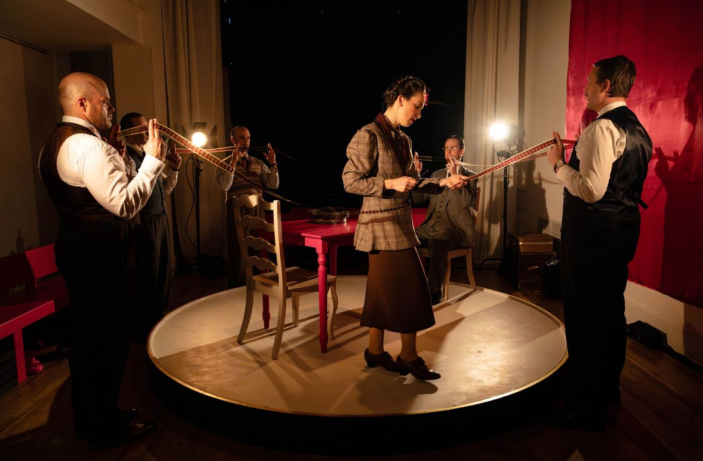
The Company (Photo: Alexia Haick)
Listening to Riefenstahl justify herself, change course, endlessly suck up to power make Beauty Freak timely. In the past century, we have learned much about how propaganda works; she taught us some of those lessons. Did it bite her back? Consider: she not only filmed Hitler, she also filmed Mick Jagger. It’s enough to make you wonder.
At the cell
338 W 23rd St
Running time: 1 hour 50 minutes, no intermission
Through May 17, 2026