
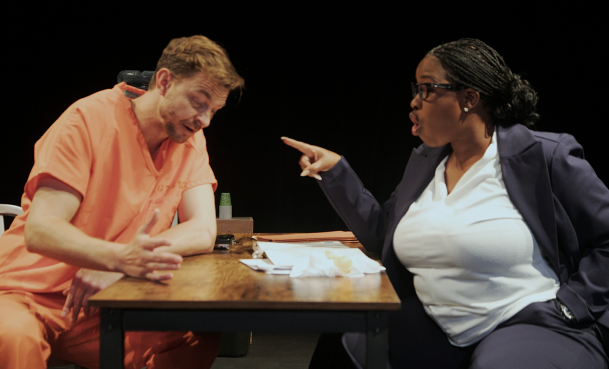
Austin Lightning Carrothers, Cecily Lyn Benjamin (Photo: Pavan Carter)
Building the Wall
By Marc Miller on June 12, 2026
Political theater doesn’t get much more political than Building the Wall, Robert Schenkkan’s 2017 two-hander now in timely revival at Urban Stages. Schenkkan, author of the Pulitzer-winning The Kentucky Cycle and other notable plays, many of them political, proffers a hot topic, the warehousing and mistreatment of immigrants, and sets up a tense encounter between two adversaries to dramatize the relevant conflicting viewpoints. In times as fraught as these, it should sizzle. But there’s no denying, his execution is clunky.
Yet there’s also no denying, Schenkkan was prescient. According to Wikipedia, he wrote Building the Wall in the runup to the 2016 election, which Donald Trump rode to victory largely on a wave of immigrant-bashing (and economic deceit, and empty promises, but let’s not go there), setting it in the then near-future, 2019. He thrusts us into a meeting room at a detainee facility, rendered so modestly at Urban Stages that no set designer is billed (nor, oddly, does Schenkkan get a bio in the program). Gloria (Cecily Lyn Benjamin) is… well, we really don’t know who she is, beyond being a college history professor, here to interview inmate Rick (Austin Lightning Carrothers) because, well, we really don’t know why, beyond the fact that some truths seemingly have been quashed and she’d like to unearth them. They’re instant adversaries, Gloria threatens to walk out, and we know she’s not going to, or there won’t be a play.
She wants Rick’s account of the events leading up to his conviction and impending sentencing, which may send him to the chair. This launches Rick into a long accounting of his history, including several predictable character details. Military brat, check; violent alcoholic dad, check; Republican, check; varied, low-paying jobs, check, until joining the Army in the wake of 9/11. It gave him something of a purpose and a career path, from MP to sergeant to state law enforcement to GEO, the private-sector monolith that continues to run for-profit prisons, mostly immigration detention centers. A program glossary includes GEO, as well as some people, places, and things in the text that many of us would prefer to forget but shouldn’t: Sandra Bland, Sheriff Joe Arpaio, Engility Holdings, etc.
For a guy in solitary and potentially on death row, Rick is curiously calm, articulate, quick with a quip (“You went home and joined law enforcement, why?” “Well, Harvard Law School turned me down”), and up on current events, despite being denied computer access. He bristles at the mention of his wife and some MAGA-angering political points; otherwise, he might be a placid guest on a talk show. Gloria, too, feels underdeveloped. Black, and convinced at first she’s dealing with a racist, she drops that notion at once and quickly volunteers a childhood memory that seems intended to amount to an entire character profile. Mostly she’s there to keep Rick talking, and it feels like her every other line is a question.
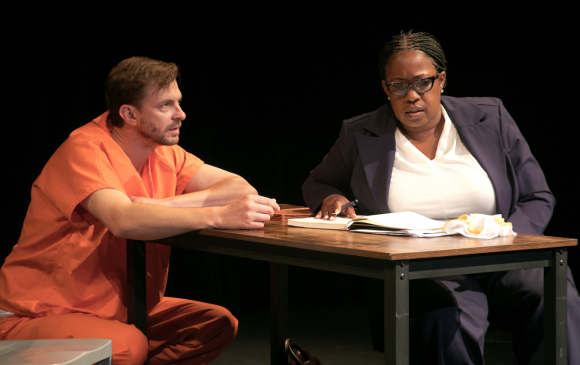
Austin Lightning Carrothers, Cecily Lyn Benjamin (Photo: Pavan Carter)
And there’s the rub: These aren’t really characters, they’re talking points. Schenkkan wants to expose the brutality of for-profit incarceration and the bottom-line corporate penny-pinching that triggers ghastly treatment of inmates. And he succeeds at that: Rick’s crime turns out to be something that thankfully hasn’t happened yet in real life, yet all too plausibly could, and something to which he could arguably offer an I-was-only-following-orders defense. But Rick and Gloria are so preoccupied with exposition and political sword-crossing, they don’t emerge as fully developed personalities.
I’d love to report that the actors turn these two verbose character sketches into completely realized individuals, but it doesn’t happen. Benjamin’s Gloria has a lovely moment recalling her late brother, momentarily crumpling; and Carrothers, despite some awfully quick mood transitions, does locate a certain humanity beneath Rick’s gruffness. But what should be a blistering verbal war of opposites stays mostly on a slow simmer, and Brent Buell’s direction invents a lot of distracting physical busyness—repeated trips to the water cooler, Rick crouching a lot—to offset the visual monotony of two people facing each other at a table. Elianna Kruskal’s lighting has one striking moment at the end, where a spotlighted Rick speaks of the titular wall Trump promised to build as not a literal wall, but a metaphor for the elimination of outside influences that so many Americans thought were ruining their lives. And Rebecca Conaway’s sound design includes some disturbing background noises of immigrant detainees in a justifiable uproar.
After taking their bows, the actors pointed to a side wall that displayed unsettling slides of detention facilities, protests, and other images relevant to the proceedings. After that, they invited Buell and two representatives from the Immigrant Defense Project, a nonprofit dedicated to protecting immigrants through legislation, information, and legal assistance, to take audience questions and reel off relevant info. They detailed the ways New York state legislators have dropped the ball, offered advice on how to provide refugee support at the local level, and sparked a lively discussion on where we are, how we got here, and how we can go about getting past it. And Benjamin made a compelling case that the two sides have to emerge from their silos and attempt to see the other as human beings with palpable needs, not just faceless enemies. It was better than the play.
Building the Wall
At Urban Stages
259 W. 30th St.
Running time: 1 hour 30 minutes, plus talkback
Through June 21, 2026