
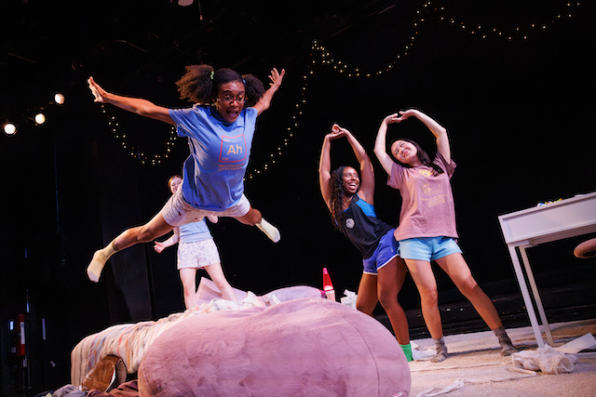
Sophie Rossman, Kayta Thomas, Renée-Nicole Powell, Amalia Yoo (Photo: Maria Baranova)
Dad Don’t Read This
By Deirdre Donovan on July 14, 2026
Adolescence is often remembered as a time of awkward transitions, but Eliya Smith’s Dad Don’t Read This, sensitively directed by Chloe Claudel, captures something even more elusive: the uncertainty of discovering who one is while constantly performing for others. Through four teenage girls navigating sleepovers, friendships, and the virtual world of The Sims, Smith crafts a sharply observed and emotionally resonant coming-of-age drama.
Following her 2025 Off-Broadway debut, Grief Camp, Eliya Smith again demonstrates a remarkable gift for capturing the complexities of adolescence. As in her earlier play, conversations matter as much for what remains unsaid as for what is spoken aloud. In Dad Don’t Read This, Smith follows four suburban Ohio teenagers gathered for a weekend sleepover, where rounds of The Sims become the backdrop for gossip, shifting friendships, and quietly profound questions about identity, agency, and belonging.
The production is anchored by four outstanding performances from Amalia Yoo, Renée-Nicole Posell, Sophie Rossman, and Kayta Thomas. Although each actor is considerably older than the sixteen-year-old she portrays, all four convincingly capture the awkwardness, vulnerability, and restless energy of adolescence.
Each member of this adolescent quartet is struggling to discover—and construct—her own identity. There is the strong-willed Mal (Yoo), who is trying to rein in her intensity; Noelle (Posell), whose social life extends to first-name familiarity with various senior boys; Sophie (Rossman), who is attempting to reconcile her evangelical upbringing with an expanding sense of self; and Lida (Thomas), whose unabashed affection for her parents makes her something of an outlier within the group.
Mal opens the play by standing outside the dramatic action and reading directly from a script: “Dad don’t read this. If you’re reading this page it means you started to read it even though you weren’t supposed to.” As she continues turning the pages, she insists there is “nothing interesting” written there, repeatedly pleading with her father to stop reading. Smith’s metatheatrical opening cleverly blurs the boundary between script and performance while immediately establishing the sleepover as a fiercely guarded space where four teenage girls can experiment with who they are beyond the watchful gaze of adults.
One of Smith’s most ingenious devices is her use of The Sims as a parallel world that mirrors the girls’ emotional lives. Although the audience never sees the laptop screens, the teenagers become virtual architects of their own digital universe, customizing characters, designing homes, and controlling nearly every aspect of their Sims’ existence—from careers and relationships to their most basic daily needs. The game offers the girls a rare sense of agency, allowing them to create ideal lives or deliberately sabotage them. Mal even declares The Sims superior to the Garden of Eden itself: “When God invented the Garden of Eden, he only did that because he didn’t have The Sims,” where people have “desire but no sinning or ribs or pain in childbirth.” As she gleefully observes, Sims “don’t fuck up, unless you tell them to.”
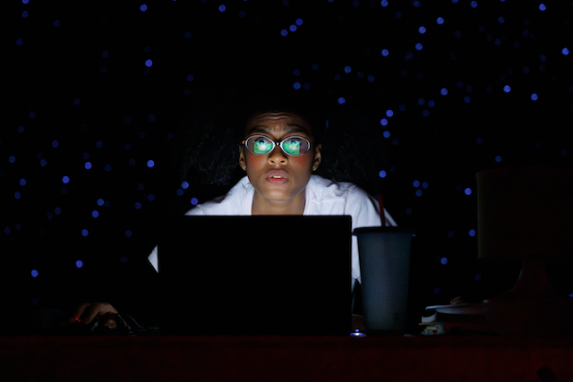
Kayta Thomas (Photo: Maria Baranova)
The game thus becomes the play’s rehearsal room for adolescence—a digital space where fantasies, frustrations, and darker impulses can be safely explored before confronting the uncertainties of real life. Mal’s favorite pastime, “wallcage”—trapping a Sim inside four walls with only a window looking onto an inaccessible world—becomes an unsettling metaphor for adolescence itself, when freedom always seems visible yet tantalizingly out of reach.
Smith resists idealizing her teenage characters, allowing them to be as flawed as they are recognizable. Lida struggles with anxiety attacks before tests—so much so that classmates have asked to be transferred out of her class—while Sophie is reportedly in therapy because of what her friends teasingly describe as her victim complex. And when the girls debate how to spend the evening, Noelle matter-of-factly reminds them that they have already gotten drunk after sampling Mal’s homemade cocktail of “vodka and gin and tequila and wine and then a different wine and also a little bit of beer.” Smith presents these moments without judgment, trusting the audience to recognize adolescence in all its awkward, impulsive complexity.
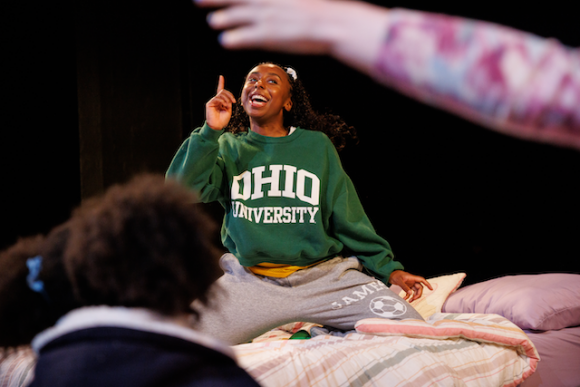
Renée-Nicole Powell (Photo: Maria Baranova)
Forest Entsminger’s scenic design grounds the play in the unvarnished reality of a suburban Ohio sleepover circa 2014, complete with an unmade bed, a beanbag chair, and the lived-in clutter of a teenager’s bedroom. Olivia Vaughn Hern’s casually mismatched costumes further capture the girls’ everyday authenticity. Yet this familiar setting is beautifully transformed by Abigail Sage and Finn Bamber’s inspired lighting, which washes the stage in an almost cosmic glow as Mal and Sophie ponder the existence of God, momentarily expanding the play’s intimate world into something far more transcendent.
Dad Don’t Read This is an evocative portrait of adolescence that refuses to sentimentalize or simplify its young characters. Eliya Smith trusts them—and her audience—enough to embrace uncertainty, contradiction, and the messy work of becoming. In doing so, she has created a quietly profound coming-of-age drama that lingers long after the sleepover has ended.
At Greenwich House Theatre
27 Barrow Street
Running Time: 1 hour, 35 minutes
Through July 18