

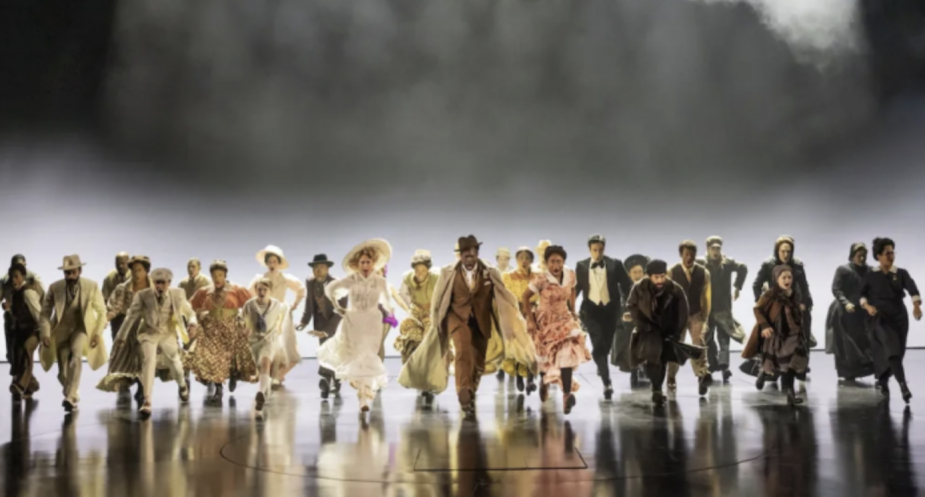
The Ensemble of Ragtime (Photo: Matthew Murphy)
Some Reflections on Breaking Down the 2025/26 Broadway Season
by Jeannie Lieberman, Editor Emeritus
The 2025/26 Broadway season has ended, marking a year that was smaller in scale than recent seasons but notable for its shifting balance of content, increased reliance on revivals, and continued evolution in how productions reach Broadway. While audiences enjoyed a wide range of theatrical offerings, the season stood out less for sheer volume and more for how it reflected broader trends shaping the industry.
The 34 productions of the 2025/26 season represent a significant decline compared with recent years (43 productions in 24/25, approximately 40 productions in each of the three prior seasons). Those numbers make 2025/26 the smallest Broadway season since 2017/18 (pandemic season excepted). While fewer shows opened, the season remained active and diverse, with many productions opting for limited runs rather than long-term engagements.
Strikingly, plays dominated over musicals this season. Of the 34 productions, 21 were plays, 12 were musicals, and one was a special event. This marks a notable departure from recent seasons, where musicals often matched or exceeded the number of plays. In 2024/25, for example, the season featured an equal number of plays and musicals, while earlier seasons leaned heavily toward musical theater. The 2025/26 lineup suggests a renewed appetite for straight plays, particularly those with strong creative pedigrees or limited-run appeal.
The balance between new productions and revivals also shifted. The season included 17 new shows, 15 revivals, and two return engagements. Compared to earlier seasons—when nearly 30 new works debuted annually—this cautious approach reflects producers leaning more heavily on established titles. Revivals played a particularly prominent role, reinforcing Broadway’s ongoing reliance on recognizable works to anchor a season with fewer overall openings.
Broadway offerings increasingly resemble curated seasons rather than open-ended repertories. By season’s end, 15 productions had already closed, many of them planned as limited engagements, which highlights a growing trend toward shorter runs: event-style programming rather than long-term commercial sustainability.
Openings were evenly divided across the calendar, with 17 shows debuting in summer/fall and 17 opening in winter and spring. April was the busiest month, with 13 shows — nearly 40 percent of the season — opening then. This concentration is consistent with prior seasons and reflects the strategic push to open before awards eligibility deadlines. Notably, no productions opened in May, July, or February, underscoring the increasingly narrow window producers target for premieres.
The season also demonstrated Broadway’s continued dependence on material developed elsewhere. Eighteen productions originated outside Broadway, including four that began off-Broadway and five that transferred from London’s West End. These transfers underscore the industry’s preference for shows that arrive with proven track records, reducing financial risk in an uncertain market.
From a venue perspective, all 41 Broadway houses were occupied at some point during the season. However, in 20 theaters there are shows that opened before May 2025, reflecting slower turnover. Three venues—the Samuel J. Friedman Theatre, the Nederlander Theatre, and Studio 54—each hosted three new productions, the highest number of any theaters this season. At present, only one Broadway theater remains vacant, with a future production already announced.
Financially, return on investment remains limited. Only two productions (so far) have announced that they have recouped: Art and Waiting for Godot. In terms of weekly grosses, Mamma Mia! achieved the season’s highest total; during the holiday period, the show’s grosses exceeded $2.5 million in a single week, followed by Chess, which surpassed $2 million at its peak. These figures highlight the continued strength of well-known titles in driving box office success.
Artistically, the season featured a wide range of work. New plays such as Call Me Izzy, Little Bear Ridge Road, and The Fear of 13 stood alongside new musicals including The Queen of Versailles, Titanique, and Schmigadoon!. Revivals remained a major presence, spanning classic dramas, contemporary plays, and beloved musical titles.
A relatively small group of creatives left an outsized imprint on the season. Several directors, composers, writers, and performers contributed to multiple productions, reflecting both the collaborative nature of Broadway and the concentration of opportunity among established artists.
In sum, the 2025/26 Broadway season may not have matched the scale of recent years, but it offered a revealing snapshot of the industry’s current priorities. With fewer productions, a heavier emphasis on plays and revivals, and a continued reliance on proven material, the season illustrated Broadway’s ongoing recalibration—balancing creative ambition with financial caution in a changing theatrical landscape.