A Few Good Men
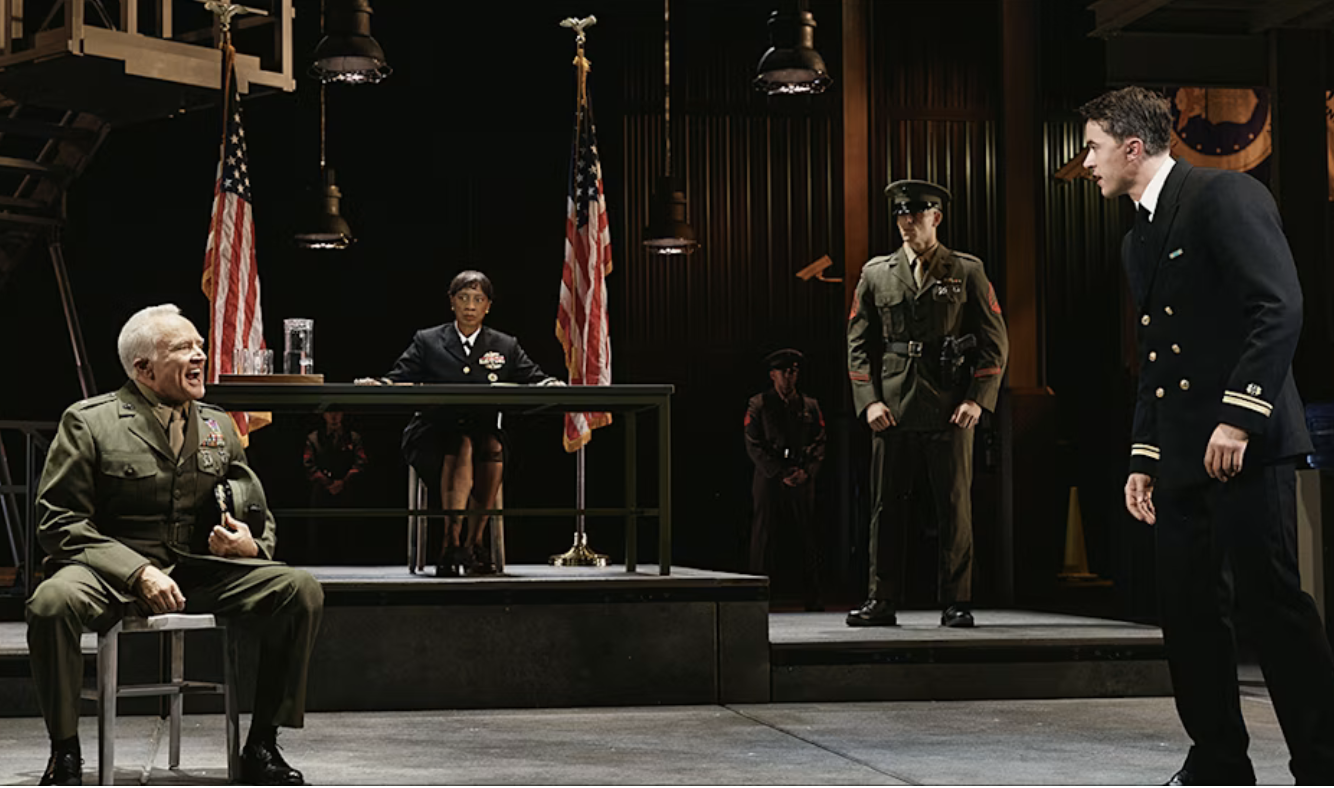
Lincoln Center Theater has revived Aaron Sorkin’s powerful military courtroom drama A Few Good Men. Now in performances at the Vivian Beaumont Theater, the play brings to the Broadway stage a story about military loyalty, institutional accountability, and the limits of following orders.
Led by Tom Blyth as Lt. J.G. Daniel A. Kaffee, Krysta Rodriguez as Lt. Cmdr. Joanne Galloway, and Nick Blaemire as Lt. Sam Weinberg, the production follows a team of Navy lawyers defending two U.S. Marines accused of murder. What begins as a seemingly straightforward case ultimately exposes a high-level conspiracy and the military establishment protecting its own, with hard-boiled, Shakespeare-quoting Lt. Col. Nathan R. Jessep (Bradley Whitford) at its center.
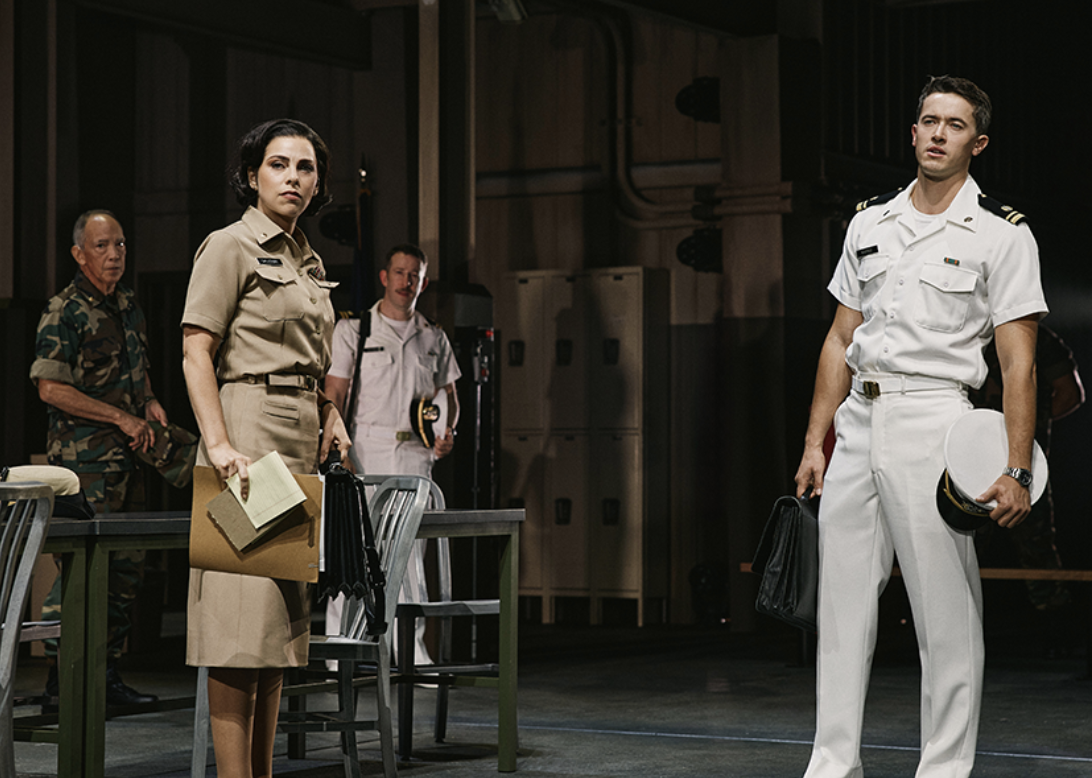
The play’s central dilemma is not simply whether someone should follow orders, but whether following those orders makes them complicit in any wrongdoing they enable. Lance Corporal Dawson (Lavel Schley) and Private First Class Downey (Collin Kelly-Sordelet) are ordered to carry out a Code Red, an unofficial, abusive Marine hazing ritual, against Private William Santiago (Daniel Velez); this ultimately results in Santiago’s death. Rather than openly confront the consequences of that order, those in positions of authority would prefer to contain the situation and protect the institution.
But that’s where the play’s most important questions begin to emerge: Does following an order absolve someone of personal responsibility? At what point does loyalty become complicity? Who is actually being protected? And when the people in positions of authority are the ones crossing the line, who is responsible for standing up and saying enough is enough?
Sorkin’s script examines unquestioning allegiance to an institution, the willingness to excuse misconduct, and the almost cult-like devotion to those in positions of authority. The writing is unmistakably Aaron Sorkin, from witty dialogue and comic relief to the hard-hitting delivery of “You can’t handle the truth!” and the unsettling repetition of “Unit. Corps. God. Country” by Dawson and other Marines.
Tom Blyth carries much of the emotional weight as Lt. Kaffee, particularly in navigating the character’s transition from an irreverent, unmotivated young attorney to someone willing to challenge the very institution he belongs to. Blyth’s performance captures Kaffee’s wit and quickness, although some of his rapid-fire exchanges occasionally feel more rushed than deliberate.
Krysta Rodriguez’s Lt. Commander Galloway is equally important to the story. Her character’s insistence on procedure, accountability, and getting every detail right can be exasperating; in fact, that rigidity is precisely what the case needs. Rodriguez gives the character the conviction and tenacity necessary to keep the investigation moving.
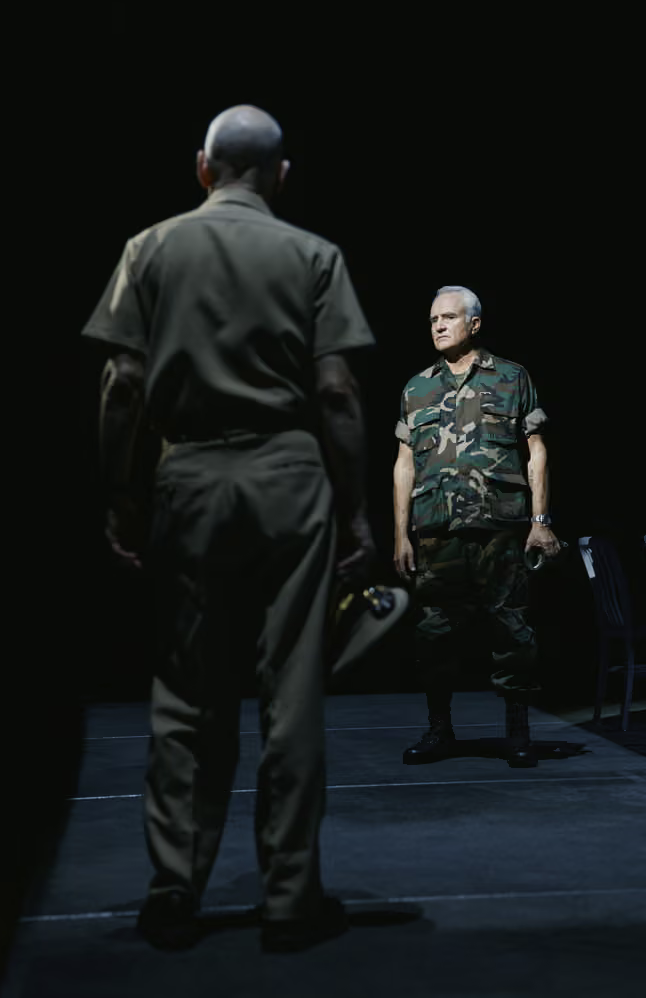
The casting of Bradley Whitford as the hardass Marine colonel brings an interesting dimension to Jessep, particularly given the association many audiences will inevitably make with Whitford’s role as political operative Josh Lyman on The West Wing. There is, perhaps, more of a connection between these two characters than audiences might initially care to acknowledge. Both are fiercely committed to the institutions they serve and convinced of their own righteousness. But where Josh is grounded in an idealistic vision of government, Jessep’s belief in the military chain of command leaves little room for dissent or individual accountability. Whitford’s roles have switched from political idealism to military absolutism, portraying a character who is both commanding and deeply unsettling.
The contrast between Kaffee and Jessep creates an interesting tension: one man believes an institution must answer for its actions; the other believes the institution is justified in nearly everything it does. Galloway, meanwhile, insists that the truth matters, regardless of how inconvenient it may be. Together, their competing approaches make this production’s central conflict particularly compelling.
Dane Laffrey’s expansive scenic design establishes a military environment, providing the backdrop for the various locations. Japhy Weideman’s lighting helps shift the focus between settings and keeps the action moving, while Alejo Vietti’s costumes give the Marines and military officers a visual uniformity. Joshua D. Reid’s sound design contributes to the atmosphere, though the miking could use some tweaking.
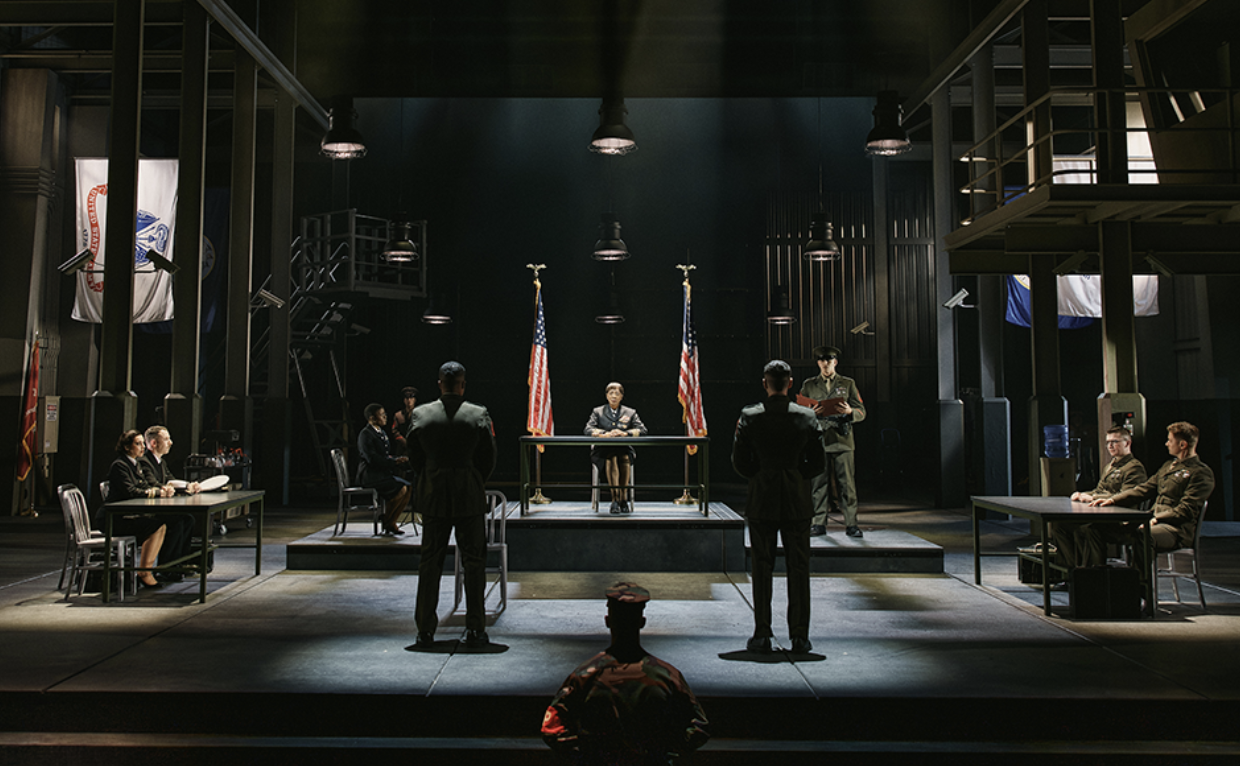
The overall visual scale of the Beaumont’s stunning space, with its deep stage, adjustable proscenium, and stadium-style seating, is something of a mixed blessing. Although the set creates an imposing military world, it also makes the more intimate courtroom exchanges feel less “in-your-face” than they should. The Beaumont can comfortably accommodate large-scale productions. A Few Good Men, however, is a much more intimate courtroom drama and hardly requires such an enormous playing area. At times, director Michael Arden seems to be searching for ways to fill the space so it doesn’t feel empty. For a story that depends so heavily on verbal confrontation and the tension between individuals, a more concentrated use of the stage might have served the material better.
A Few Good Men reminds the audience that just because something is declared doesn’t make it true. Unfortunately, some of the dialogue feels rushed or is delivered with less impact than the material deserves. In a production built around Sorkin’s famously sharp exchanges and explosive courtroom confrontations, those moments matter. The pacing occasionally works against Sorkin’s writing, possibly the production’s greatest asset.
The play also ends on a somewhat unsatisfying note, with a conclusion that feels somewhat anticlimactically fitting. Given Jessep’s affinity for Shakespearean references and his unwavering belief in the institution he serves, the question, then, is when one should stop following orders, or doing what one is commanded to do.
That depends on where your moral compass lies and where your loyalty lies. The two can be difficult to distinguish, which is what ultimately makes A Few Good Men worth seeing. Despite some uneven pacing and staging choices, Sorkin’s questions about authority, accountability, and the price of unquestioning loyalty remain as relevant as ever. The truth may be uncomfortable, but sometimes it’s precisely what needs to be heard.
A Few Good Men
At the Vivian Beaumont Theater
150 W. 65th St.
Running time: 2 hours, 35 minutes; one intermission
Through January 10, 2027