A Walk on the Moon
The summer of ’69 was a momentous time for America, from the tragedies of Chappaquiddick and the ongoing war in Vietnam, to the Gay Rights Movement, Woodstock, and the space race, with Neil Armstrong taking humankind’s first steps on the moon. That televised milestone provided the title for the 1999 film, A Walk on the Moon, which has been adapted by its original screenwriter Pamela Gray into a musical of the same name with a score by AnnMarie Milazzo (music and lyrics, with additional lyrics by Gray). This female-centric story of one discontented Jewish Brooklyn housewife’s catharsis and transformation takes place during her family’s annual vacation to the Catskills.
Following its premiere at San Francisco’s American Conservatory Theater in 2018 and a 2022 production at NJ’s George Street Playhouse (postponed from 2020 due to COVID), the show is now making its Off-Broadway debut at the Laura Pels Theatre. The delay makes A Walk on the Moon feel even more distant than when the movie premiered in 1999, then already 30 years after the historic events of 1969 occurred and the Women’s Movement surged.
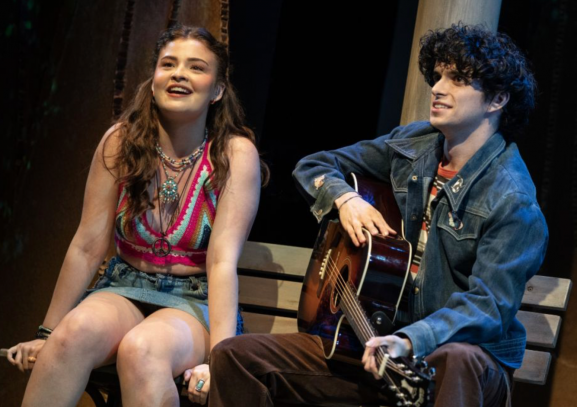
Talia Suskauer stars as Pearl Kantrowitz, who got pregnant on her first date as a teen and became a stay-at-home wife and mother. Pearl never had the chance to explore or enjoy life beyond her mundane daily routine, and feels stifled and stuck, until she decides to reach for the moon. She has an affair with the resort’s traveling blouse salesman Walker (Sam Gravitte), a flirtatious, free-spirited hippie with no fixed schedule. He asks her to join him at Woodstock and then on a “Summer of Love” road trip to California despite knowing that she’s married with children.
Max Chernin plays her frequently absent, workaholic, traditional breadwinner husband, Marty. He expects his wife to find fulfillment in maintaining the household, rearing the children, and passively satisfying his conventional sexual needs. He has no interest in listening to her feelings or her desire to experiment.
The family at the summer resort includes two more generations. Andréa Burns appears as Lillian, Pearl’s mystic mother-in-law, who reads tea leaves and tarot cards, and discerns that Pearl’s “shtupping” the blouse-man. Their loud, rebellious, and often deceptive teenage daughter Alison (Sophie Pollono) goes on her first date – raising Pearl’s concern that she not repeat the same mistake she made on hers – and subsequently makes an unexpected, eye-opening observation at Woodstock that shatters her. Their younger child Danny (Leo Caravano at the performance I attended, alternating with Reid Gardner Clarke), has a less climactic presence in the musical than he did in the film, just repeatedly wanting to sing Shirley Ellis’s 1964 hit “The Name Game” using “Chuck” (“Chuck, Chuck bo-buck, bonana fanna Fo-F*CK”!), in another example of the show’s immature sex-centered jokiness.
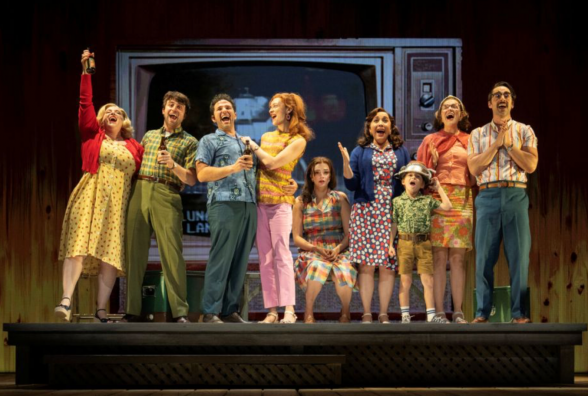
The Kantrowitz family is joined by their fellow longtime summer vacationers and friends. The women (Megan Kane as Bunny, Caroline Pernick as Eleanor, and Becca Suskauer as Rhoda) sit around the patio table, playing mah-jongg, chit-chatting about their contentment as housewives and their sex lives with their husbands, moving to the music (choreography by Josh Prince), and singing a derisive song trashing Betty Friedan’s book The Feminine Mystique and the entire feminist movement. The men (Andrew Faria as Irv, David R. Gordon as Neil, and Michael Tacconi as Stan), like Marty, work full-time and incessantly compare how long it took each of them to make the drive up to the Catskills.
The excellent Oscar Williams plays the teenage aspiring singer/songwriter/guitar player Ross; he’s the standout in the cast and, for me, the most credible character. He captures the stylings of ‘60s music and embodies the essence of coming of age with understatement, youthful uncertainty, and a desire to please both his new crush Alison and her father Marty. We also hear Tovah Feldshuh, who played Lillian in the original film version, as the voice of Mrs. Fogler, announcing the resort’s (largely laughable) daily activities over the loudspeaker in a heavy (but authentic) Brooklyn accent, with clear sound by Justin Stasiw.
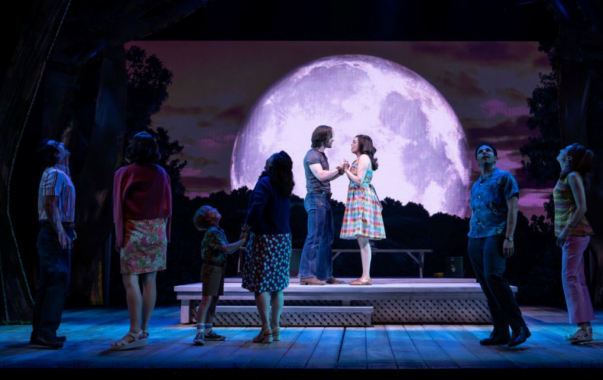
Under the direction of Sheryl Kaller, the story of socio-cultural change impacting one woman’s identity moves fluidly from one scene to the next, aided immeasurably by Tal Yarden’s scenic and video design. The set takes us from the boardwalk to the exterior of the resort’s bungalows, to the viewing party for the moon landing, and the concert at Woodstock. It’s all done by raising and lowering scrims, and video projections of full-scale background landscapes featuring the full moon, swirling psychedelic patterns, and vintage footage of the events of that pivotal year, enhanced with lighting by Robert Wierzel. Costumes by Ricky Lurie likewise reflect the times, ages, positions, and mindsets of the characters, including a tie-dye tee-shirt that has a pronounced effect on them.
Though the artistic design was visually effective, I found the storyline and humor extremely dated and the music less than compelling, with stock characters and dialogue delivered in over-the-top New York accents. The script is filled with juvenile sex talk, innuendo, and jokes, and peppered with Yiddish terms (how many times can we be expected to laugh at “shtupping”?). A pat ending defies credibility to make a predictable feel-good outcome, and overly sentimental ballads with forgettable melodies are more in the style of torch songs and show tunes than ‘60s rock (music direction by Jillian Zack, music supervision and arrangements by Andy Einhorn).
While I found the characters clichéd, the humor childish and outdated, and the ending all-too predictable, if you lived through that momentous year in American history and want to revisit the experiences of your youth and recall the summer of ’69, A Walk on the Moon provides a sense of nostalgia that could trigger your memories. It may make you think affectionately about what you were doing – or never got to do – at the time. It will also make you recognize that, under our current administration, many of the human rights won and advances made then are being increasingly restricted and reversed now.
A Walk on the Moon
At the Laura Pels Theatre
111 West 46th St.
Running time: 2 hours and 10 minutes, one intermission
Through August 22, 2026