
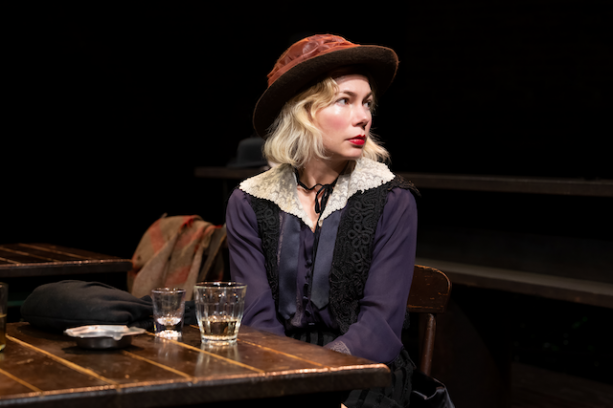
Michelle Williams (Photo: Julieta Cervantes)
Anna Christie
By Deirdre Donovan
St. Ann’s Warehouse revives Eugene O’Neill’s Pulitzer Prize–winning Anna Christie with Michelle Williams inhabiting one of the most formidable roles in the American canon, under the assured direction of Thomas Kail. Set against the Brooklyn waterfront and supported by a distinguished ensemble including Tom Sturridge, Brian d’Arcy James, and Mare Winningham, this production reframes O’Neill’s seafaring tragedy with muscular intimacy and contemporary urgency.
After years of estrangement, Anna Christie arrives in New York to reunite with her alcoholic father, Chris Christopherson, a coal-barge skipper who sent her away as a child to live with relatives in Minnesota and never looked back. As Anna begins a fragile new life at sea and falls in love with the rescued Irish sailor Mat Burke, her hope for renewal collides with the buried truths of her past, forcing both father and lover to confront the cost of forgiveness.
Director Thomas Kail (Hamilton) plunges into O’Neill’s weather-beaten classic, a play steeped in theatrical history and hard-earned renown. First staged in 1921, Anna Christie claimed the Pulitzer Prize the following year, returned to Broadway in three major revivals (1952, 1977, and 1993), and found immortality beyond the stage in the iconic 1930 film adaptation starring Greta Garbo.
Much of this production’s success rests, inevitably, on its casting. Screen star Michelle Williams—who reunites here with director Thomas Kail—proves quietly riveting as the former prostitute struggling to reclaim her life. Long admired for her chameleonic versatility and emotional transparency, Williams once again reveals her rare ability to inhabit a wounded soul shaped by loss and loneliness. Her Anna mesmerizes not through glamour, but through Williams’s gift for disappearing into a role: a lowered gaze, a guarded stillness, a fleeting flicker of resolve. When she first enters Johnny-the-Priest’s saloon and growls, “Gimme a whiskey—ginger ale on the side. And don’t be stingy, baby,” the line lands with the arduous defiance of a young woman battered by experience yet determined, at all costs, to survive.
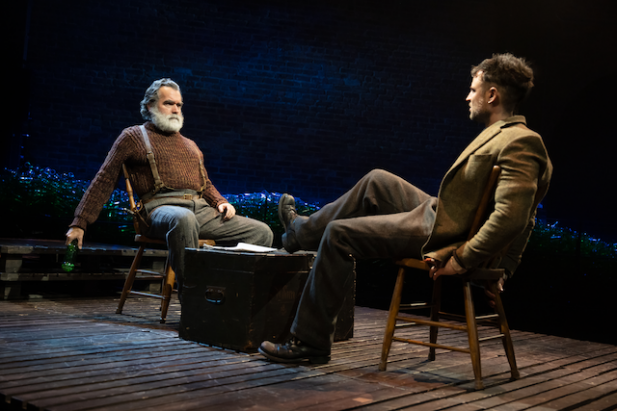
Brian d’Arcy James, Tom Sturridge (Photo: Julieta Cervantes)
If Williams gives the production its aching interior life, Brian d’Arcy James provides its weathered ballast. d’Arcy James is superbly cast as Anna’s hard-drinking, remorseful father, Chris Christopherson. Physically, he fits the role with disarming ease—compact, broad-shouldered, and seasoned—but it is his grounded intelligence that anchors the performance. He embodies the gritty coal-barge skipper who clings obsessively to fate as an explanation for suffering, a belief that hangs like fog over O’Neill’s characters. Nowhere is this fatalism more piercing than in the play’s final lines, when Chris mutters, “Fog, fog, fog. All bloody time. You can’t see where you going, no. Only dat old davil sea—she knows.”
Tom Sturridge, who stepped into the role of Mat Burke after Mike Faist’s unexpected withdrawal from the production in August, lands squarely on his actorly feet. He captures Mat as both hot-aired and guileless—a superstitiously Catholic sailor whose bluster barely masks a tender vulnerability. Just as importantly, Sturridge shares an easy, unforced chemistry with Williams, lending genuine warmth and emotional credibility to Anna’s brief, hard-won happiness.
Equally memorable is Mare Winningham, who gives a quietly marvelous turn as Marthy Owen. Tough, weathered, and unexpectedly generous, Winningham’s Marthy serves as both counterpoint and confidante to Anna, embodying a knowing adaptability that feels born of long years at sea and on society’s margins.
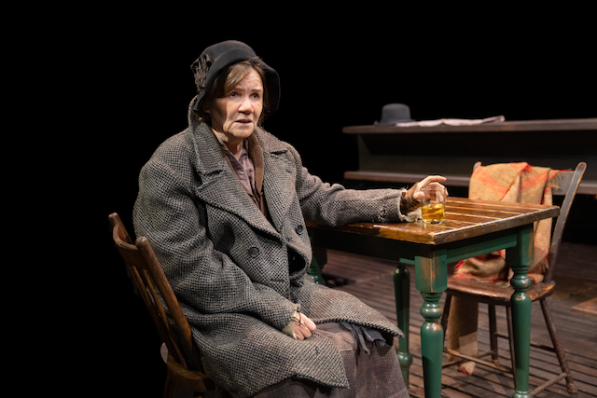
Mare Winningham (Photo: Julieta Cervantes)
Kail’s staging is enveloped by a creative team that gives tangible form to O’Neill’s omnipresent fog—moral, emotional, and elemental. Christine Jones and Brett J. Banakis’ spare, mutable set of rough wooden planks and metal supports shifts seamlessly from saloon to barge to ship’s cabin, its industrial poetry suggesting lives forever in transit. Natasha Katz’s shadowed lighting further obscures clear sightlines, bathing the stage in half-light where past and present blur. Underscoring it all is Nicholas Britell’s original, period-inflected score—his first for the theater—which drifts in like a tide, deepening the play’s theme for belonging and lending haunting texture to Kail’s evocative, non-literal staging. Together, these elements conspire to create a world where certainty is elusive, fate feels inescapable, and the sea—like the truth—remains just out of view.
In New York, Anna Christie has been staged far less frequently in recent years, often eclipsed by O’Neill’s later, more overtly autobiographical masterpieces—most notably Long Day’s Journey into Night. Yet the play’s reputation has long been shaped by a misunderstanding of its so-called “happy ending,” which early critics dismissed as a sentimental concession. Seen afresh, Anna Christie instead emerges as a quietly radical work that upends the Victorian “fallen woman” trope, insisting on its heroine’s right to complexity, desire, and self-determination. Nearly a century on, Anna remains a bracingly modern figure: wounded but unashamed, uncompromising in her demand to be seen on her own terms.
O’Neill’s long-marginalized masterpiece finally cuts through the fog and claims its rightful place in the American canon.
At St. Ann’s Warehouse
45 Water Street, Brooklyn
Running time: 2 hours; 30 minutes with intermission
Through February 1, 2026