
Susannah Perkins (Photo: Joan Marcus)
Antigone (This Play I Read in High School)
By Deirdre Donovan
In Antigone (This Play I Read in High School), playwright Anna Ziegler reimagines Sophocles’ tragedy through a contemporary, self-aware lens that blurs the boundaries between text and memory. While this bold adaptation doesn’t fully cohere—and Tyne Rafaeli’s direction tends to favor deliberation over dramatic momentum—it opens a provocative dialogue with the classic that invites deeper reconsideration.
In Sophocles’ original tragedy, Antigone’s defiance is rooted in sacred duty: she risks death to bury her brother Polyneices, placing divine law above the edicts of her uncle, King Creon. Ziegler reframes that act of rebellion through a contemporary lens, replacing burial rites with bodily autonomy—her Antigone’s transgression is an abortion, and her refusal to apologize becomes a stand for personal sovereignty. While the stakes shift from religious obligation to individual rights, the throughline remains: a young woman asserting moral agency against state power, here recast with a distinctly Gen Z sensibility that insists on self-definition.
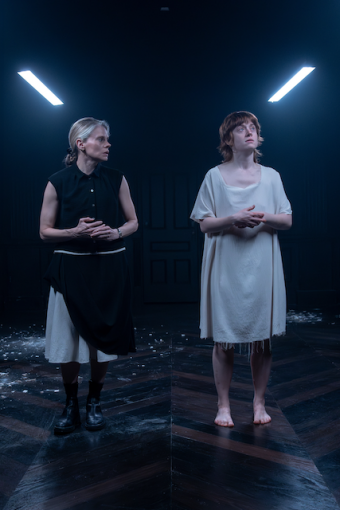
David Zinn’s set, lit by Jen Schriever’s faint lighting, is just right for this tragically woven tale. The dark paneling and elegant chandeliers ideally evoke a palace ballroom. Another member of the creative team, costume designer Enver Chakartash, deserves a shout out for designing apt contemporary outfits for the eight–member cast that brings more delineation to each character’s idiosyncrasies.
Unfortunately, Ziegler’s use of the Chorus, performed by Celia Keenan-Bolger, proves more distracting than illuminating. Conceived as a window into the psyche of Dicey—a middle-aged woman fixated on Antigone since encountering it in tenth-grade English—the device introduces an excess of exposition that dilutes the dramatic throughline. Far from the traditional collective voice of Greek tragedy, this Chorus is a solitary, anxious figure who fades in and out of the action, continually measuring herself against Sophocles’ resolute heroine.
Keenan-Bolger, an expert at conveying emotional fragility, renders this inner turmoil with precision, yet the character’s recursive introspection ultimately stalls the play’s momentum. Even so, there is a flicker of immediacy in her opening address to the audience: Chorus: “I’ll just be…honest./I didn’t want to read it. Antigone, I mean.”
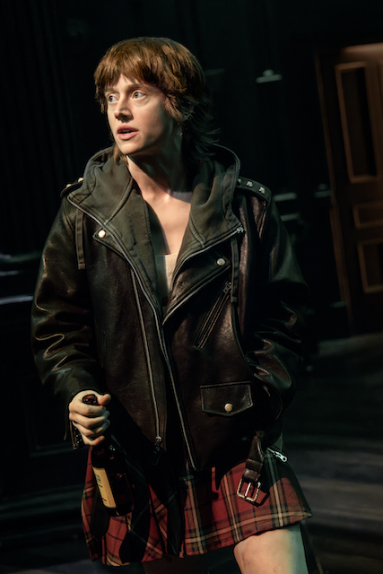
What gives the production its bite is Susannah Perkins’ performance as Antigone. Perkins fully inhabits the role, bringing sharp intelligence, quiet contemplation, and mounting tension to this defiant young woman who refuses to bow to authority. Theatergoers may recall Perkins’ breakout turn in The Wolves (2016); here, they channel that same visceral energy into a more overtly political register, nearly obscuring the play’s structural unevenness.
Celia Keenan-Bolger, Susannah Perkins (Photo: Joan Marcus)
This potency comes into sharp focus in a charged confrontation with Creon, played by Tony Shalhoub, who pressures his niece to publicly repent. Instead, Perkins’ Antigone strips naked and, standing exposed, articulates her defiance in starkly physical terms:
Antigone: “I think sometimes we are just bodies… and right now I am a body that broke the law. A body like a red marker slashing through fine print.”
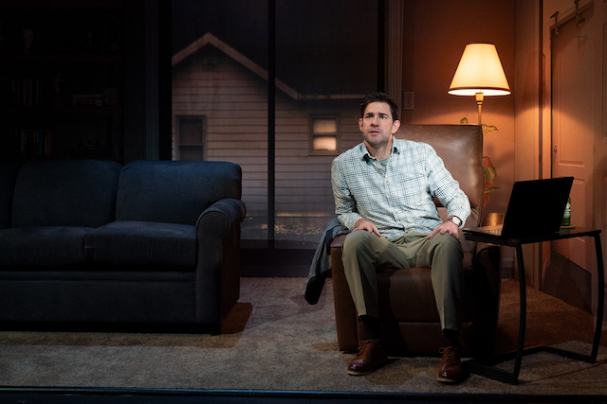
Perkins ultimately carries the play. Shalhoub brings gravitas to Creon, shaping him as a leader consumed by legacy, yet his performance struggles to gain traction within a structure repeatedly interrupted by the Chorus. His most compelling moments arise in direct confrontation with Antigone, where the stakes feel immediate and dramatically grounded.
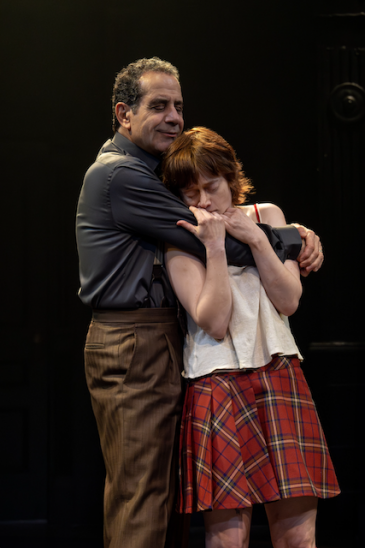
Tony Shalhoub, Susannah Perkins (Photo: Joan Marcus)
Haley Wong’s Ismene, by contrast, registers as emotionally distant, her cautionary stance shading into reproach. As a result, her late expression of devotion to Antigone feels underdeveloped and dramatically unearned.
The trio of police officers—Cop 1 (Katie Kreisler), Cop 2 (Dave Quay), and Cop 3 (Ethan Dubin)—further muddy the theatrical waters. Their casual irreverence at the moment of Antigone’s death undercuts the scene’s tragic weight, culminating in a jarring final line from Cop 1: “Now you know how it feels/To be a girl in the world.”
In the end, Antigone (This Play I Read in High School) aspires to refract Sophocles’ tragedy through a contemporary prism, but its competing frames—meta-commentary, political allegory, and psychological portrait—never fully cohere into a unified dramatic whole. Yet even in its unevenness, Ziegler’s adaptation provokes meaningful reflection, reminding us that the enduring power of Antigone lies not in fixed interpretation, but in its capacity to be questioned, reimagined, and contested.
Antigone (This Play I Read in High School)
At the Public Theater
425 Lafayette St.
Running time: 2 hours; 15 minutes with one intermission
Through April 12