

Owen Teague, Abbey Lee (Photo: Emilio Madrid)
Blackout Songs
By Julia Polinsky
In Blackout Songs, the Olivier-nominated play by Joe White running at the Robert W. Wilson MCC Theater Space, a young man and young woman meet at what’s clearly meant to be an AA meeting. Church-y looking basement, coffee setup, stacked chairs, you know the look. Yet they never get to the meeting, and the Kaleidoscopic fun-house mirrors of their relationship start, out of control from the get-go.
Her (Abbey Lee), dressed in slightly upscale but might-be-a-hooker finery and Him (Owen Teague) in his neck brace and ragged, filthy clothes, aren’t ready for AA (costumes from Avery Reed). They leave before it starts. Him has just stopped drinking cold turkey this morning, and he has the clammy hands and the shakes to show for it. Her was dropped off at the meeting, she says, against her will, she says, by a man waiting for her in the pub across the street. She says. She knows Him needs just a little “medicine,” and she can help him with that.
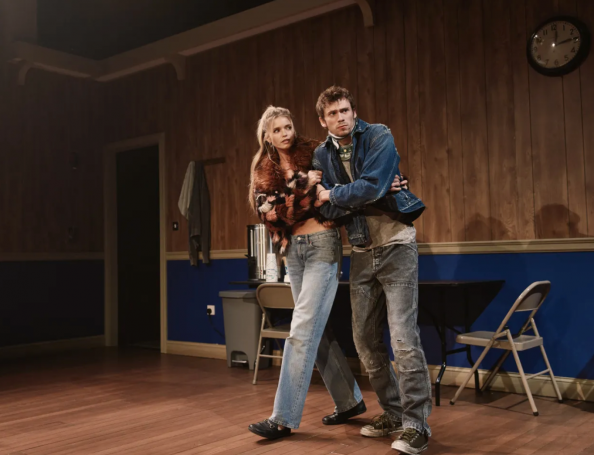
Abbey Lee, Owen Teague (Photo: Emilio Madrid)
They have fun, it seems, and fall in love, it seems, drop bits and bobs of info about themselves, and drink to blackouts. He’s American, more or less homeless, an artist. She’s Catholic, started drinking at age 12. Throughout Blackout Songs they struggle with addiction, as the saying goes, although it seems like they’re not struggling so much as giving in.
Oddly, we never see them drink, but we surely do see the results, in the blackouts, when they come. In the way they do or don’t remember each other. Her and Him dance; blackout. Her and Him argue: blackout. Time is definitely not linear, in Blackout Songs, any more than locations are. Memory fails each of them, over and over, and they repeat each other’s words from a previous meeting as if they are their own. They blend experiences, even though they’ve been apart, and try to remember their own words, as well as the other’s. Doesn’t always work. Of course, that terrifying four-letter word, love, weighs heavily on Her and Him as they meet again and again, in between blackouts.
It’s fairly easy to doubt the characters – alcoholics make famously untrustworthy narrators – but that spills over into questions for the audience. Didn’t I hear this before? Wait, that tooth in her pocket in Scene 1: why is it getting into her pocket so much later? How is it his tooth when they’re just meeting now? Pretty sure author White wants us to feel the disorientation of wondering what’s real or what’s alcohol-induced hallucination just as Her and Him do.
White also wrestles with the big issues – mercy, grace, faith, love, death, forgiveness – all through Blackout Songs. He weaves them in and out the stories Her and Him tell each other. Perhaps that’s why the only actual song in the play is a karaoke they do together when they’re both sober. They are so uncomfortable, singing; it’s as if they know that without alcohol, they share nothing.
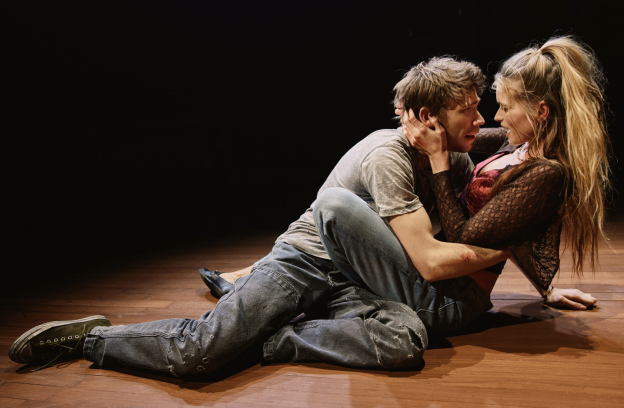
Owen Teague, Abbey Lee (Photo: Emilio Madrid)
Scott Pask’s excellent scenic design takes the Wilson Theater Space’s stage and, with the aid of precise, beautiful lighting from Stacey Derosier and Brian Hickey’s sound design, turns it into venue after venue — pub, church, graveyard — as the blackouts keep coming and time goes by.
Director Rory McGregor evokes brilliant work from his actors, who are simply astonishing. If Blackout Songs were an acting school exercise, any one scene would be a killer moment, but an entire evening of such virtuosity is breathtaking. The two of them are onstage all the time, dancing, bleeding, trembling, tempting each other with sex, “medicine,” love. Completely heartbreaking.
At the Robert W. Wilson MCC Theater Space
511 W. 52nd St
Running time: 100 minutes, no intermission
Through February 28