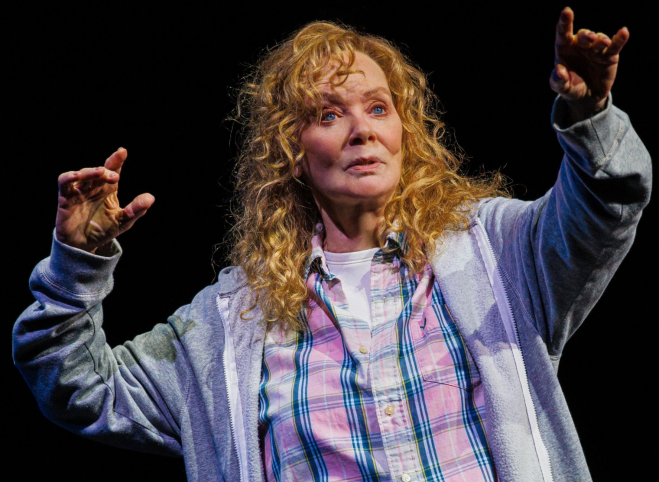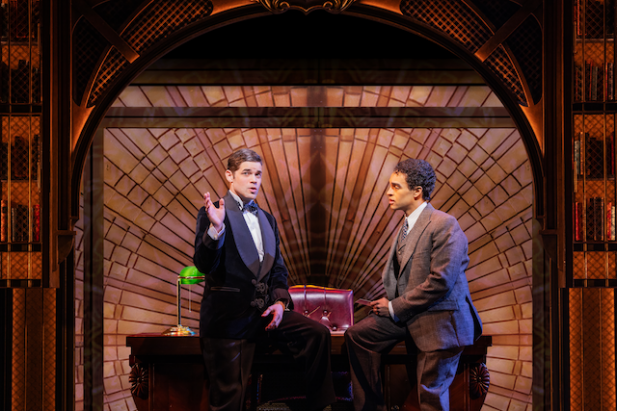

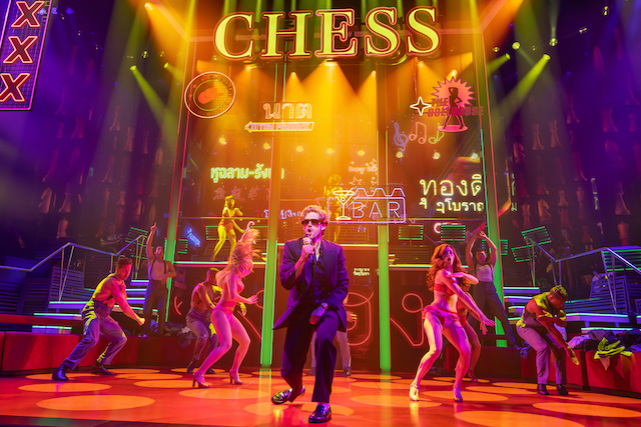
Aaron Tveit and the cast of Chess (Photo: Matthew Murphy)
Chess
By Deirdre Donovan
In its sweeping Broadway revival, Chess transforms a Cold War standoff into a pulse-pounding triangle of power, love, and betrayal. With Aaron Tveit, Lea Michele, and Nicholas Christopher at its center, Michael Mayer’s new production turns the world’s most cerebral game into a fierce theatrical showdown.
Like Jesus Christ Superstar and Evita—also penned by lyricist Tim Rice—Chess began as a concept album. Developed partly in Stockholm at ABBA’s Polar Studios, with orchestral and choral tracks recorded in London, the 1984 album became a global success, spawning top-40 radio hits “One Night in Bangkok” and “I Know Him So Well.” A stage production opened in the West End almost two years later and ran for three years, but its 1988 Broadway transfer shuttered after just 68 performances, cementing its status as one of the Great White Way’s notorious flops. Now, nearly four decades later, Chess returns with a newly reconceived book by Danny Strong.
The good news is that the score remains as infectious and propulsive as ever. At the Imperial Theatre, you can feel the energy shift the moment the overture begins—a vibrant collage by Tim Rice, Benny Andersson, and Björn Ulvaeus that draws from pop, rock, and operetta. It threads motifs from signature numbers like “Pity the Child,” “Anthem,” “Someone Else’s Story,” and “US v. USSR,” priming the audience for the show’s themes and emotional undercurrents. The music’s driving pulse mirrors the geopolitical backdrop: the U.S.–Soviet clash reverberates through the orchestration, underscoring the characters’ intertwined political and personal battles.
The not-so-good news is that Strong’s new book doesn’t fully solve the musical’s long-standing problem: its stubbornly disjointed story. True, he introduces an Arbiter—played with irresistible charm by Bryce Pinkham—who serves as an omniscient narrator and frames the stakes from the outset. And while he frequently breaks the fourth wall to keep audiences oriented in this Cold War maze, he’s given little dialogue that actually untangles the narrative’s Gordian knot. Strong also reshapes the structure by placing several existing songs in new contexts. Most notably, he reassigns “Someone Else’s Story” to the female lead, transforming it into her eleventh-hour number and granting her increased agency and a deeper emotional arc.
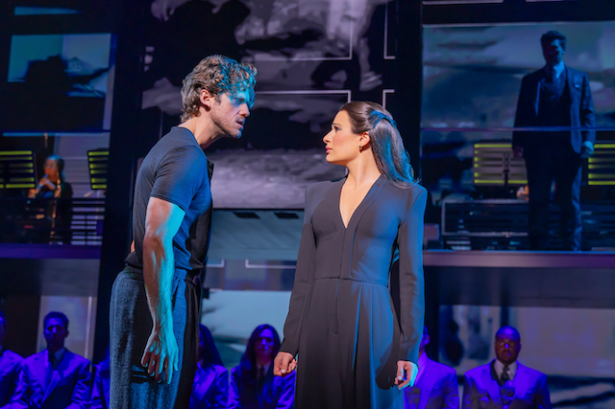
Aaron Tveit and Lea Michele in Chess (Photo: Matthew Murphy)
The story opens in 1979, with Soviet chess champion Anatoly Sergievsky (Christopher) facing his brash American rival, Freddie Trumper (Tveit) at a world championship chess match.
Arbiter: “1979. The entire world is on high alert, trapped in a never-ending confrontation between two opposing ideologies: communism and democracy.”
Enter Florence Vassy (Lea Michele), a Hungarian-born chess whiz who serves as Freddie’s mistress and second. But her loyalties shift when Anatoly arrives for a meeting at the Merano Mountain Inn (and Freddie arrives late) to negotiate whether Freddie will officially forfeit the game at the World Chess Championship; drawn to his quiet intensity, she gravitates toward him with the inevitability of a moth to flame. She soon abandons her volatile relationship with Freddie to pursue a deeper connection with the more grounded Anatoly, becoming a political pawn in the larger Cold War drama engulfing all three.
David Rockwell’s modern, minimalist set—dominated by large, mobile screens—gives the production sleek fluidity, with shifting panels that function as both backdrop and narrative engine. Rather than using video projections or the literal chessboards of earlier stagings, Rockwell creates layered imagery that mirrors shifting alliances and strategic tensions. The result is a visually dynamic environment that reflects the psychological “game” at the musical’s core.
The greatest asset of this revival is its sterling cast. Lea Michele, still riding high after her star turn in 2022’s Funny Girl, unleashes her versatile vocal power across the score’s pop, rock, and show-tune colors. Though her acting tends toward the presentational—suggesting a performance calibrated more for a concert setting than a fully inhabited portrayal of Florence—her impassioned singing delivers the role’s emotional punch. Aaron Tveit is a volatile, compelling Freddie Trumper, culminating in a blistering “Pity the Child” that becomes a true Act II showstopper. And Nicholas Christopher, as Anatoly, anchors the production with his resonant, rock-tinged baritone; his “Anthem” and “Endgame” land with striking gravitas, and his finely tuned emotional work solidifies his status as one of Broadway’s commanding leading men.
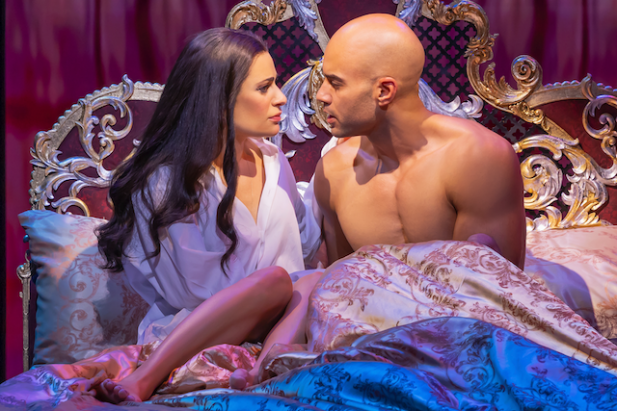
Lea Michele, Nicholas Christopher (Photo: Matthew Murphy)
For all its lingering structural flaws, this Chess ultimately triumphs on the strength of its performances, its visual sophistication, and its renewed dramatic urgency. Michael Mayer’s production doesn’t pretend to resolve every knot in this famously unwieldy musical, but it illuminates its emotional stakes with clarity and power, reminding us why the score continues to captivate decades after its debut. If nothing else, this revival proves that Chess—for all its complexities—remains a singular theatrical experience, one whose bold ambitions are well worth revisiting.
At the Imperial Theatre
249 W. 45th St.
Running time: 2 hours 40 minutes with intermission.
Through May 3, 2026