
Laurie Metcalf, Nathan Lane (Photo: Emilio Madrid)
Death of a Salesman
By Carol Rocamora
The walls of the Winter Garden Theatre on Broadway are shaking, as the overpowering revival of Arthur Miller’s Death of a Salesman takes the stage. Directed by Joe Mantello, featuring a formidable ensemble, this landmark production reminds us why critic Kennth Tynan called it the greatest American play ever written.
This cavernous Broadway theatre is an appropriate setting for the scope, impact, and magnitude of Miller’s towering tragedy. Written in 1949, originally titled “The Inside of his Head,” it dramatizes the last twenty-four hours in the life of Willy Loman, a sixty-year–old salesman living in Brooklyn with his wife Linda (Laurie Metcalf). As played by the admirable Nathan Lane with passionate intensity, Willy is the iconic American everyman, devoting his life to pursuing the American Dream, but failing to achieve it. Exhausted, unable to continue his job as a traveling salesman, unable to pay his bills, he appeals to his current boss (half his age), gets fired, and is forced to confront the truth about his two sons Biff (Christopher Abbott) and Happy (Ben Ahlers), who will never live up to his unrealistic expectations for success that he himself could never achieve. (You already know the denouement of this American classic, so no spoiler alert is necessary.)
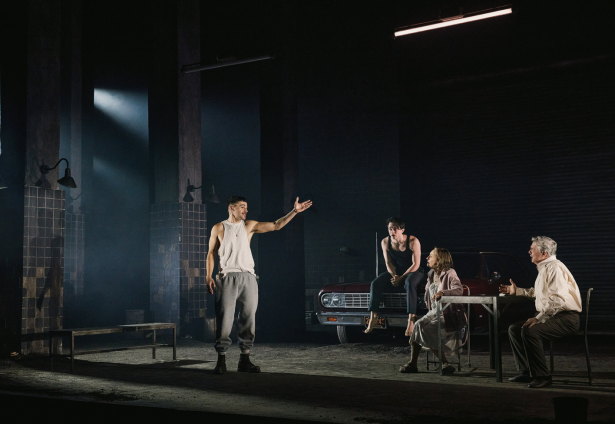
Christopher Abbott, Ben Ahlers, Laurie Metcalf, Nathan Lane (Photo: Emilio Madrid)
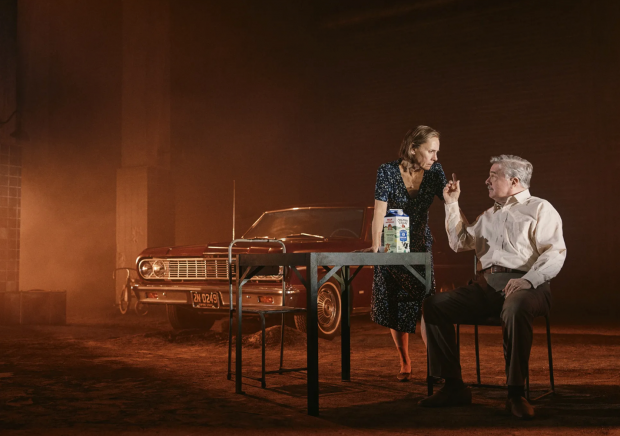
We’ve all admired stage productions of this great tragedy over the years, featuring Lee J. Cobb (the original Willy), George C. Scott, Dustin Hoffman, Brian Dennehy, Philip Seymour Hoffman, and most recently Wendell Pierce in the title role. Several factors give this current revival an unforgettable power. Mantello’s staging on Chloe Lamford’s bare, shadowy set features a huge red Chevrolet that rolls in at the top of the show, behind which a garage door slams shut as the action begins. Faintly illuminated by a giant upstage window (lighting by Jack Knowles), you get the sense of “the inside of Willy’s head,” as scenes in the present are interrupted by flashbacks to a time when his sons were young and full of promise (especially Biff, as a football star). As Willy’s tragic descent accelerates, flashbacks also include lost opportunities (offered by his successful, almost mythic brother Ben, played by a larger-than-life Jonathan Cake). The most devastating flashback dramatizes the discovery made by Biff that Willy, the father he admired and adored, was having an affair with a secretary from one of the Boston offices where Willy was selling his wares, gifting her with stockings while Linda wore ones with holes.
Mantello directs these overlapping scenes of present and past with seamless skill and speed, as they alternate on the empty stage with only a placement of a chair or a table, conveying the sense of confusion and chaos in Willy’s mind. Also effective is his double casting of young Biff and Happy (played by Joaquin Consuelos and Jake Termine respectively) in the flashback scenes, enhancing the element of promise that would never be realized, at least according to their father’s values.
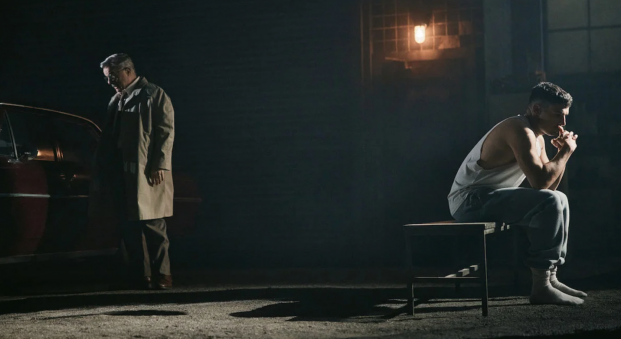
Nathan Lane, Christopher Abbott (Photo: Emilio Madrid)
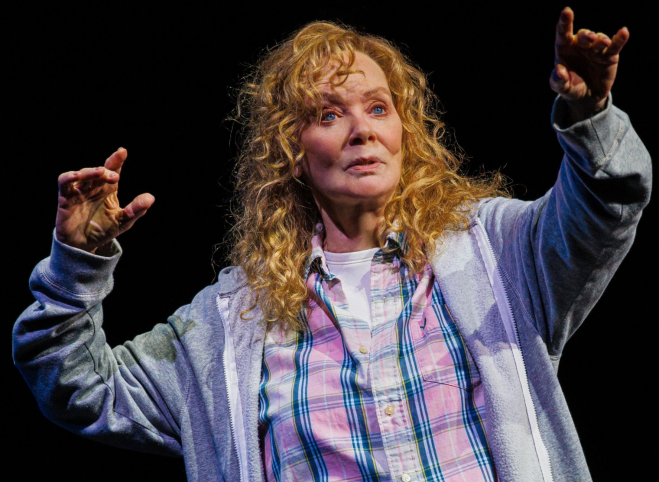
Nathan Lane’s Willy is a man fighting for his life, up until the very end. Though of medium stature, his rage is nonetheless towering as he faces his inevitable downfall. For me, the surprise performance comes from Laurie Metcalf, as the strongest, most passionate Linda I’ve ever seen. As the sons, Ben Ahler’s Happy is a charming “boy” who will never grow up. Christopher Abbott’s Biff broke my heart, in his final encounter with his father. “I know who I am,” Biff finally says, after confessing to a life of petty theft and a brief prison sentence. In that regard, he has succeeded where his father, Willy, hadn’t. In contrast: “The man didn’t know who he was,” says his best friend Charley (K. Todd Friedman) about Willy, as he delivers his epitaph.
Ultimately, this shattering revival delivers the power of Arthur Miller’s play and its lasting themes: namely, the American Dream; American business as the standard-setter of American ethics and values; American success symbols (sports, cars, etc.); and, above all, what it means to be a man. I found myself overwhelmed by the cascade of aphorisms that define our culture, hearing them once again in this profound play: “A man who can’t handle tools is not a man,” “A man can’t go out the way he came in. A man’s got to add up to something,” “The wonder of this country, that a man can end up with diamonds here on the basis of being liked,” “A man who makes an appearance in the business world is a man who gets ahead,” and, prophetically, “After all the highways and the appointments and the years, you end up worth more dead than alive.”
Isn’t it stunning that, after almost a century, Miller’s words still define who we are? As Linda says, “Attention…attention must finally be paid…”
At the Winter Garden Theatre
1634 Broadway
Running time: 2 hours 50 minutes, one intermission
Through August 9, 2026