Fallen Angels
The tradition dates back at least to Oh, Boy! in 1917, and though it’s since fallen out of favor, it held sway for decades: the notion that an unlikely character getting inebriated was automatically hilarious. Comic drunk scenes were a staple of pre-Code movie comedies, and they populated plenty of plays, too. Fallen Angels, Noel Coward’s 1920s stage comedy now in elegant but bland revival by the Roundabout Theatre Company, is largely one long double drunk act, and while it has its jollities, the premise hasn’t worn well.
There are other plot factors, of course: stale marriages, lust, misremembered pasts, lust, the double sexual standard of the past (and present?) when infidelities counted less for the men, and lust. And Coward’s characteristic quips come steadily, sometimes most amusingly. Page One: “I say, Muriel Fenchurch is divorcing her husband.” “I think that uncommonly selfish of the fellow, unleashing her upon an unsuspecting world.” It’s a breakfast conversation between Julia (Kelli O’Hara) and Fred (Aasif Mandvi), very well-to-do Brits in a sumptuous London flat. David Rockwell’s set, all deco sconces, curved staircase, and floor-to-ceiling glass fronting the balcony, is a show in itself. So is Kenneth Posner’s lighting, casting a pearly romantic glow as the action progresses into evening. So, for that matter, are Jeff Mahshie’s costumes, including some eye-catching flowing gowns (though would Julia, pre-Katharine Hepburn, spend the afternoon in pants?).
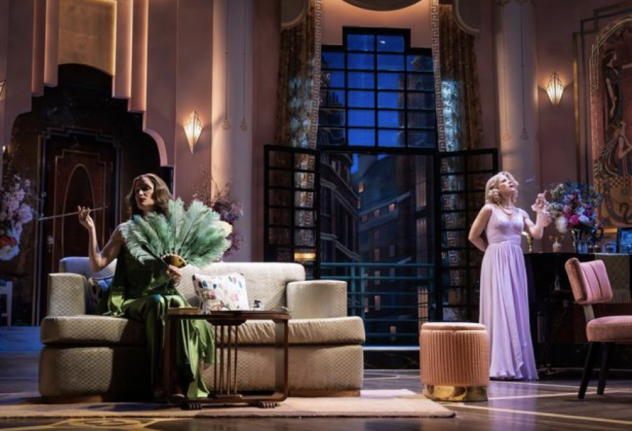
Fred is toddling off for a couple of days of golf, waiting for his buddy Willy (Christopher Fitzgerald) to arrive. When he does and the duo depart, Willy’s wife Jane (Rose Byrne), Julia’s best friend and sometimes-frenemy, shortly enters. She’s distraught: She just received a note heralding a visit from Maurice, a dapper Frenchman with whom both she and Julia had premarital affairs, nine years back. Seeing him again might plunge both back into an old-time ardor that could threaten their marriages; shouldn’t they escape to Brighton? From the complexity of Rockwell’s set, we know they’re not going anywhere.
No, they’re going to hang, fret over Maurice’s impending appearance, rehash old complaints about each other, analyze their marriages—Julia has already informed Fred that, while she loves him, she ceased being in love with him ages ago—and get steadily sloshed. Wine, champagne, martinis, liqueur, it all flows freely, and there’s some amusement in just watching Byrne unthinkingly refill her glass, after saying she’s had enough.
But the drunkenness gets tired. Byrne, in particular—we know what a fine actor she can be, do stream If I Had Legs I’d Kick You if you haven’t—overdoes it, slurring and shouting her dialogue to the point where she’s completely unintelligible; I went back to the script and saw we were missing some zingy Coward bon mots. She does garner laughs murmuring “Maurice, Maurice” with increasing zeal and stretching out of consonants, she can wave a feathered fan fetchingly, and when she returns the morning after with her hair a fright, her wig—the hair and wigs are so elaborate that they took two designers, David Brian Brown and Victoria Tinsman—is another yuk. O’Hara does better: Who knew she could do pratfalls, or mime a hangover doing funny things with her legs as she staggers down that staircase. Scott Ellis stages the slapstick capably, notably the lighting of cigarettes in ever-lengthening holders, though there’s an awful lot of it. And the pair’s accents, supervised by voice coach Kate Wilson, are competent, no better.
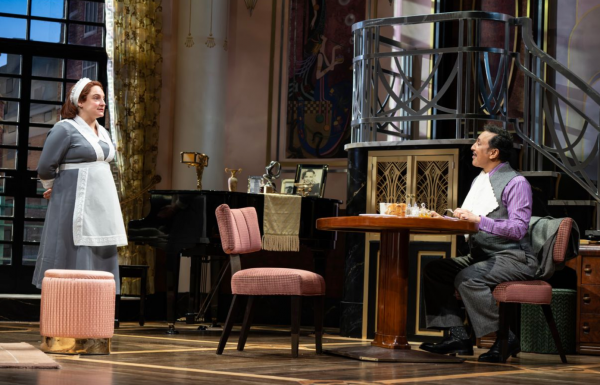
Merriment does happen. With each arrival of Saunders (Tracee Chimo), Julia’s frighteningly competent maid who seems to have experienced and accomplished more than either of them, Julia and Jane, deep into speculation about Maurice, lapse into irrelevant non sequiturs: “I have heard that the worst part of parenting is the children,” and “I often wonder if the ocean would be deeper if there were no sponges.” But as they grow impatient for Maurice’s appearance, so do we. There’s only so much comic richness to be extracted from too much alcohol, and Fallen Angels exceeds its limit.
Chimo is actually the most consistent source of hilarity; she pops in and out at the most unexpected times, and her delivery is splendidly varied. Mandvi also can do a lot with a so-so line. Fitzgerald, and there’s no more reliable source of enjoyment on a New York stage, has less, and lesser, material, but he makes the most of it.
Coward’s original was a good deal longer; Claudia Shear is credited with “additional material,” but a lot must have been cut, and whatever her additions were, she did him no favors. The play ran only a month on Broadway in 1927, but it’s been staged occasionally, and a late friend, a theater historian whose theatergoing went back to Banjo Eyes in 1941, swore than a 1956 revival, with Nancy Walker and Margaret Phillips, was among the funniest things he ever saw. I wonder what he’d think of this.
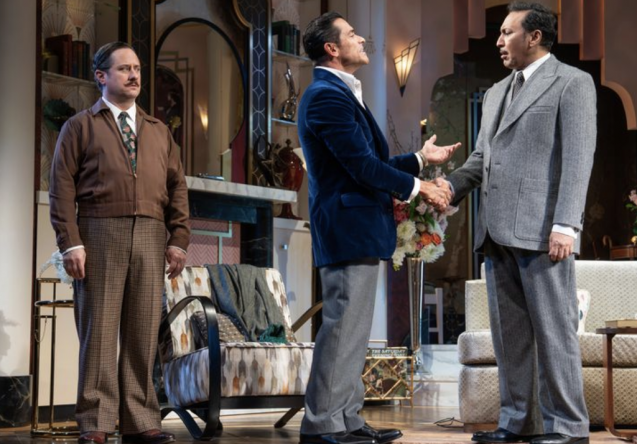
Maurice does finally arrive, in the person of Mark Consuelos, whose entrance applause probably stemmed from his gig on “Live With Kelly & Mark.” After hearing so much about this bon vivant, he’s something of an anticlimax, and aside from a clever sight gag at the fadeout, the 90 minutes do not race by. Sorry to be such a sourpuss on this, and let’s add, plenty in the audience seemed to be having an uproarious time. Nor am I suggesting that Noel Coward is past his sell-by date: Done properly, Hay Fever and Present Laughter can still play beautifully, and there’s always another Private Lives or Blithe Spirit around the corner. Judging from this, Fallen Angels, despite many ripe lines (when Byrne isn’t impossible to understand) and some relationship insights that are pretty impressive for a 25-year-old playwright, isn’t in that class.
Fallen Angels
Roundabout Theatre Company, Todd Haimes Theatre
227 W. 42nd St.
Running time: 1 hour 30 minutes, no intermission
Through June 7, 2026