
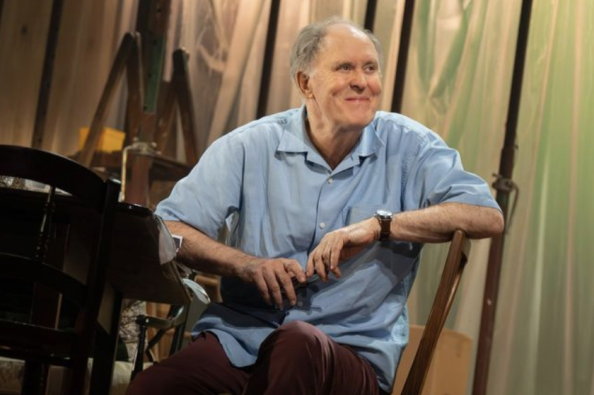
John Lithgow (Photo: Joan Marcus)
Giant
By Carol Rocamora
It’s a rare occurrence when you sit in a theatre and hear audible gasps from audience members around you, in response to what’s happening onstage.
Such was my experience at the end of the first of act of Giant, the devastating new award-winning import from London now on Broadway. The gasps of horror came in response to the words of a literary figure we all admire, at least up until seeing this play. He’s Roald Dahl, the world-renowned author of children’s books that we’ve enthusiastically shared with our own offspring – including family favorites like The BFG (Big Friendly Giant), Charlie and the Chocolate Factory, James and the Giant Peach, Matilda, and numerous theatre and celebrated film versions thereof.
So how does Mark Rosenblatt’s stunning new work about this literary giant shock us? It’s the revelation that Roald Dahl was a self-declared, life-long anti-Semite, so outspoken, destructive and venomous that his own family published a posthumous apology in 2020, decades after his death. Why? Because Dahl himself hadn’t apologized, not during a lifetime showered with literary awards and adoration. That is what inspired Rosenblatt to create this work. Thanks to this playwright’s courageous focus, and the phenomenal performance of John Lithgow as Dahl, our eyes are being opened anew to the poison of anti-Semitism, as well as its many complex aspects.
This powerful new play focuses with laser-sharp intensity on an afternoon in the summer of 1983, set in Dahl’s family home in Great Missenden, England (scenic design by Bob Crowley). Dahl and Felicity (“Liccy”), his soon-to-be wife (Rachael Stirling), are hosting a lunch, to which Dahl’s British agent and friend, Tom Maschler (Elliot Levey) has also been invited. Their goal: to talk to another guest, Jessie Stone (Aya Cash). She represents Dahl’s American publisher, Farrar & Strauss, and their concern about how to handle an incident that threatens to destroy Dahl’s reputation with his readers, booksellers (who are considering a boycott of Dahl’s latest work), and libraries that may chose not to carry his books.
That inciting incident is a review Dahl wrote praising a photo book about Israel’s 1982 invasion of Lebanon that killed many civilians and children. In it, Dahl vehemently calls for the destruction of the state of Israel, comparing the Israelis with Hitler and Himmler. “Never before… has a race of people switched so rapidly from being much-pitied victims to barbarous murderers,” Dahl wrote passionately. When questioned in a subsequent interview, Dahl added more anti-Semitic diatribe: “There is a trait in the Jewish character that does provoke animosity… even a stinker like Hitler didn’t just pick on them for no reason.”
Mrs. Stone arrives with a message from the publishing house, suggesting that Dahl publicly apologize for his anti-Semitic statements. Tom and Liccy agree. But Dahl won’t even consider it. “Nothing will be enough, so why not give them anything at all,” he says. Instead, using charm and humor to mask an uncontrollable sadistic cruelty, he provokes Mrs. Stone (who, he learns, is Jewish) with further insults about Jews and Israel, calling the latter “the Fourth Reich.”
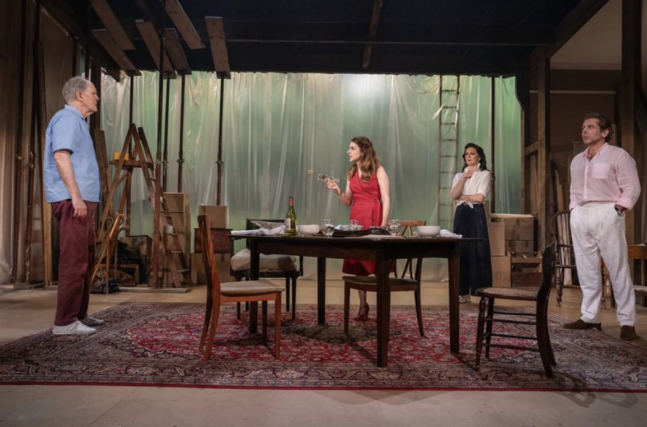
John Lithgow, Aya Cash, Rachael Sterling, Elliot Levey (Photo: Joan Marcus)
Mrs. Stone responds bravely and a full argument explodes, with the dumbfounded Liccy and Tom standing by helplessly. Dahl doubles down further in Act II in expressing his intense anti-Semitism, going after his friend Tom (a German-born Jew), insulting him, calling him a “house Jew.” In a penultimate scene, Dahl finally agrees to apologize. But a phone call with another press interviewer reveals him incapable, and he again bursts into an anti-Semitic rant.
The playwright tries to hint at an explanation for his cruel, destructive behavior. Dahl and his first wife (the actress Patricia Neal) lost one child, and another suffered from a terrible accident as an infant. Mrs. Stone also has a damaged child. At one point, Dahl tries to make a connection with their shared tragedies. But he can’t help himself. An irrational anger overcomes him when he feels challenged in any way, and he channels that anger with inflammatory anti-Semitic insults.
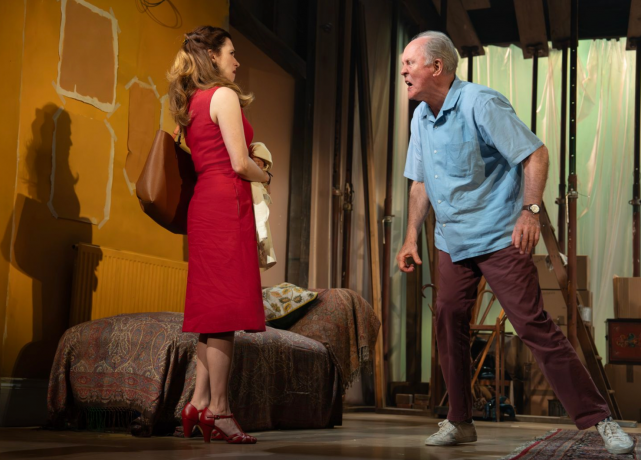
Aya Cash, John Lithgow (Photo: Joan Marcus)
Words cannot adequately describe the power and complexity of Lithgow’s performance. With immense skill, he plays all the contradictory attributes of this historical figure, including charm, cruelty, brilliance, and an inner confusion and pain that he cannot express. Under Nicholas Hytner’s expert direction, his supporting cast shines: the spirited Mrs. Stone (Aya Cash): the loving wife-to-be Liccy (Rachael Stirling), the loyal agent Tom (Elliott Levey): and Hally (Stella Everett), the respectful family servant who dares not express her opinion, even when he asks for it.
Ultimately, the play is about more than Roald Dahl. It’s about anti-Semitism, and what it tells us about human nature. The play poses provocative questions: 1) Why anti-Semitism? Where does it come from? 2) How can we distinguish anti-Zionism and anti-Semitism? 3) Is anti-Semitism more than a prejudice? Could it be an irrational obsession, a kind of mental illness? 4) Can we love the art, and not the artist? And finally, 5) Why do people need to hate, at all?
Roald Dahl has been called “the Shakespeare of children’s literature.” Indeed, Dahl has all the attributes of a “giant”, including stature (6’6” tall), heroic war service, and philanthropic efforts in the field of children’s health. But, as the play asks, what is the value of a legacy, coming from a man capable of such cruelty?
At the Music Box Theatre
239 W 45th St.
Running time: 2 hours 20 minutes, one intermission
Through June 28, 2026