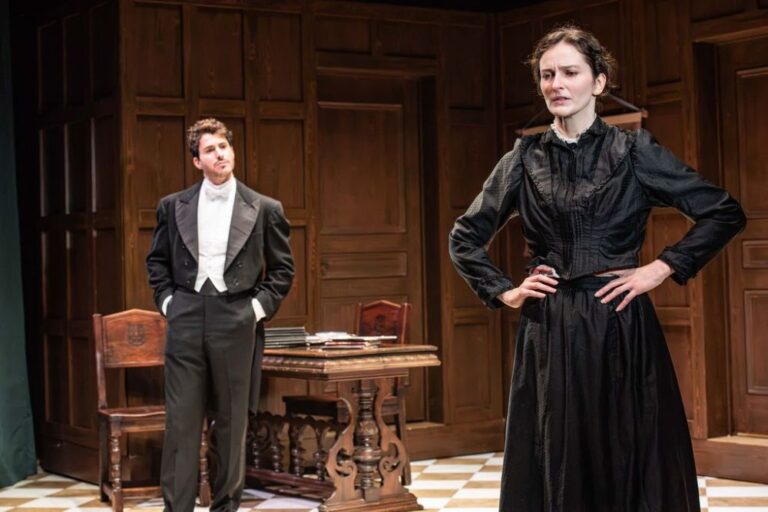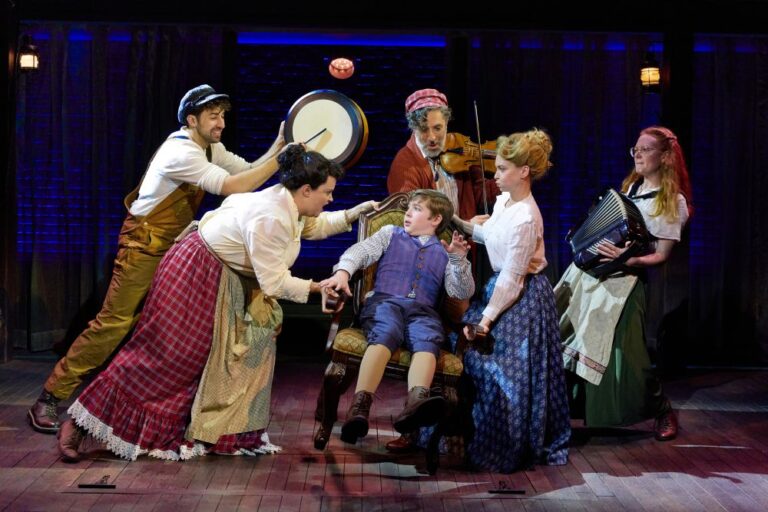
Hamlet
At the Brooklyn Academy of Music (BAM), Hamlet arrives not as a museum piece but as a joltingly alive modern tragedy, with director Robert Hastie stripping away centuries of dust to reveal the play’s unnerving immediacy. Led by a magnetic, emotionally volatile performance from Hiran Abeysekera, this National Theatre production proves both darkly funny and devastating, capturing the prince’s spiraling consciousness with electrifying urgency.

This production premiered last fall at London’s National Theatre, and its Brooklyn engagement marks the launch of BAM’s new multi-year partnership with the storied British institution. Olivier Award winner Hiran Abeysekera — best known for his acclaimed turn in Life of Pi — brings an electrifying mix of volatility, vulnerability, and sly comic wit to Shakespeare’s tormented prince.
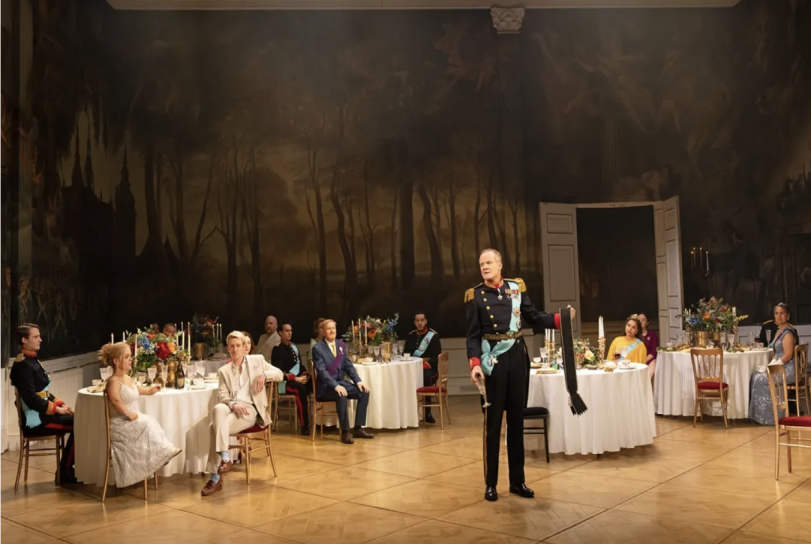
Most of the action unfolds on Ben Stones’ striking single set, whose backdrop of angels and cherubim evokes the sacred grandeur of a Renaissance painting by Raphael. Jessica Hung Han Yun’s lighting design alternately washes the stage in an alluring sheen and cloaks it in ominous shadow, subtly heightening the emotional temperature of each scene throughout the production’s nearly three-hour runtime.
Hastie’s production does not open, as many conventional stagings of Hamlet do, on the frigid battlements of Elsinore Castle. Instead, the play begins in a dimly lit banquet hall, where the ghost of old King Hamlet — clad in combat fatigues — suddenly materializes, prompting the guards to instinctively draw their guns. The reimagined setting preserves the drama’s ominous atmosphere while immediately grounding the production in a world of militarized tension and contemporary unease.
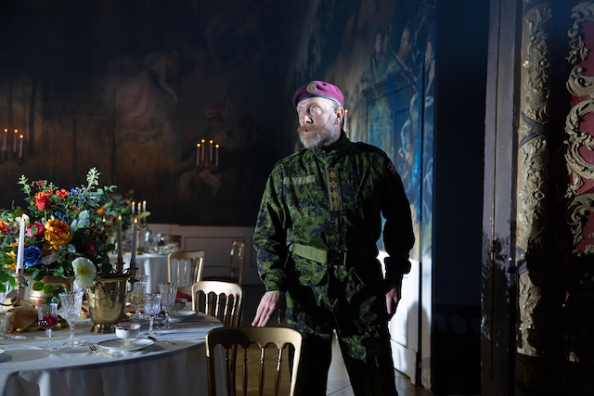
This Hamlet, of course, does not fully come into focus until its title character appears, and Abeysekera’s Hamlet is immediately set apart from the court around him. Seated alone at a banquet table and dressed in somber mourning attire amid the colorful formal wear of the other guests, he projects both alienation and quiet defiance. Abeysekera delivers his opening soliloquy directly to the audience — as he will all the others that follow — establishing from the outset a conspiratorial intimacy that continually invites the audience to share Hamlet’s conviction that the royal court is steeped in hypocrisy and deceit.
But the most striking aspect of Hiran Abeysekera’s performance is not simply his desire to make the audience his confidante, but the restless, high-voltage energy and comic flair he brings to the role — a marked departure from the more traditionally melancholic interpretations of Hamlet as a brooding prince. At times, he seems closer to a stand-up comic than a stately royal heir, deploying physical comedy through finger guns, exaggerated gestures, and spontaneous leaps into chairs that lend the character a boyish innocence and impish charm. To match this comic aesthetic, Hiran Abeysekera cycles through outfits during the play that range from casual pants and slogan-emblazoned T-shirts reading “tobacco and boys” or “Blockbuster Video” to formal attire accented with a playfully anachronistic Elizabethan ruff collar. The approach can feel invigoratingly fresh, though it also occasionally keeps the performance from probing the darkest and most psychologically intricate recesses of Hamlet’s inner life.
Alistair Petrie’s Claudius emerges as the embodiment of patrician authority — a tightly controlled head of state rather than the hard-drinking, pleasure-seeking “bloat king” often emphasized in more traditional interpretations. Playing opposite him, Ayesha Dharker brings a quietly nuanced intelligence to Gertrude, revealing the character’s growing unease and moral disquiet beneath her composed exterior. This becomes especially evident in Act 4 when, after Claudius curtly commands, “Let’s follow, Gertrude,” she hesitates rather than instinctively obeying him. In that subtle moment, Dharker suggests that Gertrude is no mere appendage to her husband’s power, but a woman deeply shaken by Ophelia’s death and painfully aware of the emotional devastation consuming the royal household.
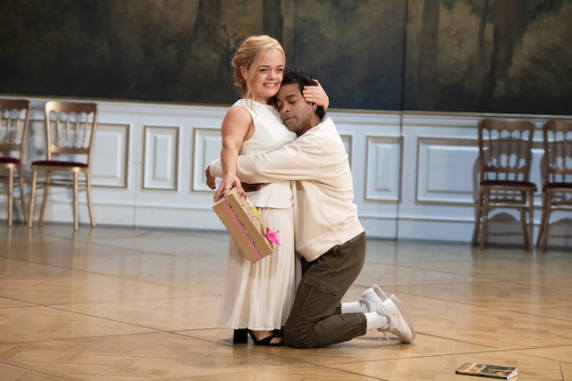
It is Francesca Mills, however, who delivers the production’s standout performance as Ophelia. Rejecting the character’s more traditional portrayals as a passive victim swept along by the schemes of others, Mills gives Ophelia a striking sense of agency, intelligence, and emotional resilience. Even her descent into madness is rendered with remarkable nuance, and despite the role’s comparatively limited stage time and dialogue, Mills invests nearly every line with piercing emotional clarity and purpose.
Robert Hastie also takes notable poetic license with the text, most conspicuously by repositioning the famous “To be or not to be” soliloquy until after Ophelia’s burial. The shift reframes the speech less as Hamlet’s abstract contemplation of his own mortality and more as a grief-stricken response to Ophelia’s apparent suicide. While purists may bristle at the alteration, the choice proves dramatically compelling, casting fresh emotional light on one of Shakespeare’s most exhaustively analyzed passages.
Even if Hastie’s production does not fully plumb every philosophical and emotional depth embedded within Hamlet, it remains a thrillingly alive and imaginatively retooled staging that refuses to treat Shakespeare as a relic of the past. Anchored by Abeysekera’s charismatic high-energy performance and an ensemble unafraid to challenge convention, this contemporary Hamlet succeeds in making a four-hundred-year-old tragedy feel urgent, accessible, and vibrantly connected to the anxieties of the present moment.
Hamlet
At the Brooklyn Academy of Music’s Harvey Theatre
651 Fulton St., Brooklyn
Running time: 2 hours 50 minutes, one intermission
Through May 17, 2026