
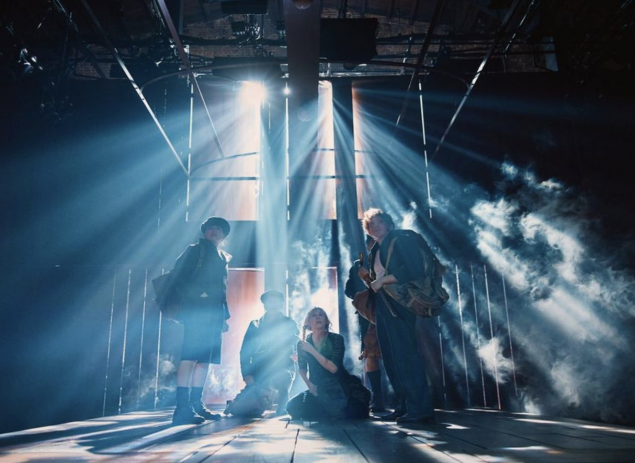
Tedra Millan, Max Gordon Moore, Maddie Corman, Ethan Slater (Photo: Emilio Madrid)
Marcel on the Train
By Marc Miller
From the looks of it, much of the audience at Classic Stage Company probably remembers Marcel Marceau. He was a mime, widely considered the greatest in the world, and widely derided by the many folks who hate mimes. He bestrode the mid-20th century world stage, performing everywhere from Broadway to Australia to Taiwan, mime fortunately presenting no language barrier. And he had a pretty interesting life before that, though, as represented in Marcel on the Train, not quite interesting enough.
It’s a new play written and staged by its respective star and director, Ethan Slater and Marshall Pailet. That’s right, Slater, Broadway’s Spongebob Squarepants and the Wicked films’ Boq, has co-written himself a vehicle. Born Jewish in Strasbourg, Marceau fled with his family to Limoges during the Nazi occupation, where he allied himself with the redundantly named French Jewish Resistance in France. They rescued thousands of Jews from being sent to the camps, and Marcel on the Train recounts one such adventure, with the 20-year-old Marceau escorting a band of Jewish orphans over the Swiss border in 1943.
It begins, not unpredictably, with Marceau miming, a familiar routine involving a flower and a butterfly. Slater evokes Marceau expertly, all graceful movement and expressive face, and if you’re into mime, you’ll enjoy the several mime episodes. The sequence, however, has little to do with what comes next: Scott Davis’s scenic design, up to now a bare raised platform, magically sprouts benches from under the floor, and we’re suddenly riding the rails, though this haphazard seating array doesn’t resemble any railcar I’ve ever seen.
Slater and Pailet wisely plunge us right into the thick of the suspense, though they also indulge in flashback and not-always-relevant flash-forward. Marceau is in charge of four teens and preteens, disguised as Boy Scouts (because there are so few Jewish Boy Scouts) and played by adults, some with better–delineated personalities than others. The most compelling is surely Berthe (Tedra Millan), an unusually smart, mouthy, and philosophical 12-year-old whose kidney problems are but one complication in a journey fraught with them. Henri (Alex Wyse) and Adolphe (Max Gordon Moore) exist primarily to jibe at each other, a back-and-forth barrage of “idiot!” and “stupid!” And Étiennette (Maddie Corman), whose blonde braids would surely give lie to the Boy Scout disguise, has been traumatized into muteness, though she responds favorably to Marceau’s pantomime and bad jokes.
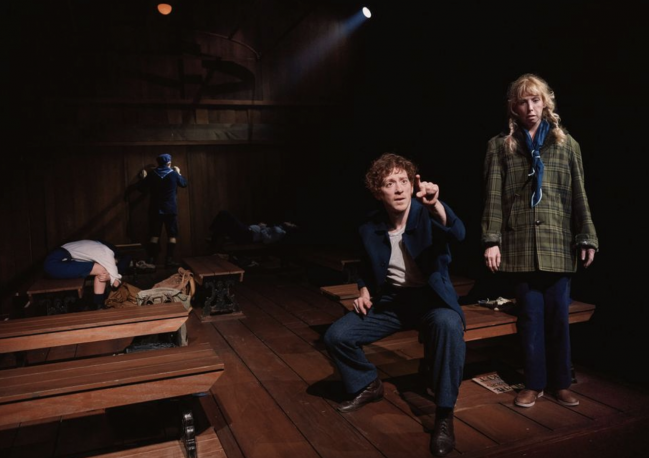
Ethan Slater, Maddie Corman (Photo: Emilio Madrid)
A cutaway to 1985 (I had to consult the script for the date; the flash-forwards are really vaguely timed) has Étienette auditioning for the mime school Marceau founded, her relatively advanced age working against her. It’s not clear what this vignette, nor one of Adolphe in a Vietcong prison camp, contributes to the overall vision. Berthe’s mimed flash-forward appears to represent the placid domestic existence Marceau has predicted for her, but Pailet’s direction doesn’t zero in on the details that would clarify what he and Slater are trying to tell us about Berthe.
Mostly, though, we’re on that train, with an increasingly panicky Marceau doing his best to divert and amuse his charges and quash their well-deserved fears, not to mention his own. Slater, with his balletic grace and verbal dexterity, offers as full-bodied a portrait as his and Pailet’s script allows.
But so many questions! How did Marceau hook up with this Resistance group, and what’s his relationship to Georges (Aaron Serotsky, also billed in the program as “Everyone Else”), a Resistance leader? (They were cousins, though I didn’t catch that.) Why is this particular band of orphans being pursued, and how did the Nazis find out about them? What of Marceau’s brother, Alain, a co-conspirator who doesn’t even rate a mention? There’s a tense scene of a French Nazi inspecting the railcar and suspicious that these are the orphans he’s hunting, but when he leaves, what has happened? Have they really fooled him so easily, or was he undercover Resistance? Where did Marceau acquire his mime skills, and, a fleeting reference to Charlie Chaplin aside, what was his inspiration? Slater masterfully delivers a “Bip” routine near the end (Marceau’s best-known character), but what does it have to do with what’s around it?
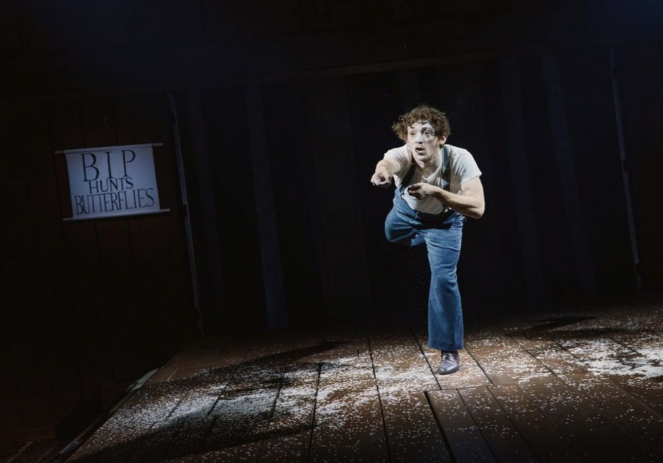
Ethan Slater (Photo: Emilio Madrid)
Slater’s and Pailet’s dialogue has a curiously contemporary edge to it: “Um, like any of us knows what Switzerland looks like, idiot,” (Henri to Adolphe) just doesn’t sound very 1943. They do scatter some good jokes in, and we grow to care about Berthe, at least, less so about the other kids.
Classic Stage Company’s prior effort, The Baker’s Wife, was also set in France, a few years before this, and Jason Sherwood’s lovely scenic design was all-enveloping. Davis’s is much more basic, mostly that platform and those benches, plus some upstage tree branches to evoke the forest near the border when these five have to flee the rails. But Studio Luna’s lighting is wonderfully dramatic, piercing spotlights and flowing bands to represent train movement, and Jill BC Du Boff’s sound design smartly covers train noises, the whistling winds of that cold forest, and Nazis saying guttural things to each other offstage.
Marcel on the Train tells an inspiring story, and, at a moment when so many groups in so many places are being discriminated against and terrorized for their otherness, it’s a valuable reminder that a little human kindness can go a long way. That doesn’t prevent much of it from being rather a slog.
Marcel on the Train
At Classic Stage Company
136 E. 13th St.
Running time: 1 hour 40 minutes, no intermission
Through March 22, 2026