
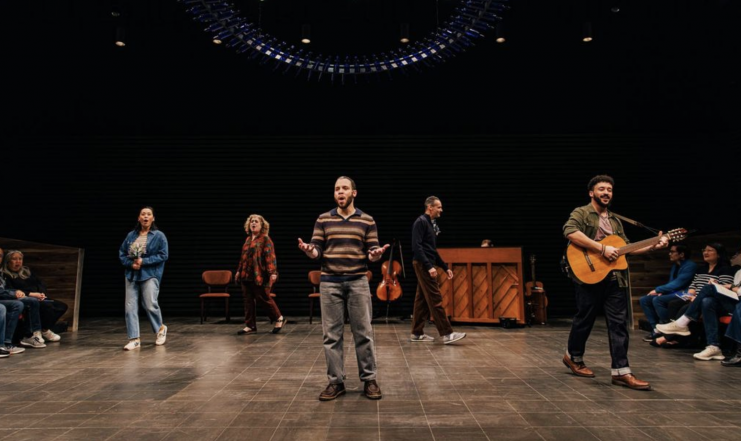
The Ensemble (Photo: Marc J. Franklin)
Night Side Songs
By Jarrett Winters Morley
In 1956, Brooks Atkinson wrote, “Broadway is used to heart. It is not accustomed to evocations of the soul.” What is more soul-exposing than a piece that explores illness and death, in an intimate staging, where the audience itself becomes the beating heart of the show?
Night Side Songs explores the life of Yasmine Holly (Brooke Ishibashi), who is diagnosed with cancer while simultaneously dealing with her overbearing mother (Mary Testa). It uses Susan Sontag’s famous description of illness as its frame: “Illness is the night side of life, a more onerous citizenship. Everyone who is born holds dual citizenship, in the kingdom of the well and in the kingdom of the sick.”
At the top of the show, you are thrown right in to that night side as two of the five players—Ishibashi and Testa— step forward. They explain that this piece was developed in consultation with nurses, doctors, patients, and others in the healthcare field. Over 90 minutes, the piece balances the joys and sorrows of life while acknowledging the hardships of living through cancer, whether in treatment or remission.
Developed at the Philadelphia Theatre Company and the American Repertory Theater before arriving at the Claire Tow Theater at Lincoln Center, the musical features a book and music by Daniel and Patrick Lazour with a score developed by Madeline Benson. It welcomes you like a loving grandmother offering freshly baked cookies—before abruptly turning and piercing your heart. The story unfolds in a series of emotional shifts—the good, the bad, and the precisely timed moments of humor that draw laughter just after something devastating occurs.
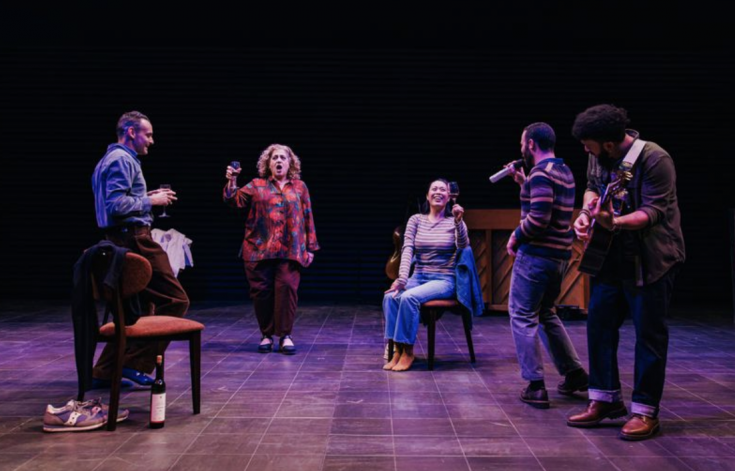
The Ensemble (Photo: Marc J. Franklin)
Whether or not you’ve ever faced serious illness, the way the show is written forces you to become a part of the story. Audience members are given songbooks upon entering the theater and encouraged to become active participants. Led by a high-energy yet somber Robin de Jesús, the early songs are deliberately simple, even repetitive. They serve a clear purpose: building a shared rhythm among strangers. By the time the audience is singing together, participation feels like a quiet emotional contract – one that makes disengagement impossible. Singing alongside the cast keeps the audience emotionally present, collapsing any distance between observer and participant.
The production’s intimacy extends beyond staging into its orchestration. Performed by Musical Director Alex Bechtel (piano/guitar), sometimes joined by actor Kris Saint-Louis (guitar/cello), with no more than two instruments at a time, the score mirrors the show’s emotional closeness, leaving no space for distance or distraction.
The music evokes memories of singing hymns or spirituals in synagogue over a high holiday. The styles of music within the show constantly creates a sense of shared emotional space, and in many instances, the songs feel like they were written for the specific performers.
Mary Testa’s voice and presence as Yasmine’s mother (and many other bit parts) made it almost impossible to tear your eyes away. Robin de Jesús’s heartbreaking “Miracle Song”, the production’s one step into the past, captures the fragile act of projecting optimism even though you know there are hard times ahead, and hoping for a miracle.
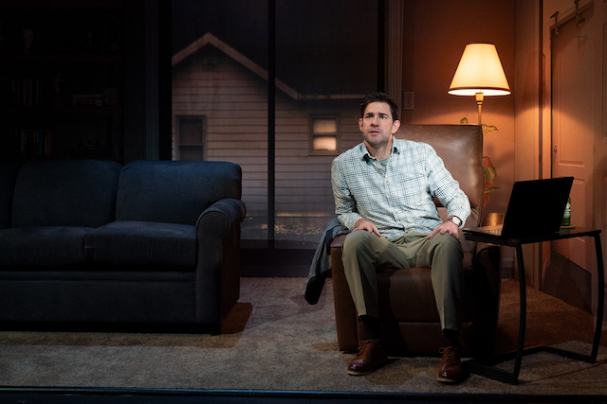
Jonathan Raviv, who portrayed Yasmine’s fiancé/husband Frank, has the second–hardest job on stage. If Yasmine’s journey is the emotional core of the piece, Frank’s is its quiet devastation. Yasmine may have been the one going through cancer, remission, then cancer again, finally succumbing to leukemia, but Frank is the one who has to watch her deteriorate. Frank shows us that the patient is not the only one suffering; the pain borne by loved ones can be even greater.
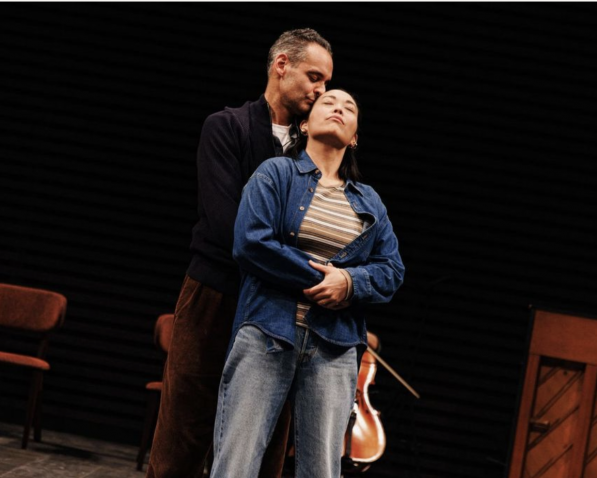
Jonathan Raviv, Brooke Ishibashi (Photo: Mark J Franklin)
Lighting design by Amith Chandrashaker and set design by Matt Saunders do the fantastic job of supporting the clear storytelling, with a simple yet elegant ring light made of blue glass bottles suspended above the stage for most lighting changes, and a minimal set. Somewhat muddy sound design (Justin Stasiw) could have been clearer.
Night Side Songs is constrained yet unhinged. While not every song advances the narrative, the eleven titled sections allow each performer to guide us through a different stage of Yasmine’s journey. No topic is off the table, whether it be orange Velveeta powder or death and the afterlife.
Brilliantly directed by Taibi Magar, Night Side Songs doesn’t overwhelm so much as it quietly closes in on you, scene by scene, as the emotional weight feels shared rather than observed. The piece reminds us that it’s okay to be okay. It’s okay not to be okay. And as Susan Block, a national leader in the development of the field of palliative medicine, was quoted at the end of the show, “we get through it together by singing for the sick”.
At the Clare Tow Theater
150 W 65th St
Running time: 90 minutes, no intermission
Through March 29, 2026