No Singing in the Navy
When I first heard about a show titled No Singing in the Navy, premiering at Playwrights Horizons, the same institution involved with works like Sunday In The Park With George, Floyd Collins, and William Finn’s Falsettos trilogy, I was intrigued. Playwrights Horizons has long been the home for ambitious new musicals and a launching pad for major American theater. So I went in expecting something sharp, daring, or at least conceptually clear.
I left unsure of what I had just seen.
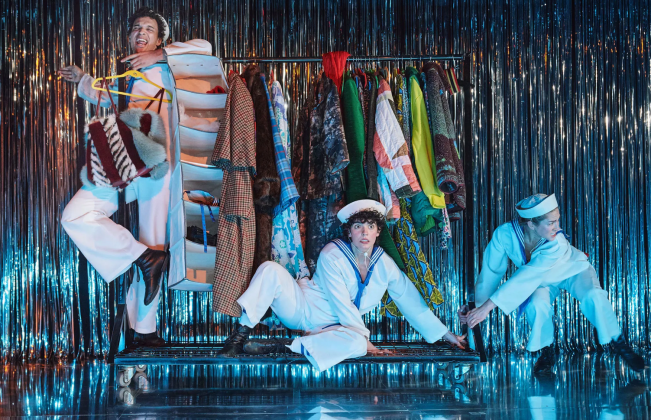
Nothing about the production is, technically, broken. Bailey Lee (Sailor 1), Ellen Nikbakht (Sailor 3), and Elliot Sagay (Sailor 2) all sing well, move well, and give committed, strong performances, doing what they can with Milo Cramer’s book, music, and lyrics. The issue is not effort; it’s structure and intent.
We don’t even learn the sailors’ names (or numbers) until roughly fifteen minutes into the show, in a reveal that feels like it should have opened the piece rather than arrived as delayed exposition. From the title and marketing, I was expecting something along the lines of Comden & Green’s On The Town, filtered through contemporary deconstruction, perhaps in the spirit of Urinetown. Instead, the show’s own description, “a delightfully sardonic explosion of the myth of American innocence,” sets up an ambition the writing rarely supports.
What follows feels less like a clear stylistic vision and more like a collage of influences without synthesis. The show gestures toward the kind of meta-theatrical chaos associated with StarKid Productions-style work, but it never establishes a stable point of view. Where Urinetown or Avenue Q use crudeness and self-awareness as part of a larger satirical machine, No Singing in the Navy often feels like it is simply reproducing those textures without any underlying logic.
Jokes repeat rather than escalate; physical comedy relies on some Three Stooges-style beats; and a literal crab appears, initially distracting, eventually more compelling than the sailors themselves. There is a difference between intentional cringe and unshaped chaos, and this production rarely clarifies which it is aiming for.
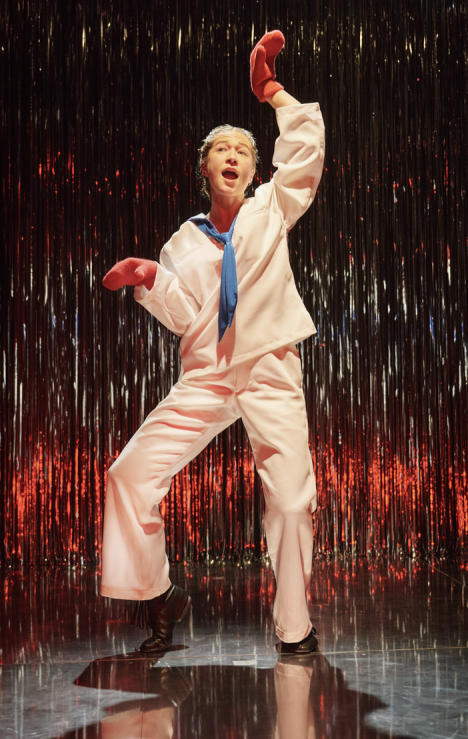
There’s an anecdote from the out-of-town tryout of Rodgers & Hammerstein’s Me & Juliet, where audience members reportedly became more interested in the set design than the performance itself. At times, I had a similar experience here- not because Krit Robinson’s scenic design is overwhelming, but because it offers more visual clarity than the storytelling onstage. The glittery set catches and fractures the light in ways that occasionally pull attention away from the action. It was easy to watch how the strands shifted with the air conditioning, tracking their movement more closely than the scenes unfolding in front of them.
Musically, this show positions itself as ‘a one-piano attack on the Golden Age musical’, and pianist Kyle Adam Blair’s pre-show playing, classical excerpts alongside ditties from the 1930s and 1940s, made this feel like it was also going to be a period piece. That promise, however, never fully materializes once the show begins.
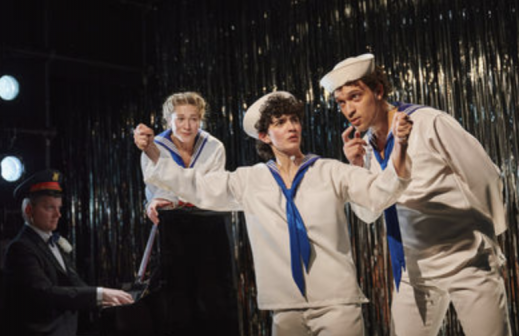
Despite costume choices by Enver Chakartash that gesture towards multiple eras, the production remains stylistically ambiguous. The result is a piece that feels conceptually suspended rather than intentionally hybrid. Lighting by Masha Tsimring and sound by Tei Blow are competent, but largely reactive, doing what they can to support material that rarely gives them much to shape.
The writing is where this lack of cohesion becomes most apparent. Jokes are sparse, and wordplay often defaults to obviousness; at one point, a word is simply rhymed with itself (“smart” with “smart”). There are occasional pleasing ensemble harmonies, but they feel incidental rather than structurally earned.
Ultimately, No Singing in the Navy feels like a show searching for its own identity but never settling on one. It gestures towards satire, nostalgia, and absurdist comedy, yet fails to unify those impulses. Is No Singing in the Navy intentionally embracing cringe as a reflection on American Innocence, or is it simply reaching for a cheap laugh without a clear satirical framework? Whether its ambiguity reads as concept or confusion is, for now, left to the audience.
No Singing in the Navy
At Playwrights Horizons
416 W. 42nd St
Running time: 80 minutes, no intermission
Through April 26, 2026