Not Ready For Prime Time
The 2024 Sony Pictures release Saturday Night dramatizes, and I use the term loosely, the chaos and anarchy that preceded the launch of NBC’s Saturday Night (the Live didn’t happen till the second season) on October 11, 1975. While it illustrates the frantic tugs-of-war among cast members, producer Lorne Michaels, and the NBC brass, it somehow keeps us at a remove. We don’t get to know John Belushi, Chevy Chase, Gilda Radner, and their beloved castmates as well as we’d like, and the tension seems to be happening on the other side of the screen; we just don’t feel it. Something similar happens with Not Ready for Prime Time, the SNL history by Erik J. Rodriguez and Charles A. Sothers that just dropped at the Newman Mills Theater at MCC Space (it’s not, however, an MCC production). Prime Time goes beyond the movie to depict the first several fraught seasons of SNL and the interpersonal sparring that bedeviled it, a promising premise that falls short in execution.
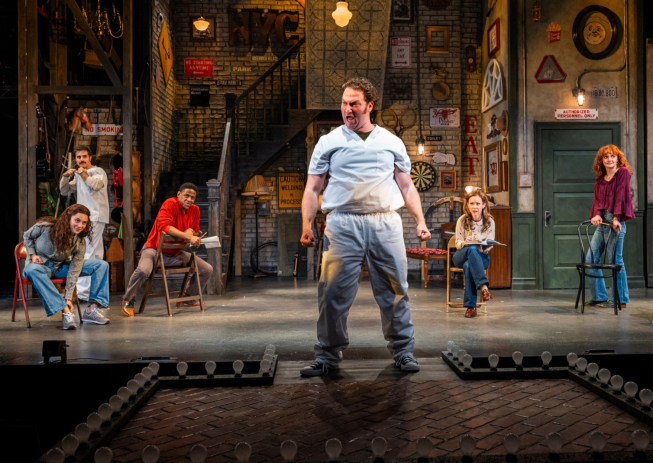
Visually, it’s all there. Christopher and Justin Swader’s expansive scenic design convincingly evokes the cluttered Studio 8H backstage, with revolves on either side of the wide space to take in various personnel’s living spaces (Michaels’, tellingly, has a poster for The Apartment). And an onstage four-piece band, led by musical director-arranger Annastasia Victory, serves up some fine Paul Shaffer boogieing. Beyond that, the verisimilitude hits a snag.
What’s Michaels like, and what drove him? We don’t get much of a sense of that in Ian Bouillion’s dry portrayal of an unknowable entity; he’s excitable, easily angered, lacking in people skills, and tunnelvision-focused on making SNL a hit. But he doesn’t breathe. Surely that’s somewhat Rodriguez’ and Sothers’ doing, as they’re so busy reeling out production details and exposition that the cast members’ personalities, the qualities that distinguished them from one another and helped younger viewers see themselves in them, get shortchanged.
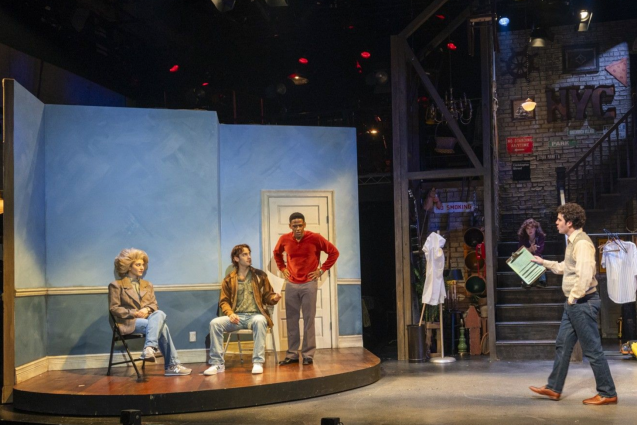
Jared Grimes’ Garrett Morris, perhaps, comes closest: We feel his frustration at being the token black guy, usually forced out of the running order by the more popular Chevy Chase (Woodrow Proctor), Dan Aykroyd (Kristian Lugo), John Belushi (Ryan Crout) and Bill Murray (Nate Janis). (Janis also plays Dick Ebersol, NBC’s director of late-night programming. For all we know, he’s a spot-on Dick Ebersol; he sure ain’t Bill Murray.) And Crout conveys the surly, drug-fueled antagonism and unpredictable violent outbursts that made Belushi as dangerous as he was brilliant.
Then there are the women, who were routinely considered subsidiary to the men—and while Rodriguez and Sothers delve into that, they’re also guilty of it. Gilda Radner (Evan Rubin), Laraine Newman (Taylor Richardson), and Jane Curtin (Caitlin Houlahan) are engaging presences, more like sorority sisters than comic icons. But that’s the trouble: Nothing in the script suggests what was unique and endearing about Radner, or captures Newman’s spaced-out etherealness, or Curtin’s efficient, businesslike persona that made her an ideal “Weekend Update” host. Mostly, this trio argues about boyfriends.
There was, apparently, a lot to argue about. Aykroyd flitted between Gilda and Laraine, lying to and eventually breaking the hearts of both, while Gilda subsequently took up with Bill, who tried and failed to let her down gently. The three women alternate between screaming at one another and giggling like airhead teenagers. Conor Bagley’s direction doesn’t calibrate the mood switches very neatly, but the main problem is, these three come across as average, generic young women, which they clearly were not. And one cringey late scene between Gilda and her doctor plays her cancer diagnosis as comedy; that is NOT a good idea. Further, while the script does acknowledge that other writers were at work, it implies that the cast wrote virtually the whole show; did it, really?
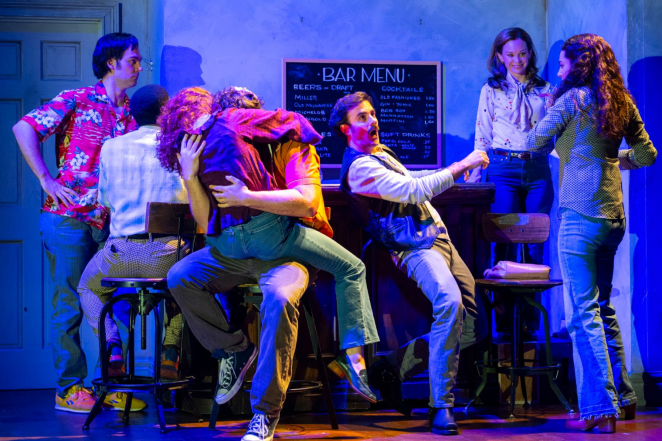
There’s also some straightforward SNL, some sketches of which play better than others. It’s been 50 years, after all, and humor can date. The opening skit, with Belushi doing one of his famous accents, thuds. But a later one with Aykroyd as a blow-up doll/sex toy lands pretty well, and Rubin does a more than respectable Roseanne Roseannadanna.
Rodriguez and Sothers regularly break the fourth wall, with Michaels in particular narrating what would take too long to dramatize. But narrated or dramatized, the manifold conflicts and pettinesses that drove the first few seasons feel like they’re behind a glass wall. Sarita P. Fellows’ costumes, ’70s bell-bottom jeans and awful sweaters, help, and so does Liam Bellman-Sharpe’s sound design, which makes most of the dialogue audible, not that much of it is bracing dialogue.
There’s a lesson, I suppose, in SNL’s early days: Look what happens when gifted young people suddenly acquire too much fame, money, and power, how they squander it on drugs and sexual conquests and bad career decisions (Chevy Chase’s Oh, Heavenly Dog is invoked). It’s just never as involving as we’d expect an SNL history to be. If you’re of a certain age, and as a college student you used to gather with your buds, order a pizza, and wonder what edgy new satire Chevy, John, and Gilda et al. were going to come up with tonight, you may be able to view Not Ready for Prime Time and coast happily along on the wave of nostalgia. For the rest of us, it is, in fact, not quite ready for prime time.
Not Ready for Prime Time
Newman Mills Theater, MCC Space
511 W. 52nd St.
Through Nov. 30, 2025