Nothing Can Take You From The Hand Of God
Performance: Extraordinary. Story: Heartbreaking. Production: Challenging.
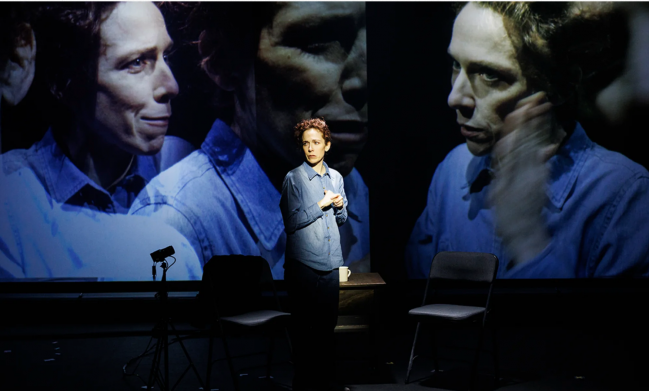
Firmly in the school of “solo performance acting with video projections of the actor,” Nothing Can Take You From The Hand Of God gives its star, Jen Tullock, who wrote the play with Frank Winters, a superb opportunity to display her acting chops. Which are significant. She’s superb. She performs all eleven roles in it, switching lightning-fast from one to another, with accents and body language fully realized. Among others, she flips from Eastern Kentucky down-home good ol’ boy to Polish refugee to nightmare sweet mom to patronizing pastor: Tullock makes them all live completely.
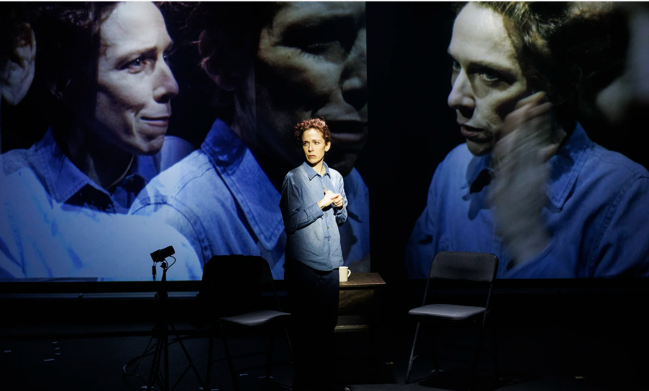
That’s a neat trick, on a minimally furnished black-box stage with two chairs, a table, and a few cameras on tripods (scenic design from Emmie Finckel). We come to realize there are also lots of big screens on which Stefania Bulbarella’s projection design flares. The projections are characteristic of director Jared Mezzocchi, who integrates video into many of his productions. It doesn’t work, in Hand of God. Too many images hit all at once, and they pull the eye away from the actor herself. The visual noise, combined with the quick-cuts nature of a non-linear narrative, can be confusing and make an observer have to work very hard to understand what’s going on.
The play – a series of vignettes and quick cuts linked by flashing, glitching, jarring lights and sound – revolves around Frances Reinhardt. She’s a witty, clever Lesbian writer, whose new book, “Never the Twain Shall Meet: Losing God and Finding Myself,” about her brutally strict Christian upbringing, is ready for publication. Except. Her literary agent reveals that someone has leaked her book to the church in her home town, and maybe there will be a lawsuit unless she makes some changes. So she goes home to confront the church, her family, her community, and the woman she fell in love with.
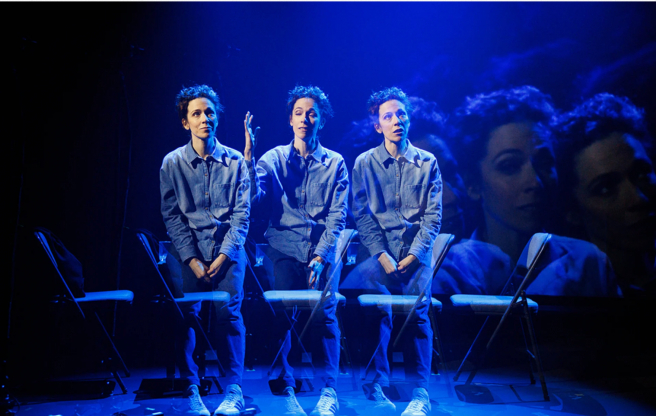
Those projections do sometimes helpfully caption a scene by introducing the character Tullock is about to play, or show a visual of a text or email. Mostly, they offer looping and live video of Frances as she fractures. Fractures? Yes; the sophisticate who monetized her childhood Christian Trauma gradually changes into someone who uses her own tell-all book as a hymnal, nearly weeping for the loss of God.
I’m not, not not not absolutely not saying that religious trauma doesn’t exist, nor that it’s petty or easily dismissed. However, the people in Frances’ life, on whom she bases the characters in Hand of God, do exactly that: they almost persuade her – and with her, the audience — that her memory is faulty or at the very least different. This gaslighting makes the show devastating.
Frances asserts that her fundamentalist parents tried not only to “pray the gay away,” but beat her, choked her, and even had her exorcised. Raelynn, her mama, swears it didn’t happen that way, that they loved Frances and wanted the best for her: “Just ’cause you don’t remember it doesn’t mean it didn’t happen.” Agnieszka, the Polish woman whom Frances remembers as her first love and now lives in her hometown, goes to her church, does her laundry at Raelynn’s house, says that, “I don’t remember what happened the same way you remember it.”
These statements, of course, beg the question: if you write about the past, does it change your memories? If what you believe happened, other people believe wholly did not happen, then what can you believe? If you end up literally praying to God in a basement during a tornado, do you still believe?
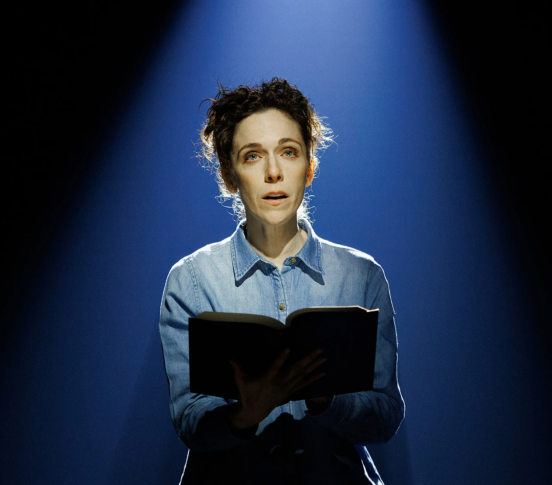
The show ends with Frances having realized that God was everything and now is not and she has to learn to be OK with that. She’s bereft. After all the frenzy of the projections, the glitches, the memories, Amith Chandrashaker’s lighting and Evdoxia Ragkou’s sound bathe Frances in what could be seen as grace. A choir sings a hymn she earlier called “creepy-ass” and, as Frances holds her own book as if it were a hymnal, sings along with arguably the best known of the Protestant/fundamentalist anthems, “The Lord Bless You and Keep You.” Is she asking you or telling you? Jen Tullock’s brilliant performance will leave you to answer that for yourself.
Nothing Can Take You From The Hand Of God
At Playwrights Horizons
416 W 42nd St.
Running time: 70 minutes, no intermission
Through November 9, 2025