
Michael Urie (Photo: Carol Rosegg)
Richard II
Review by Carol Rocamora
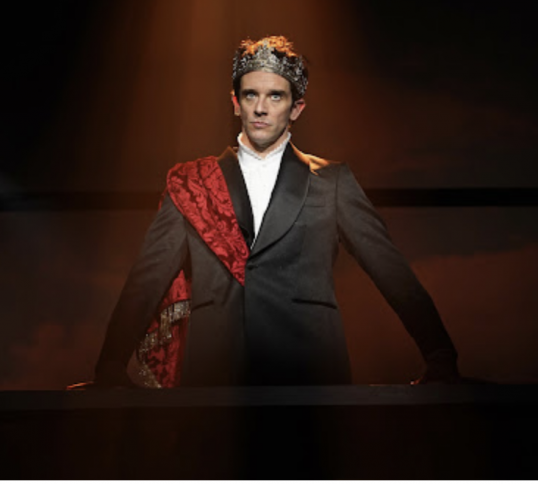
The issues of power and rule in Shakespeare’s Richard II, now playing at the Astor Place Theatre, feel painfully present and even prophetic. They are expressed urgently by Red Bull’s riveting revival, featuring a charismatic Michael Urie in the title role.
Richard’s story (set in 1398) is both a compelling and a complicated one. In the first scene, the young king shows himself to be a headstrong, authoritative young leader over war-torn England, one whose decisions are absolute. He intervenes in the fight-unto-death between two noblemen: Bolingbroke, his cousin (Grantham Coleman); and Mowbray (Daniel Stewart Sherman), saving their lives but banishing them both.
Emboldened, over-confident, Richard makes a subsequent audacious move, one that will ultimately cost him his crown. John of Gaunt (an imposing Ron Canada), Richard’s uncle and father of the banished Bolingbroke, dies. Richard seizes Gaunt’s goods and property, which would have been Bolingbroke’s inheritance, and uses Gaunt’s money to help fund Richard’s war in Ireland. While Richard is away in battle, Bolingbroke returns, and begins amassing supporters to avenge the theft of his father’s estate. When he confronts his cousin Richard the King, however, Bolingbroke proves to be respectful of his authority, professing his continued loyalty provided Richard restores the property and title that was his father’s.
When Richard refuses, Bolingbroke’s support grows so overpowering that Richard recognizes defeat and relinquishes the crown (a shocking and unprecedented action, since the king was considered God-appointed.)

Grantham Coleman, Michael Urie (Photo: Carol Rosegg)
Craig Baldwin, both adapter and director, has assembled a superb cast and production team. The design elements are stunning. Arnulfo Maldonado’s set features a rotating glass room, where Richard II spends much of the play’s two-and-one-half-hour’s “traffic”. The dramatic lighting by Jeanette Oi-Suk Yew commands the stage, featuring brilliant oranges and blues flashing as violently as the action that it illuminates. On an empty black set featuring only the elements of glass and flashing light, the strikingly colorful costumes of Rodrigo Munoz stand out vibrantly. In short, the combined visuals are electrifying.
Baldwin has taken some liberties in adapting the play, though none significantly affect the integrity of the original text. He begins his production with Richard alone in his glass prison reciting a speech from Act V: “I have been studying how I may compare this prison wherein I live unto the world.” That speech is repeated in this production twice more, apparently to underscore the isolation of a deposed leader trying to make sense of his loss. Baldwin has also changed the gender of the Dukes of Northumberland and York, two characters who figure critically in the switch in loyalty from Richard to Bolingbroke. Here they are Duchesses played by Emily Swallow and Kathryn Meisle respectively. Third, the Duke of Aumerle (son of the Duke of York and Richard’s cousin, played by David Matar Merten) becomes Richard’s lover and ultimately his murderer, a notable change from the original.
In making these changes, Baldwin appears to be emphasizing the major themes of the play: namely, power, loyalty, and the fragility of both in a divided land. It’s also about love of country, and what happens to the tormented soul of a deposed leader who has lost “… this blessed plot, this earth, this realm, this England.”
Serving as director as well as adapter, Baldwin moves his excellent ensemble through the traumatic events at a pace of a thriller. In the center of this dramatic maelstrom, Michael Urie gives an exciting, provocative performance. At first, he’s brilliant, buoyant, youthful and playful, delighting in power and possibility. His command of Shakespeare’s language is masterful. Then, when he faces defeat, he delivers this deeply moving speech with poignancy and simplicity: “Let us sit upon the ground and tell sad stories of the death of kings…for within the hollow crown that rounds the mortal temples of a king keeps Death his court.”
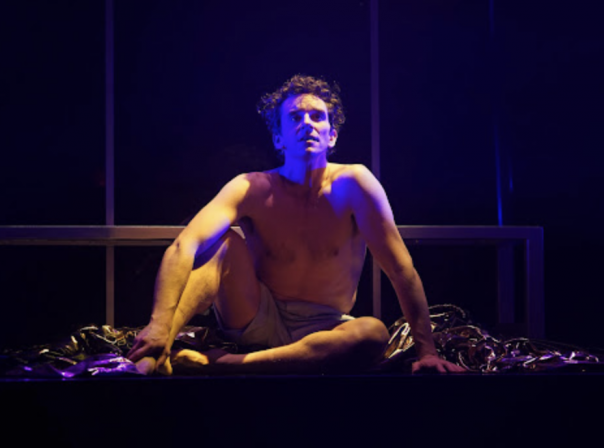
Michael Urie (Photo: Carol Rosegg)
Central to the play is that “hollow crown,” a symbol of power and fearful responsibility. In a climactic moment, Richard extends it for Bolingbroke to take in his hand and then rescinds it. Back and forth this motion continues like a so-called tug-of-war, until Richard final relinquishes it and faces the terrible consequences of defeat that lies ahead. It’s always a stunning moment in the play, and Urie and Coleman play it well.
That symbol and its consequences should serve as a warning to those who rule today. In our country, the hollow crown, as Richard calls it, feels hollower than ever.
At the Astor Place Theatre
434 Lafayette St
Running time: 2 hours, 30 minutes, one intermission
Through December 14, 2025