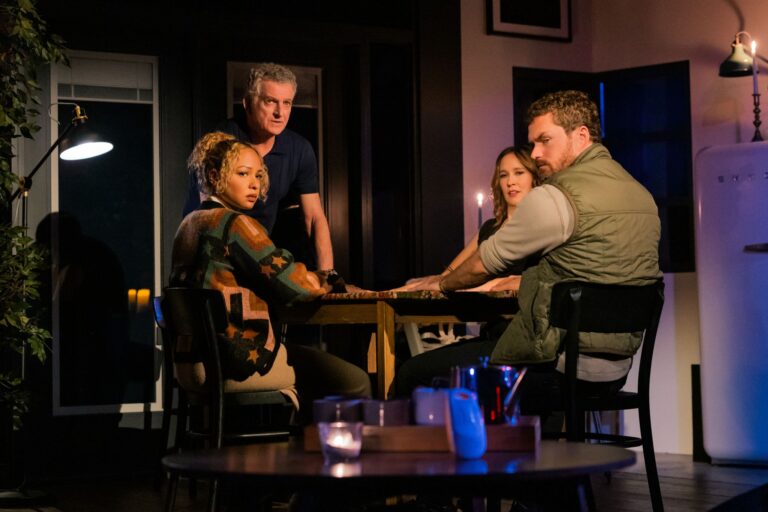
Rope
Rope, Gordon Greenberg’s new adaptation of Patrick Hamilton’s play, draws on the notorious 1924 Leopold and Loeb murder case to tell a chilling story of murder and deception. Directed by Scott Elliott, this world-premiere production centers on two attractive Princeton graduate students who host a dinner party in a stylish Manhattan apartment, serving food atop a trunk containing their victim’s body.
In 1924, privileged University of Chicago students Nathan Leopold and Richard Loeb kidnapped and murdered 14-year-old Bobby Franks, believing their intellectual gifts placed them above conventional morality and would enable them to commit the perfect crime. Their thinking was influenced in part by Friedrich Nietzsche’s concept of the Übermensch, or superman, which they distorted to justify their sense of superiority. The crime inspired Hamilton’s stage thriller and, decades later, Alfred Hitchcock’s film adaptation.
Promoted as a “glamorous, queer-forward psychological thriller,” The New Group’s production relocates the action to Manhattan’s Turtle Bay neighborhood and advances it roughly three decades, to 1957, perhaps in a nod to Hitchcock’s 1948 film.
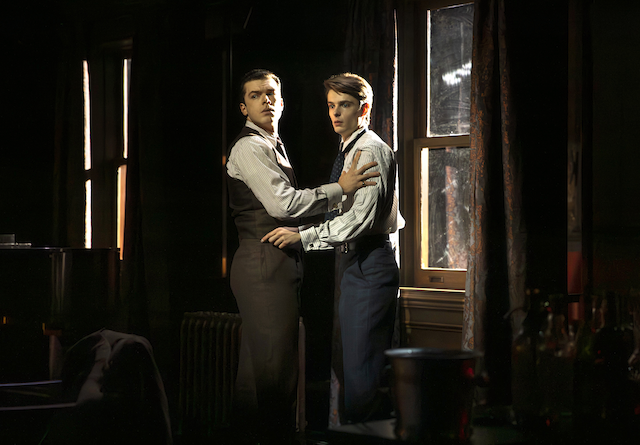
Greenberg also makes significant changes to Hamilton’s treatment of the two young men, Garrett Stern (Cameron Monaghan) and Nate Singer (Corey Fogelmanis). The sexual tension largely sublimated in the original becomes considerably more explicit, with several steamy encounters. Although this heightened sexuality may be intended to bring the material in line with contemporary LGBTQ sensibilities, it sometimes threatens to distract from the central horror: a cold-blooded murder driven both by the men’s delusions of intellectual superiority and by their desire to conceal their relationship after their victim, Ronald Kentley, discovers they are lovers.
The production’s visual elements compensate in part for the adaptation’s shortcomings. Derek McLane’s atmospheric scenic design, enhanced by Jeff Croiter’s lighting, evokes an upscale Manhattan apartment decked out for Christmas, with elegant furnishings, a tree, and a grand piano. Before the action begins, shadows shroud the space as the two young men stealthily rearrange furniture in the drawing room.
As the lights come up, Nate and Garrett bend over the chest when its lid suddenly falls shut, startling the already anxious Nate (“Shit! Sorry, sorry. I’m shaking.”). The steadier Garrett tells him to “breathe.” That first unsettling moment establishes the play’s tone.
The initial jolt gives way to a seemingly more composed scene: the apartment is revealed in all its splendor as Garrett and Nate prepare for a holiday party that will include members of Ronald’s family. Nate’s affluent father owns the building and ensures that his son has what he calls “swish digs” whenever he is in town. Nate describes the apartment as “an early graduation gift.” Everything appears picture-perfect at first glance, including the ornate trunk concealing Ronald’s body, the room’s most ominous furnishing.
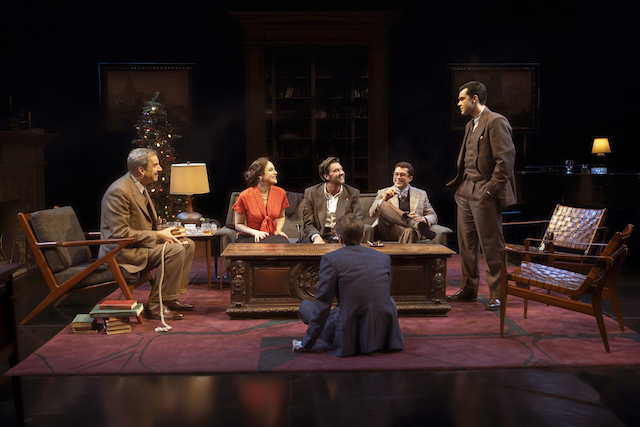
Hamilton’s underlying premise remains riveting, particularly the audacity of Garrett and Nate’s scheme. Having strangled Ronald, who had discovered their secret relationship, and hidden his body in the trunk, they proceed with their party plans as though nothing untoward has happened. Their brazen behavior exposes their hubris and conviction that they belong to an intellectually superior class, capable of committing the perfect crime. Twisting Nietzschean philosophy to suit their purposes, they turn the murder and gathering into an elaborate test of their supposed superiority, confident they can conceal the crime in plain sight.
They have also invited their mentor, Rupert Cadell (Jason Butler Harner), a cynical, brilliant intellectual given to detached, elitist pronouncements about superior human beings. Rupert seems oblivious to the dangers of his abstract theorizing and its possible real-world consequences. Moments after arriving, he declares cavalierly, “It’s society bargain. Artists are exempt from moral boundaries.”
Garrett and Nate seem to derive an almost erotic thrill from serving food and drinks atop the trunk containing their victim. Both are Jewish and gay, negotiating their place in mid-century Manhattan’s predominantly WASP society; Garrett also conceals his lower-middle-class origins. Their murder and the party that follows can be read as a violent rebellion against the social constraints, insecurities, and shame associated with their carefully guarded identities.
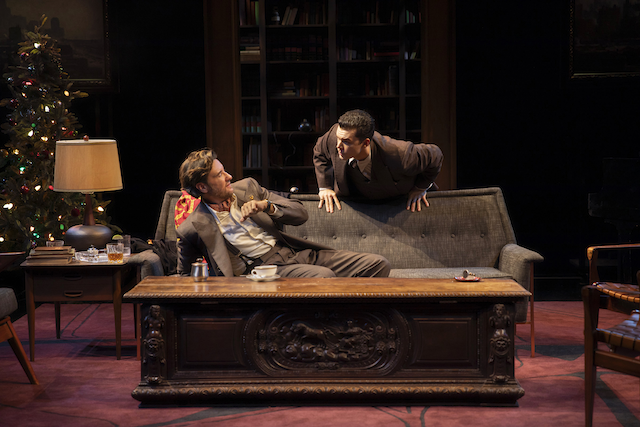
Monaghan and Fogelmanis deliver psychologically layered performances, particularly in their encounters with Rupert. Eager to discover whether their former mentor’s own philosophical posturing has made him blind to their crime—or whether he can see through their charade—the young men engage in some of the play’s most compelling exchanges. Harner makes Rupert an able foil.
Although Greenberg’s adaptation is far from flawless, and Elliott favors shock value over a slow-burn psychological atmosphere, Rope remains a compelling cautionary tale about intellectual arrogance and elitism. It delivers a chilling repudiation of the toxic belief that intellectual superiority or social standing confers the right to decide who is inferior—or who deserves to live.
Rope
At Theater at St. Clement’s
423 W. 46th St.
Running Time: 95 minutes with no intermission.
Through December 6, 2026