The Maids
In Kip Williams’ electrifying new adaptation of Jean Genet’s The Maids at St. Ann’s Warehouse, the playwright’s fever dream of class resentment and fractured identity is thrust headlong into the social media age with startling immediacy and theatrical bravado. Fueled by storming performances from Phia Saban, Lydia Wilson, and Yerin Ha, this turbo-charged Donmar Warehouse production transforms Genet’s 1947 masterpiece into a dizzying, darkly mesmerizing portrait of obsession, performance, and self-annihilation in the influencer era.
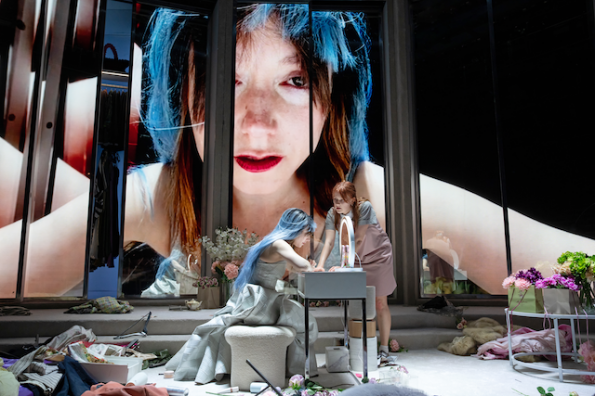
While their wealthy employer is away, two housemaids indulge in increasingly dangerous role-playing games in which they mimic, mock, and symbolically destroy the glamorous social media influencer who dominates their lives. As their obsessive performances spiral out of control, the boundaries between fantasy and reality begin to collapse, turning Kip Williams’ contemporary reimagining of The Maids into a chilling meditation on identity, envy, and the toxic allure of celebrity culture.
The play’s nightmarish atmosphere is rooted in actual events: Jean Genet drew inspiration from the notorious 1933 Papin sisters murder case in France, in which two live-in maids killed their employer and her grown daughter. Rather than dramatizing the crime realistically, however, Genet transformed it into a darkly ritualized psychodrama in which the sisters, Claire and Solange, repeatedly act out fantasies of domination, humiliation, and violence, their obsessive role-playing gradually eroding the boundary between performance and reality until it drives them toward a tragic end.
Williams extends that blurring of illusion and reality through a staging concept that recalls the high-tech, video-driven aesthetic of his Broadway production of The Picture of Dorian Gray, though here the technology feels even more invasive and psychologically corrosive. Instead of employing roving camera operators, Williams floods the stage with live-streamed iPhone footage projected onto a massive rear screen, allowing the sisters Claire (Wilson) and Solange (Saban) to construct fantasy versions of themselves as Madame through obsessive role-playing, while Madame herself (Yerin Ha) performs a carefully curated version of her own existence for an unseen online audience.
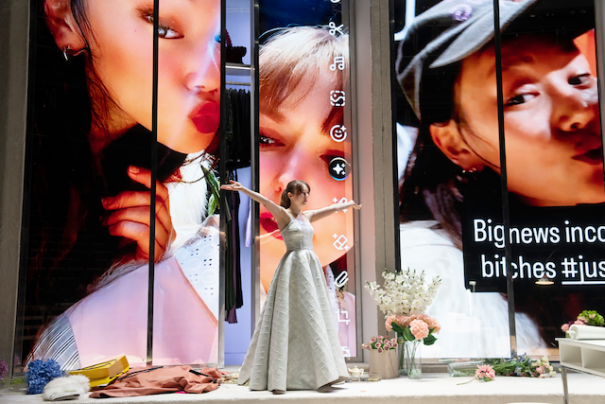
There’s no question that Williams radically reimagines Genet’s 1947 classic for the digital era. Yet the production inevitably raises provocative questions: do the relentless multimedia effects ultimately overshadow the actors themselves, placing them in service to the screen rather than the drama? And does the rapid-fire assault of visual effects, filters, livestreams, and machine-gun dialogue sacrifice some of the original play’s sinister psychological depth and emotional complexity? These are fair criticisms to weigh, particularly since the production’s feverish pacing can at times induce a kind of sensory overload, leaving little opportunity for the audience to fully absorb or reflect upon the escalating horrors unfolding before them during the tightly wound 100-minute performance.
Yet even if such reservations linger, the production ultimately succeeds because the performances are so fiercely committed and finely calibrated (more on that shortly), working in potent synergy with Williams’ technological wizardry rather than being eclipsed by it. If the audience has scant time to contemplate the play’s larger themes in the moment, the cumulative effect nonetheless proves haunting: the actors conjure a grotesque, nightmarish world that feels less like a stylized fantasy than an unnervingly recognizable reflection of today’s image-obsessed culture.
Ultimately, however, the production’s success rests squarely on the shoulders of its three-person ensemble, and the cast rises magnificently to the challenge with daring, intricately layered performances. Filtering Genet’s psychological power struggle through the lens of smartphone livestreams, the actors skillfully balance raw emotional immediacy with the glossy artificiality of carefully curated online personas. As the sisters Claire and Solange, Wilson and Saban capture with unnerving precision the pair’s suffocatingly obsessive bond, their performances pivoting seamlessly between abject insecurity and imperious cruelty as they desperately imitate a world forever beyond their reach. Or as Claire solipsistically puts it: “Make me iconic. Make me iconic. Your desperation stinks, Claire!”
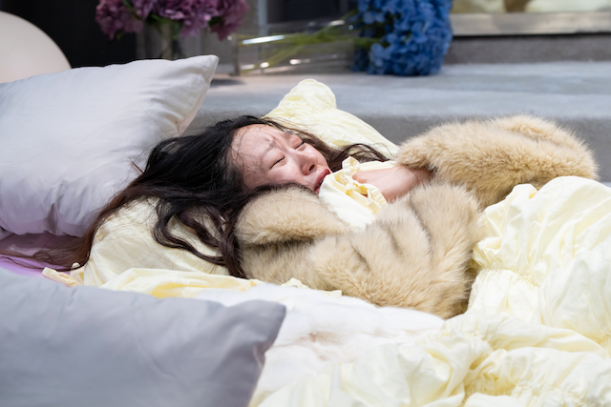
Equally compelling is Yerin Ha as Madame, who brings commanding stage presence to the production’s satirical portrait of influencer culture. Ha deftly balances the exaggerated affectations of a pampered online celebrity with enough emotional authenticity to keep the character from dissolving into mere caricature, grounding the production even at its most frenzied moments.
Most chillingly, all three performers fully embrace the script’s unsettling “Theatre of Cruelty” impulses, hurling themselves through the narrative at a blistering pace that steadily erodes the distinction between genuine emotion and theatrical performance. By the production’s final moments, identity itself seems to have become unstable terrain, leaving the audience trapped inside the same delirious psychological maze as the characters.
In the end, Kip Williams’ production of The Maids may overwhelm as much as it mesmerizes, but its audacious fusion of live performance and digital spectacle proves undeniably hypnotic. Beneath the barrage of livestreams, screens, and social-media satire lies a disturbingly timely vision of people so consumed by image, status, and imitation that they lose all sense of authentic selfhood. Fueled by fearless performances from Wilson, Saban, and Ha, this high-voltage staging transforms Genet’s dark psychodrama into a haunting reflection of contemporary culture’s endless cycle of performance, envy, and self-destruction.
The Maids
At St. Ann’s Warehouse
45 Water St., Brooklyn
Running time: 1 hour 40 minutes, no intermission
Through June 14, 2026