The People Versus Lenny Bruce
The People Versus Lenny Bruce, now playing at Theatre Row, should’ve been called Martin Garbus Reflects on the Lenny Bruce trial and Other Stuff. Even though Lenny Bruce’s name was in the title, clearly Martin Garbus, Bruce’s trial attorney, was the star.
In fact, Martin Garbus, 92, is still practicing law. He’s best known for his work defending the First Amendment and civil rights. His client list reads like a who’s who list of Hollywood celebs and publishing companies. One of those was Lenny Bruce, the famed comedian and socio-political satirist, whose career peaked in the late 1950’s/early 1960’s. He was targeted, made an example of by the government. Bruce was arrested fifteen times within two years. It broke his bank account and his spirit. He spiraled downward and became obsessed with his trials and prejudiced treatment.
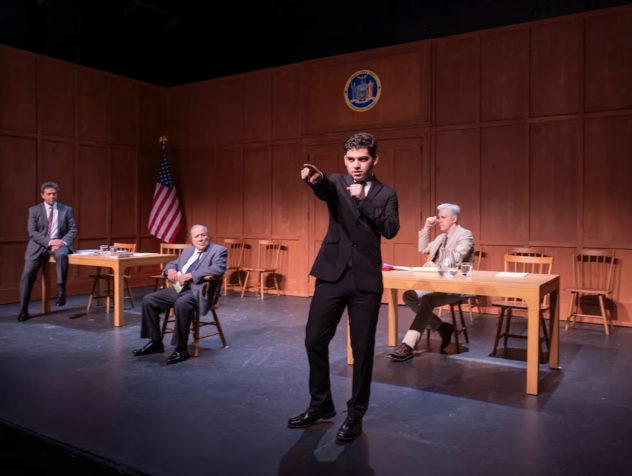
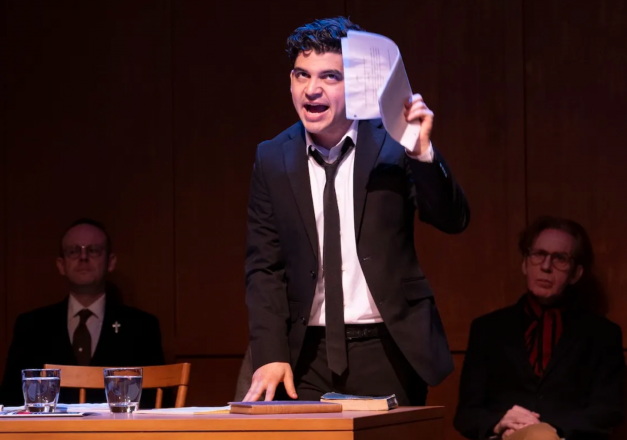
The play centers around Lenny Bruce’s six-month 1964 New York trial, at which Bruce (Johnny Anthony) was charged with obscene, indecent, immoral, and impure performances. The format was mostly a narration by Martin Garbus (Stephen Schnetzer), which sounded like he read it directly from Garbus’s memoir, interspersed with scenes of the trial, taken verbatim from the transcript. Three of the notables who testified for the defense were highlighted in the show: conservative newspaper columnist and television personality Dorothy Kilgallen (Roberta Wallach); famed writer and cartoonist Jules Feiffer (Timothy Doyle); and Presbyterian minister Reverend Forrest Johnson (Johnathan Spivey). Prosecutor Richard Kuh’s (Ian Lithgow) primary witness, swearing to false testimony, was undercover NYC license inspector and ex-CIA agent Herbert Ruhe (Dan Grimaldi).
Ultimately, both Lenny Bruce and Howard Solomon, the owner of Cafe Au Go Go, the Greenwich village nightclub where Bruce performed, were found guilty. Bruce immediately filed for an appeal but died before that came to fruition (Bruce died of a drug overdose at only 40 years old). A few scenes depicted how Garbus fantasized what would happen if certain characters engaged, or how Lenny might have reacted when he learned the decision was overturned 37 years after his death.
The lead actor toggled from narrating the play, to ’acting’ out a scene, to breaking the fourth wall to speak to the audience, or describe what he was thinking, or what he thought Lenny was thinking. His mental meanderings created a spasmodic, yet sluggish recollection. The play interrupted itself so many times that it never got to build any momentum. The trial story got diluted with Garbus’s musings, and stream of consciousness thoughts. And as if that wasn’t distracting enough, the narrator/Garbus was also given the judge’s lines to deliver. Why? Since we never see the judge, those lines could easily have come from offstage.
Performances ranged from adequate to excellent. Of the two principals, Johnny Anthony was a standout for capturing the essence of Bruce’s frustration and unraveling during this taxing time. With years of soap opera acting embedded deep in his DNA, Schnetzer slowly and deliberately discoursed. Hard to say if the copious pregnant pauses were for dramatic effect or something else.
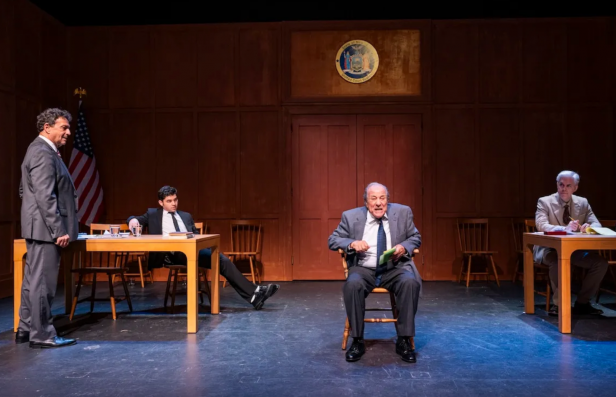
Dan Grimaldi, well experienced at playing bad guys and clearly very comfortable with stage acting, was perfectly unlikeable portraying Herbert Ruhe. Ian Lithgow was stiff and pokerfaced as the prosecutor, and lacked charisma. Another veteran actor, Roberta Wallach, didn’t mimic Dorothy Kilgallen but rather deftly represented her persona: articulate, intelligent, and sophisticated. The talented Timothy Doyle chose to play Jules Feiffer as a flighty, nervous character, which worked for performance although somewhat diminished the astute contributions of the satirist. Johnathan Spivey brought the most energy with his enthusiastic performance as Reverend Forrest Johnson.
A simple, cheap looking, mock-up of a courtroom was adequate as a set. (Josh Iacovelli, scenic design) The theater didn’t seem to use much lighting equipment (Matt Berman, lighting designer) so the lighting was rather harsh, which actually evoked a dramatic sense and gravitas.
Director Anthony Marsellis has collaborated with playwright Susan Charlotte multiple times. There were many questionable choices within The People vs Lenny Bruce. Without being there, it’s hard to assign responsibility. Towards the end of the play, the characters all joined together in a chorus of dirty words Lenny Bruce had used in his act. What was the purpose of that?
Susan Charlotte is more than a playwright; she’s an activist. She wrote The People vs Lenny Bruce as part of a trilogy featuring a few of Marty Garbus’s famous cases. Originally conceived as 3 one act plays (Lenny Bruce dealing with freedom of speech issues, Jane Doe which addresses sexual abuse, and The Last Chance Cafe about voter suppression). At a dragging one hour and 50 minutes with no intermission, The People vs Lenny Bruce is not a one-act. Wish Charlotte had stuck with her first instinct.
Garbus says after the trial he never spoke to Bruce again; after a staged reading of the play in Dec 2025, Garbus acknowledged that “while the plays conveys an emotional closeness between lawyer and client, that relationship was theatrically embellished”. So, while censorship is a timely subject, and there may be a place for The People Versus Lenny Bruce after it is overhauled, it is currently dry, lethargic, and unfocused.
The People Versus Lenny Bruce
At Theater Row
410 W. 42nd St
Running time: I hour 50 minutes, no intermission
Through June 28, 2026