
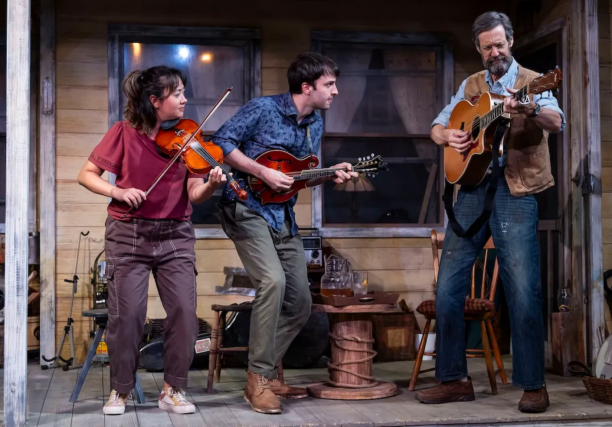
Tora Nogami Alexander, Morgan Morse, and David M. Lutken (Photo: Ben Hider)
The Porch on Windy Hill
By Julia Polinsky
Here’s a run-don’t-walk moment: if you’re ready to warm up this deep-chill winter, go see The Porch on Windy Hill, the “new play with old music” written by Sherry Stregack Lutken, Lisa Helmi Johanson, Morgan Morse, and David M. Lutken. Lutken and Morse also star, along with Tora Nogami Alexander, in this heartfelt play about family, healing, forgiveness, and music.
But what kind of music? Hint: the kind people come together to play, spontaneously, on an old porch.
The music in The Porch on Windy Hill is what’s usually called Old Time Music, even by Wikipedia, which our lead character Edgar (David M. Lutken) would not recognize if it came and sat in on a tune or two. Edgar is himself as old-timey as it gets, in his old home in the hills of North Carolina. He has a rotary phone, for Pete’s sake. He’s been mired in the past for decades. Upside: glorious music. Downside: sad family history.
We first meet him when two New Yorkers, Mira, (Tora Nogami Alexander) a Korean-American classical violinist, and Beckett, (Morgan Morse) her nerdy academic boyfriend, who are escaping the pandemic and in search of “hootenannies” and capital-A Authenticity, arrive at a pickin’ party in Windy Hill. The moment they walk in, Mira recognizes Edgar, who’s playing banjo. He’s her long-estranged grandpa, a musician who had played with many of the greats of the style.
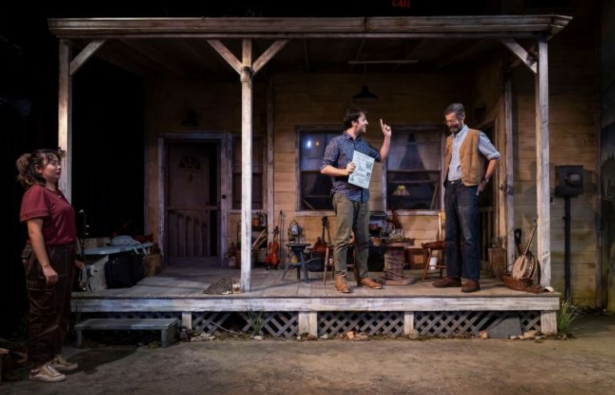
Tora Nogami Alexander, Morgan Morse, and David M. Lutken (Photo: Ben Hider)
All else flows from there. The setup that includes Mira and Bennet’s clapped-out van with its wonky fuses, Beckett’s encyclopedic, academic knowledge of this musical style – he’s a superfan who carries old records of this music in the van — and the shocking family reunion, bring us to the eponymous Porch.
And what a porch it is! Scenic designer Andrew Robinson has given it not one, but two screen doors. Armless seats, perfect for playing instruments. Convenient places to stash guitar, banjo, dulcimer. A wire-spindle repurposed as a table. Broken lattice; faded paint: it feels real, and in Urban Stages’ 75-seat theater, the impact is immediate.
John Salutz’s lighting does a beautiful job of bringing everyone through an evening into the morning, making a point of haloing the big, emotional moments. Spot-on costumes from Grace Jeon seamlessly signal who everyone is, from Beckett and Mira’s Brooklyn-hipster duds to Edgar’s Vietnam Veteran ball cap and clip-on suspenders. Director Sherry Stregack Lutken moves her cast up, over, and around that porch as if it were natural as breathing. Transparent sound design from Sun Hee Kil hits all the right notes.
When Beckett, excited as a puppy, brings their instruments out of the van, Mira’s violin stand looks out of place in all its shiny steel glory, amid the mandolin, banjos, guitars, dulcimer: acoustic music made without electric amplification. (The irony that Edgar is an electrician is not insignificant, and please do remember that wonky fuse box in the van; it comes into play.)
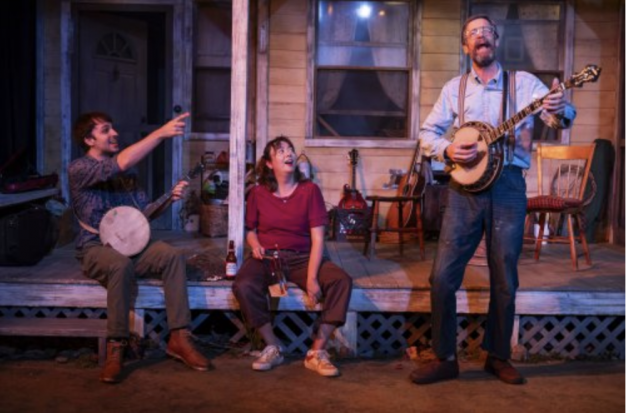
Morgan Morse, Tora Nogami Alexander, and David M. Lutken (Photo: Ben Hider)
The Porch on Windy Hill deals in secrets, of course. Beckett is ignorant of Mira’s family history; Edgar knows nothing about Mira’s life; Mira’s big reveal of the racism, anger, and hurt that made the rift in her family comes as a surprise to everyone. It will, however, be no surprise that the play ends with a resolution at least partly flavored by Beckett’s fervent, passionate belief in the evolutionary influence of immigration on American folk music.
That belief comes with a big dose of compassion, bridge-building, forgiveness, and reconciliation. In our popular culture, which seems to seek endless wounding, there’s a lot to be said for weaving together frayed relationships with music, hope, and a hug.
At Urban Stages
259 W. 30th St
Running time: 2 hours 10 minutes, one intermission
Through February 22