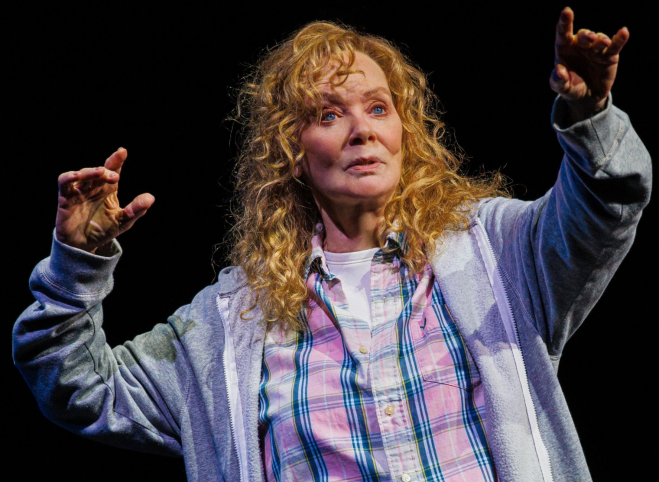


Kristin Chenoweth (Photo: Julieta Cervantes)
The Queen of Versailles
By Marc Miller
You may have your quibbles about The Queen of Versailles—I know I do—but there’s no denying, in terms of professionalism, this show is off the charts. The new musical at the St. James boasts a big cast, a huge production, a Stephen Schwartz score, and a narrative that veers off in a couple of directions that don’t always pay off but never bore. Plus, it has Kristin Chenoweth.
She’s Jackie, the wife of billionaire David Siegel (F. Murray Abraham, for crying out loud) and the subject of a 2012 documentary that provides the basis for Lindsey Ferrentino’s book. It is, the script’s preface says, “the story of one family that reflects an entire country—a modern fable about the American Dream and what it has become in contemporary America.” That’s a good way to put it. Capitalism, the striving for more, more, more, and the moral compromises inherent in acquiring it ring out loud and clear, sometimes too much so. The theme might be boiled down to one of Schwartz’s many pithy couplets: “We live in a nation/ That requires ostentation.”
That’s certainly the guiding philosophy for Jackie, born to loving, lower-middle-class parents who are satisfied with the simple life (welcome veterans Stephen DeRosa and Isabel Keating), but still raise their daughter on generous helpings of Lifestyles of the Rich and Famous. She’s materialistic from the get-go—Chenoweth has to play a 17-year-old here, and she pulls it off—but her ambition of becoming an IBM engineer gets sidelined when she meets and marries Ron (Michael McCorry Rose), a Wells Fargo VP who relocates them to the Everglades and starts slapping her around. She and her infant daughter retreat to a one-room hovel, where her connections as a former Mrs. Florida send her to an upper-crust party, where she meets David.
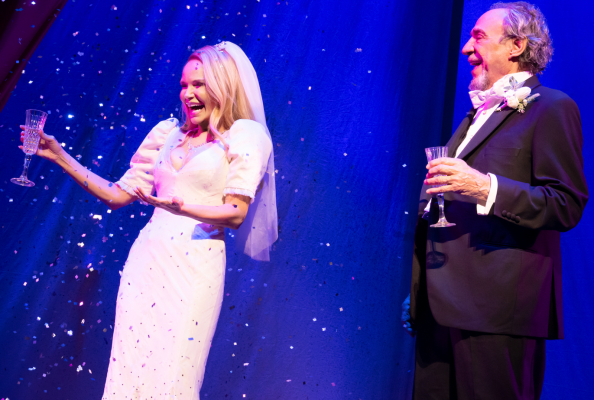
Kristin Chenoweth, F. Murray Abraham (Photo: Julieta Cervantes)
F. Murray Abraham is 86. As David, he has to sing (he’s perfectly fine at it), dance, bluster, run around the stage, and at one point ride a lion. The founder of a timeshare empire, David shares Jackie’s values—“if you don’t want to feel rich,” he says, “you’re probably dead”—and swiftly woos and weds her. (Jackie, uttering one of Ferrentino’s best lines: “Only in America can you become a wife, a billionaire, and a Jew in one day!”) Eager to give her everything she wants, he honeymoons in France, tours Versailles with her, and is all too pleased to realize her dream of building a duplicate Versailles in Orlando. More pithy lyrics, from Jackie: “The house we’re in now, although it’s sweet/ It’s only, like, 26,000 square feet.”
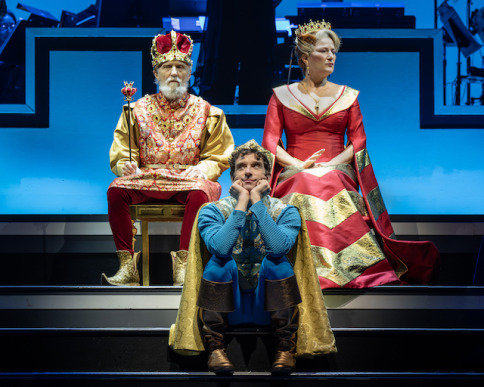
The Queen of Versailles actually features two Versailles: the one the Siegels are building, and the original, wherein Louis IV (Pablo David Laucerica) and his courtiers offer witty counter-commentary to the goings-on in Orlando. Both are elaborately rendered by scenic and video designer Diane Laffrey, and when the Florida version is completed, it’s gobsmacking—how did they change that enormous set behind a drop curtain in a matter of minutes? Similarly luxurious are Christian Cowan’s costumes, with Jackie guaranteed to show up in another gown, bejeweled miniskirt, or other period fashion in the next scene, or sometimes the same scene.

Kristin Chenoweth and the Ensemble (Photo: Julieta Cervantes)
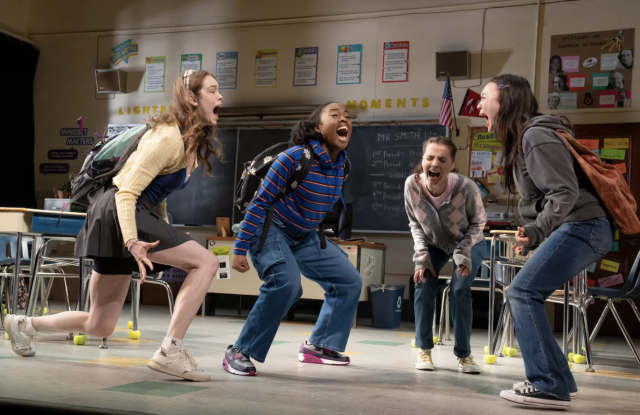
The story gets a little crowded here. David and Jackie have seven kids, six of whom, curiously, we never meet. Cast limitations, perhaps, but they’re barely mentioned—except for her oldest, Victoria (Nina White), a rebellious youth who rebels mainly against her parents’ crass materialism. She’s joined by Jonquil (Tatum Grace Hopkins), Jackie’s niece, who comes to live with them and grows close to Victoria after a contentious start. Neither has much use for a Versailles, and when the first act curtain drops on the 2008 financial meltdown and David’s possible ruin, they regard it as a positive development.
And the tone gets a little confused here. David, surly and borderline abusive in the throes of economic crisis, is blessed with a bailout and turns back into a doting spouse—logical, yes, but incredibly abrupt. Tragedy visits the Siegels, but David barely seems to notice, Jackie gets over it quicker than you’d expect, and Ferrentino’s dialogue here remains awkwardly jokey.
Stephen Schwartz has been writing music and lyrics for over a half-century. This score may not approach Wicked or Pippin popularity, but it’s a very assured piece: ballads, comedy numbers revealing the Siegels’ vulgarity and vanity, Mozart-esque rondelays for the Louis IV crowd, and a Gilbert & Sullivan patter moment for a desperate Jackie, selling off Versailles riches to pare down the debt. And character numbers for Victoria, Jonquil, and Jackie’s parents that offer glimpses into their souls we otherwise wouldn’t be privy to. Schwartz plays by old-timey rules: defining character, forwarding the action, rhyming (almost) perfectly, and always providing the proper melody for the context. A couple of unwieldy transitions aside (a confusing Elvis moment, a reprise or two we don’t need), it’s excellent work, and this is a cast album I’ll want.
Michael Arden, coming off Maybe Happy Ending, has a whole lot more to direct this time. He combines the sumptuous Versailles spectacle with the intimate dynamics of a family that has everything, yet money in this case sure isn’t buying happiness. The choreography, by Lauren Yalango-Grant and Christopher Cree Grant, doesn’t rise much above the functional, but Natasha Katz’s lighting does. Laffrey’s scenic design is truly spectacular, and her projections, news clips and live cameras on Chenoweth and Abraham actually help tell the story.
Helpful work, too, from Melody Butiu and David Aron Damane as the Siegels’ beleaguered principal staff, and White impresses in a strong solo about how “pretty always wins.” Chenoweth, still pretty 28 years after Steel Pier, is confident, funny, and touching, and her quiet finale—perhaps questioning, after all this time, the skewed American values that permeated Jackie’s existence—felt odd in the moment, but in retrospect seems appropriate, even inevitable. What kind of a country are we, how did we get here, and what do we do about it? Ragtime deals with that, and so does The Queen of Versailles, if not nearly as brilliantly. But very entertainingly.
The Queen of Versailles
At the St. James Theatre
246 W. 44th St.
Running time: 2 hours 40 minutes, with one intermission
Tickets: queenofversaillesmusical.com
Open-ended run