


Emma Ramos, McKinley Belcher III, Sarin Monae West (Photo: Hollis King)
The Tragedy of Coriolanus
By Carol Rocamora
The scene is Rome; the time is the fourth century BC. But its themes of war, power, and leadership resonate painfully and urgently today.
Shakespeare’s The Tragedy of Coriolanus (1605), in a compelling revival at the Theatre for a New Audience, tells the story of a fiery, fanatical warrior named Caius Martius (played by McKinley Belcher III) who leads the Roman army against the attacking Volscians led by Aufidius (Mickey Sumner). Having won the battle, Caius is proclaimed a hero and named Coriolanus, in honor of Corioli, where the conflict took place. Subsequently, he is urged to serve as a consul in the Roman government, with the support of other Roman leaders including Menenius (Jason O’Connell) and Cominius (Barzin Akhavan).
But Coriolanus is reluctant to accept; he’s a warrior, not a politician, who “has not loved the common people,” as one citizen put it. When the city’s leaders and his family urge him to appeal to the people for support, he outright refuses to address them. Outraged by his arrogance, disdain, and unapologetic attitude of superiority, the people turn against Coriolanus and banish him from the city, along with the other tribunes whom he might have joined in the Roman government.
As if that were not shocking enough, Coriolanus accepts their rejection instantly. “There is a world elsewhere,” he declares defiantly, leaving his devastated mother Volumnia (Roslyn Ruff), wife Virgilia (Meredith Garretson) and son Young Martius (Merlin McKormick) behind. He then makes a dismaying choice; he approaches his enemy Aufidius (who wounded him multiple time in the recent battle) and offers his services to fight with the Volscians against his own Roman home. In other words, Coriolanus changes sides.
You undoubtedly know the rest. Arriving with the Volscians at the gates of Rome, his family (wife, mother, son) kneel before him, and beg him not to destroy his city and his family along with it. He ultimately backs down, uttering that unforgettable line: “O mother, mother, what have you done?” Evidently, Coriolanus foresees what is to come; Aufidius ultimately murders him for betraying his promise to aid the Volscians.
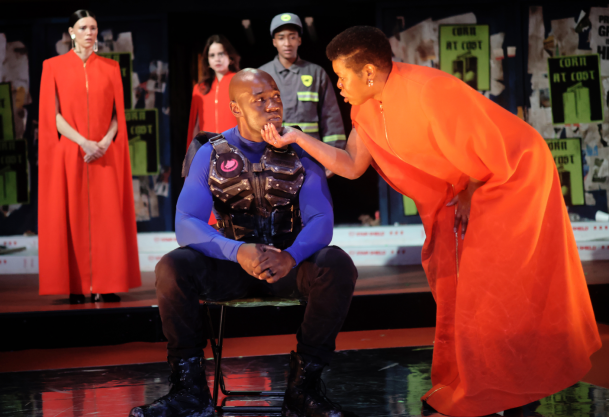
Meredith Garretson, Emma Ramos, McKinley Belcher III, Merlin McCormick, Roslyn Ruff (Photo: Hollis King)
I’ve recounted the plot here, since it’s one of the most stunning in the whole Shakespearean canon. The notion of a leader in wartime who would actually switch sides is overwhelming, given what we have witnessed in past and recent history. In my view, Coriolanus stands at the top of the list of Shakespeare’s flawed, tragic heroes in terms of making a misguided, self-destructive, fatal choice.
The strength of the current production lies in the atmosphere it creates of fear and emergency. Director Ash K. Tata and his set designer Afsoon Pajoufar have reconfigured the entire theatre. On three sides of the playing area, the audience surrounds the front of a government palace, regal in classic design but plastered with crude hand-painted posters suggesting a contemporary era. Overhead, an enormous cube hangs from the ceiling, where scenes of the action on stage are simultaneously projected but blurred, as if from a surveillance camera. (The projection designers are Lisa Renkel and Possible.) Actors in the fourteen-member ensemble who represent “the people” (costumed in modern street clothes by Avery Reed) enter and exit through the audience, shouting their protests. These elements, combined with Brandon Keith Bulls’s sound design and J. David Brimmer’s fight choreography, create an atmosphere of terror and violence, reminiscent of what’s going on today in parts of the world.
So strong and dominant are the visual design elements and technology that they tend to overpower the acting ensemble itself, at least as I experienced it. Nevertheless, as Coriolanus, Belcher delivers a charismatic performance that matches the overwhelming strength of the production. An actor of great stature, he towers over the rest of the cast with his commanding presence. His prideful disdain toward his fellow Romans and his reckless rage border on the irrational, making his ultimate downfall even more traumatic.
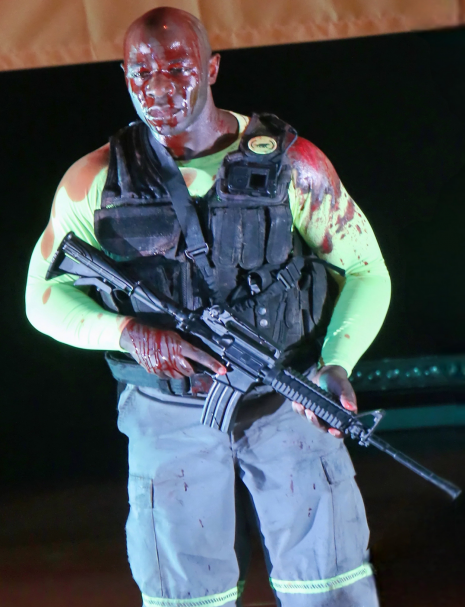
McKinley Belcher III (Photo: Hollis King)
I left the theatre, stunned by the power of the story, haunted by a particular, unusual design feature. During intermission, on that huge square cube that looms over the stage, there were literally hundreds of messages posted, as if from a site on the dark web. They represent the voice of “the people,” reacting in horror to Coriolanus’s betrayal of his Roman home and family.
“This Coriolanus has grown from man to dragon,” says Menenius in Act IV. Such is the tragedy of war, as Shakespeare warns us of what may become of leaders in times of conflict who may not be listening, either to their people or to history.
At the Theatre for a New Audience
Polonsky Shakespeare Center
262 Ashland Pl., Brooklyn
Running time: 2 hours 45 minutes, one intermission
Through March 1 2026