The Unbelievers
How do you dramatize loss, and the grief that follows? We will all experience it in our lifetime, but it’s a huge challenge to put on the stage.
Playwright Nick Payne dares to tackle this daunting topic in The Unbelievers, his new play now performing at Manhattan Theatre Club’s City Center Stage 1, under the direction of Knud Adams. In doing so, he chooses to go down a dramatic path where other playwrights might fear to tread.
The Unbelievers tells the story of a terrible loss. A fifteen-year-old boy named Oscar Wright went missing one day after school. Now seven years later, after thorough and continuous investigation, he is still not found. On the seventh anniversary of his disappearance, the family can apply for a certificate of presumed death. Will they, and will it end their extraordinary suffering?
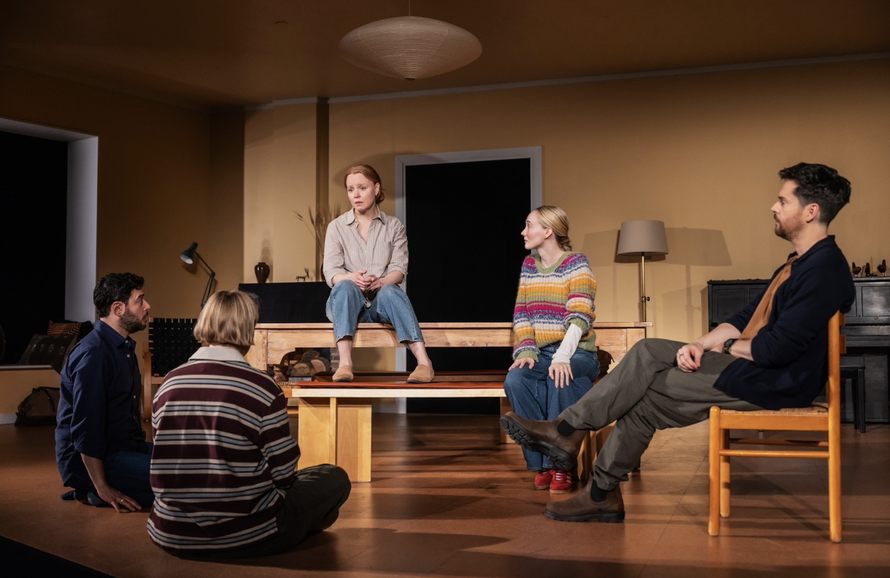
This tragic story is deeply moving, focusing on Oscar’s mother Miriam (Lauren Ambrose), a schoolteacher, and her fierce refusal to give up hope of his return even after seven years. However, the dramatic structure of the play makes it overly complex. Mr. Payne has overpopulated the play with a large family, consisting of Miriam’s first husband Karl Khoury, (Hadi Tabbal) and their daughter, Nancy Khoury, (Nina Ross), Miriam’s second husband David Wright (Tom Riley) and their daughter Margaret Wright (Elizabeth Yeoman). It takes a while into this 110-minute drama to sort out who’s who.
Moreover, the dynamic between them is complicated. First-husband Karl is a minister, and tries (without success) to provide spiritual guidance to his ex-wife Miriam, the unhinged mother. As for second-husband David, he and Miriam had separated a month before Oscar’s disappearance, and their interactions are explosive. Nancy (Karl and Miriam’s daughter) is haunted by Oscar’s disappearance, to the extent that she has visions of him in her room at night. Margaret (David and Miriam’s daughter) is enraged at her mother for neglecting her, due to her single-minded focus on her missing son. Margaret has sought refuge with her boyfriend Benjamin (Jack DiFalco), and is now pregnant. (There are numerous other characters, too, including police investigators, social workers, David’s’ new girlfriend, and a psychic. Some of these roles are double-cast, to add to the confusion).

The second complexity of the play’s dramatic structure is its sequence of scenes. The action takes place in three separate time frames over a seven-year period: the week following Oscar’s disappearance, one year later, and seven years later. The problem is that Mr. Payne leaves specific instructions in his script that there be “no blackouts, no scene changes, and no transitions” between scenes, so the action jumps without warning from one time frame to another, leaving us confused about when each scene occurring. (Note: We don’t even know where it takes place, presumably in the UK, since Mr. Payne is British and the play premiered there in 2025. The action of each of the play’s fourteen scenes occurs in Miriam’s living/dining room, sparsely designed by Paul Steinberg.)
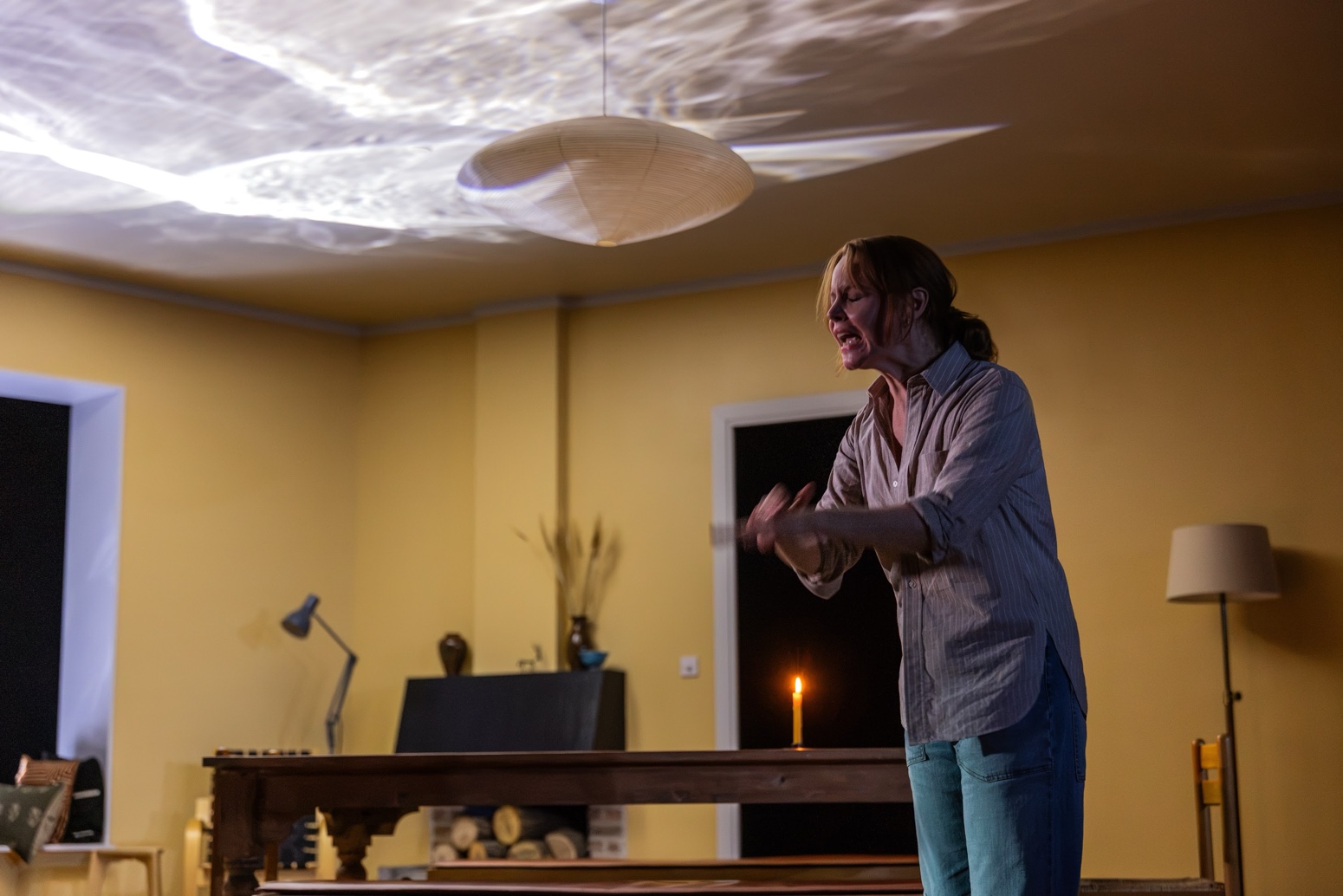
The cumulative effect of this overpopulated play with its fragmented scenes and constant conflict is one of turmoil and confusion. To be fair, that may be the playwright’s intention, since it reflects Miriam’s state, both physically and psychologically. Laura Ambrose’s powerful, agonized performance gives the play its much-needed focus, though her journey is painful to watch. She’s irrational, argumentative, and prone to violence. She alienates everyone in her family, as well as those outsiders trying to help. Her violent outbursts are particularly upsetting; we learn that she has broken the window of her own car (because she can’t find her keys) and screams at other people in the supermarket. When her ex-husband’s new girlfriend Lorraine (Marjan Neshat) tries to embrace her, Miriam attacks her physically.
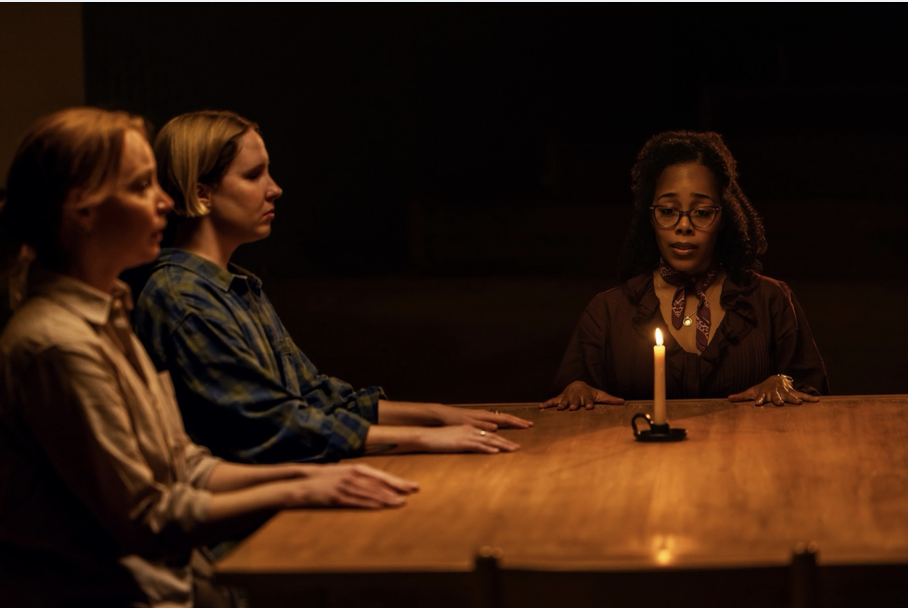
There are several moments when the play attempts to offer spiritual healing. A psychic tries to conjure up Oscar in a seance with Miriam and Nancy. In another scene, Nancy, a musician, offers songs she has composed on the piano and guitar. Toward the end of the play, Miriam asks Karl to pray with her. But neither music nor prayer provide the spiritual lift that the characters are seeking; hence, the ambiguity of the meaning of the play’s title. Could it refer to Miriam and to some extent Nancy, who still can’t believe that Oscar is dead? Or could it be found in the final scene, when the family members beg Miriam to accept the loss of Oscar after seven years. Can Miriam believe in their unanimous expression of love and its power to heal?
The Unbelievers teaches us compassion for the trauma that Miriam and her family members have endured over an unimaginable loss. The ordeal of police inquiry, the depression, the violent outbursts of rage, the damaged relationships, the mysterious phone calls, the disturbing visions, the false sightings: these are among the suffering they have endured, and we witness them with empathy and humility.
There will be no solution to the mystery of Oscar’s disappearance. Nor will there be an end to the family’s suffering. But there may be a lessening of it. Mr. Payne offers a glimmer of hope in the play’s last scene when Margaret and Benjamin announce the name of the baby they are expecting. In the end, there is life, new life…
The Unbelievers
At Manhattan Theater Club City Center, Stage 1
131 W. 55th St.
Running time: 1 hour 50 minutes, no intermission
Through November 29, 2026