Titus Andronicus
The ultra-violent Titus Andronicus is now enjoying (if you can use that word) a splendid revival at Signature Theatre, in the skillful hands of the Red Bull Theatre Company. And oh, is it sensational!
Prepare yourself for the horrific story. Titus Andronicus (Patrick Page) is a Roman general who has returned after a ten-year war between the Romans and the Goths, during which he lost several of his many sons. He brings with him as his prisoner Tamora, Queen of the Goths, (Francesca Faridany) whose son he murders onstage right before her eyes. Devastated, Tamora and her surviving sons vow revenge on Titus and his family. Meanwhile, Titus declines to be appointed Emperor of Rome, instead supporting Saturninus, (Matthew Amendt), the brother of Bassianus (Howard W. Overshown), to whom Titus’s lovely daughter Lavinia (Olivia Reis) is betrothed.
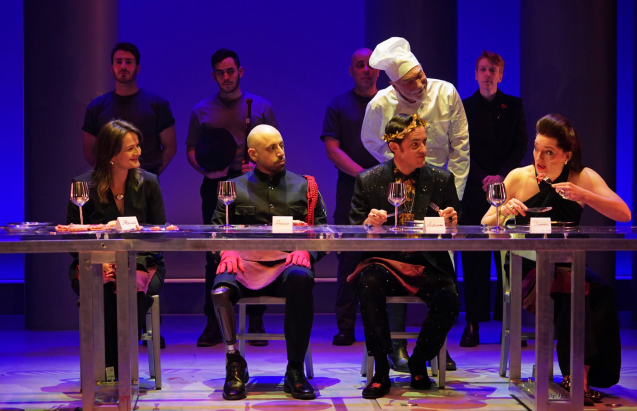
So begins a relentlessly violent double-revenge plot, too complicated to recount in detail here. Briefly (I’ll try), it includes multiple gory onstage murders; a rape and mutilation of Lavinia by Tamora’s sons, organized by the vengeful Tamora through her lover, Aaron the Moor (McKinley Belcher III); the behanding of Titus; and the pièce de résistance: a banquet, prepared by Titus and served to the Emperor (Matthew Amendt), featuring a pie containing the remains of latter’s butchered sons. By the end of the play, just about everyone gets murdered (except for a newborn baby, but I’ve run out of space to recount that plot tangent).
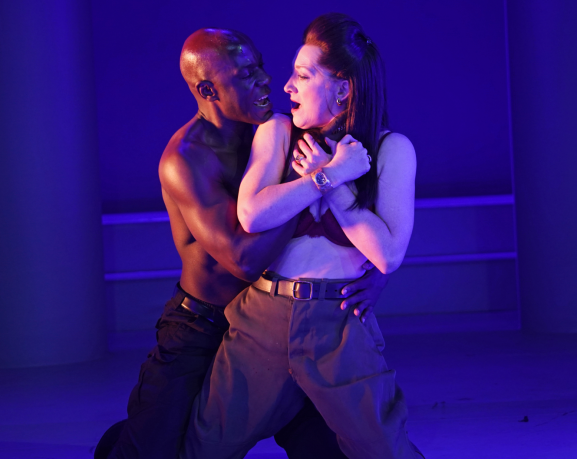
Red Bull delivers this lurid, violent, over-the-top tragedy with unapologetic glee. Patrick Page is a larger-than-life Titus Andronicus, his powerful, deep voice commanding our awe and admiration. He also shocks us with some devilishly humorous moments, when, for example, he consoles his devastated daughter Lavinia who cannot speak (her tongue had been cut out) by managing to elicit her laughter in a playful, tender interchange. In the end, Titus himself dies laughing, making a mockery of the foibles of man and the futility of revenge. Matthew Amendt plays Saturninus, the new Emperor, with wicked flamboyance and flourish. McKinley Belcher III is a villainous Aaron, and Francesca Faridany’s Tamora is appropriately vengeful. Enid Graham plays the loyal Marcia, Titus’s sister (the character was Marcus in the original).
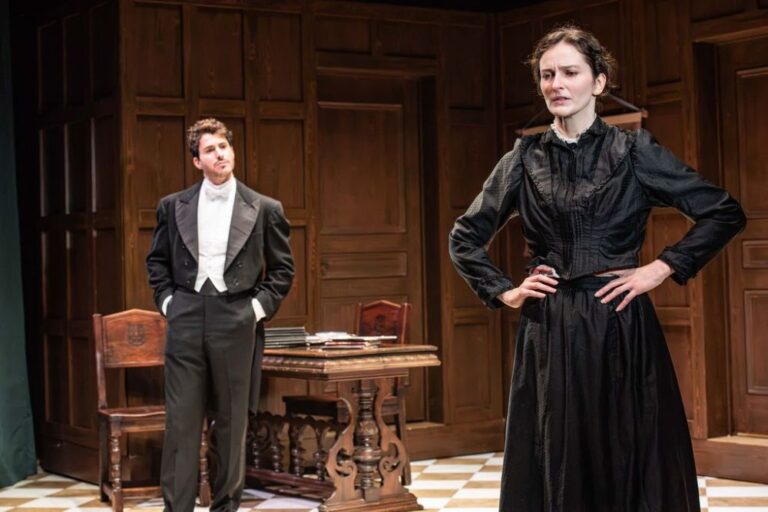
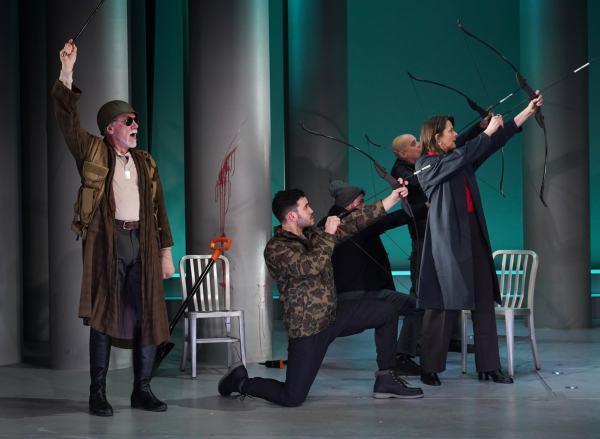
Jesse Berger directs his superb ensemble with supreme skill and breathtaking urgency on Beowulf Boritt’s stately set. The attack on Lavinia by two of Tamora’s blood-lusting sons (played by Jesse Aaronson and Adam Langdon) is sensationally choreographed by Rick Sordelet. Emily Rebholz’s period costumes are appropriately trimmed in violent blood-red, reflecting the play’s theme. In short, the Red Bull artistic team embraces the play’s demanding theatricality, and the results are electrifying.
Back to this unique, early, overly violent play that is credited in part to our beloved Bard. Did you know that the bloodiest, goriest play by William Shakespeare may not have been written by William Shakespeare? Well, at least not by him alone….
Scholars have been researching the authorship of “The Lamentable Tragedy of Titus Andronicus (1588-1593) for centuries. Currently, there is consensus, based on the play’s stylistic elements, that an author named George Peele (1556-1596), a contemporary of Shakespeare (1564-1616) wrote the first act and the beginning of the second act, while Shakespeare wrote the rest of the play (or most of it).
That may come as a relief to those Shakespeare lovers among us, who are shocked by the overwhelming number of graphic murders and mutilations in this work. “You can’t make this stuff up,” to use a contemporary expression, since this play apparently does not have historical groundings. But someone did. So let’s blame it on George Peele (mostly), shall we? And leave our beloved Will off the hook (at least for now), since this is one of his earliest works and he may have been influenced by the popular revenge plays of the day.
What is its intrinsic value? In it we can see prototypes of his later characters, like Othello the Moor (not as wicked as Aaron, but equally passionate); or the villainous Iago (Aaron, again); or Richard III, who inherits Titus’s ruthlessness. And of course there is Hamlet, the ultimate revenge play to come in the Shakespearean canon.
Meanwhile, thanks go to Red Bull for staging this rarely presented classic so artfully, and (dare I say) making it entertaining by provoking laughter at its horrific excesses. Further thanks for reviving it at a time where comparisons are being made about the last stages of the Roman empire and our own troubled civilization. “Rome is but a wilderness of tigers,” a character says. That line lands too close to home.
Titus Andronicus
At the Pershing Square Signature Center
480 W. 42nd St.
Running time: 2 hours
Through May 3, 2026