Hungry Women
Could you ever imagine a world without men, in which males have mysteriously died en masse and become extinct, the patriarchy is gone, and women are in charge? Playwright Melissa Maney does, in her feminist sci-fi absurdist dark comedy Hungry Women. The play is now in its world premiere engagement at SoHo Playhouse, following its top honors last year in the venue’s competitive works-in-development Lighthouse Series.
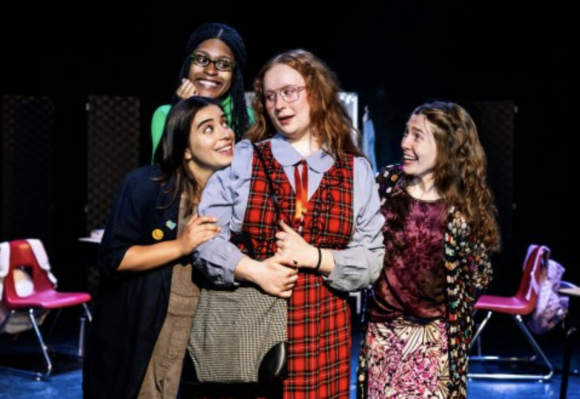
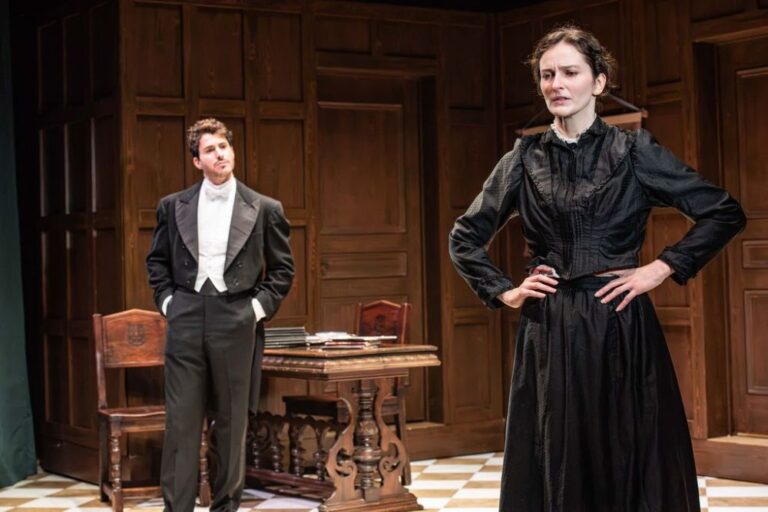
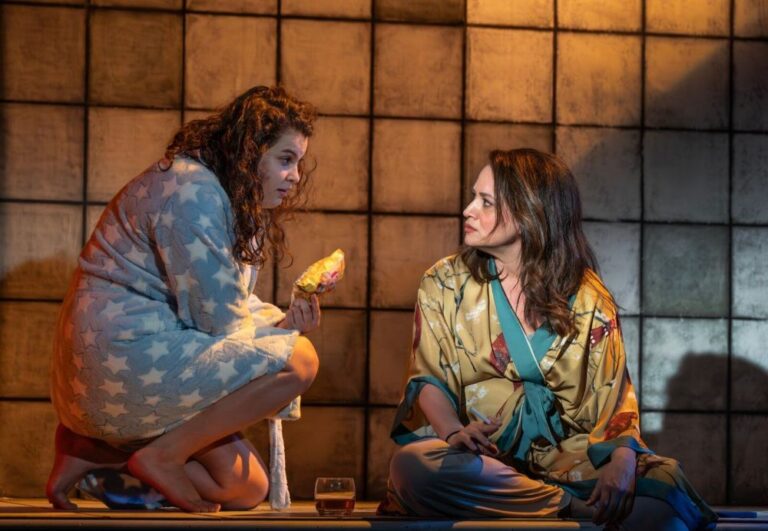
Produced by Black Watch Theatre, the original work, under the dynamic direction of Daniella Caggiano, examines an imagined “herstory” spanning 200 years. Presented in three parts – “Hungry Women,” “Curious Women,” and “Scared Women” – the segments, set respectively in 1891, 1991, and 2091, follow the evolution (and devolution) of a worldwide mono-gendered society. To keep the narrative moving, the active cast, backed by a loud high-energy soundscape (sound by Chris Verde), changes the period-defining set (by Qingan Zhang) and costumes (by Olivia Vaughan Hern) on stage. In full view of the audience, they shift from the Victorian to the Post-Modern era, and into the utopian (or is it dystopian?) future.
A cast of four embodies the women of the different centuries, each with a distinctive personality and point of view. Each character they play in the consecutive scenes has a name starting with the same letter. The outstanding Julia Lester stars as the more traditional but eventually persuaded Ruth, Rebecca, and Regina, while the bold and trailblazing V-track of Vic, Valerie, and Violet is perfectly performed by Sophie Zmorrod. An engaging Mariyea appears as the smart and funny Eden, Elizabeth, and Eleanor, whose speech is punctuated with sharp-witted wordplay, and Zoe Dean portrays the younger, inexperienced, and more curious Mary, Melanie, and Miranda.
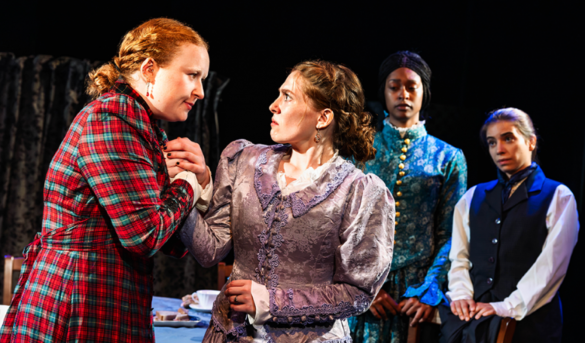
In the opening scene, Ruth, Mary, and Eden, clad in tight Victorian corsets, slurp their tea as they await the arrival of Victoria, who is preparing sandwiches; dressed in her deceased husband’s suit, she prefers to be called Vic. Their conversation revolves around the mounds of dead men outside, what happened to them, and what they can do about taking charge of their own lives and society and appeasing their hunger, since the male extinction has resulted in a food shortage; what they do is deliciously shocking and hilarious. Punctuating the discussion are their direct-address monologues in the spotlight (lighting by Anne Garret-Larsen, which was often out of synch with the actors’ movements at the performance I attended), recounting their backgrounds and situations, sexuality and hopes as women raised under a repressive patriarchy.
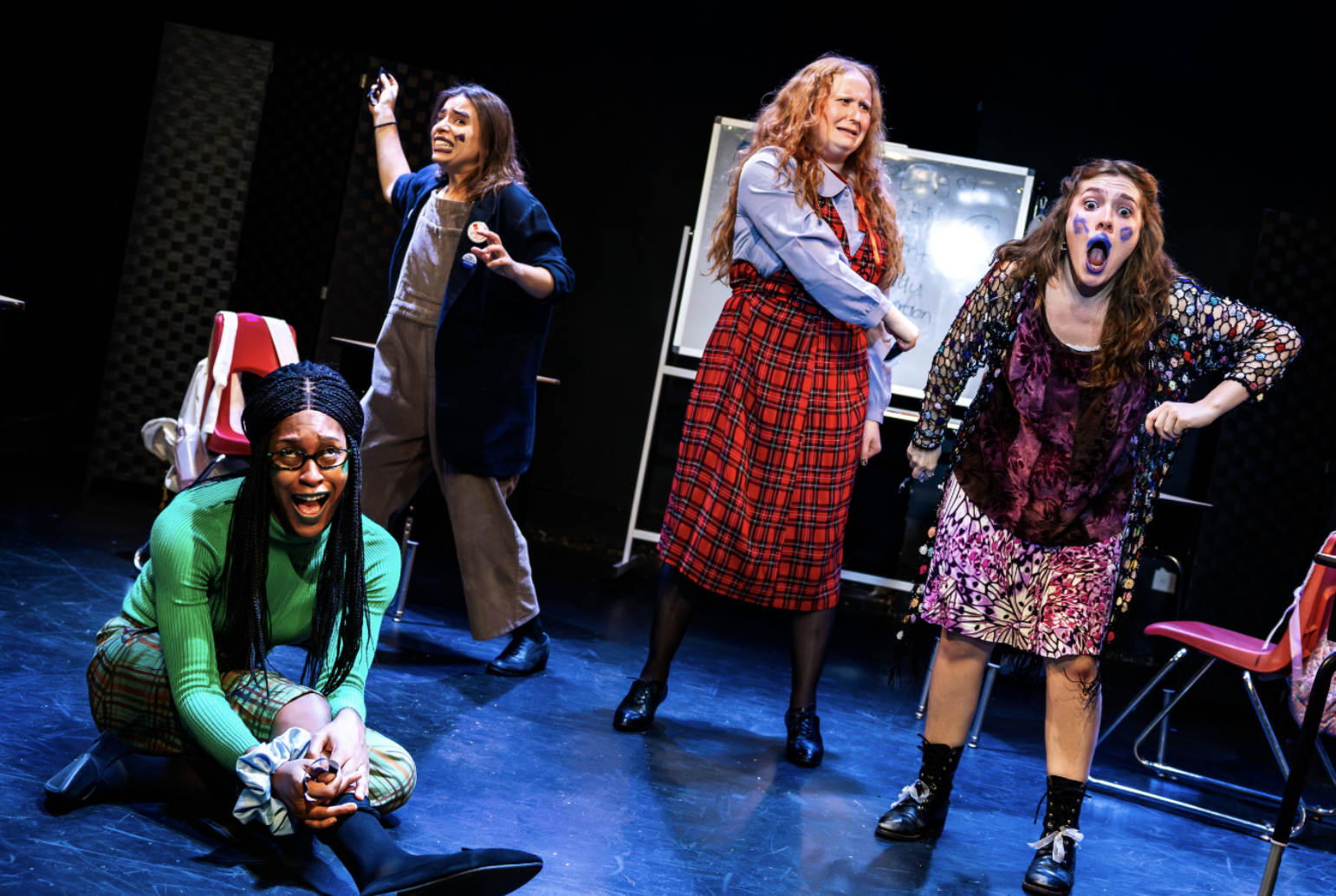
The second part shifts to a late 20th-century classroom, in which three students, Valerie, Elizabeth, and Melanie, who already know everything about Herstory, question their substitute teacher Rebecca about what occurred in the male-dominated times before 1891. She is hesitant to deviate from the standard curriculum, since all the previous information was burned and eradicated. But she decides to find the answers, for both the students and herself, by attempting to reach the long-gone men through a séance. They succeed in conjuring four male spirits (heard via voiceovers by the all-female cast), who recount their own commendable historic contributions. They then affirm their inherent sense of superiority, power, and control over women, and their belief that women are largely incapable and exist mainly to give birth and to care for their husbands and children. It’s a surreal, otherworldly encounter that turns physical, leaving the women screaming and banishing the threatening ghosts from the room.
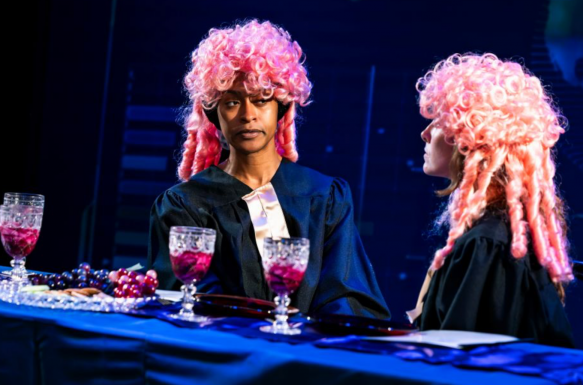
Part Three takes us into the female-centric future of a World Council meeting, where the leaders, dressed in the pink wigs and black robes of the Founding Mothers, decry the political protests of the Men’s Movement (by rebellious women determined to honor history) taking place outside. Assisted by The Global Surveillance System, with changing data seen on a full-scale upstage projection screen (designed by Zhang), those in charge can monitor the behavior and movements of everyone for compliance and conformity. It uncovers major violations on the part of Violet, Miranda, and Eleanor, culminating a life-changing decision by the highest-ranking Governor Regina. What will she do?
Along with the unabashed feminist theme are traditional stereotypes of women screaming, disagreeing, longing for something different, but resorting to the same systems, categories, and unilateral decisions to manage society (e.g., drafting women to become lifelong Housewives and Mothers, as opposed to being Working Women, or letting them choose, without the option of changing their decision). While the central premise of the show is to consider the rise of self-determination and the reshaping of empowerment of the long-repressed female sex, in the end, Hungry Women leaves us with the thought that it’s not just men, but people in general, who crave power and take control, lack political compassion and subjugate others. We can only hope that everyone of every sexual identity learns from the play, heeds the message, and works hard to right the rulers’ socio-historic wrongs that persist in the present.
Hungry Women
At SoHo Playhouse
15 Vandam St.
Running time: 90 minutes, no intermission
Through August 30, 2026