The Last Hamlet
What if Hamlet’s final performance really were his last? In The Last Hamlet, conceived and directed by multidisciplinary British artist Ben Duke, Duke and his company Lost Dog imaginatively turn Shakespeare’s most frequently performed tragedy inside out, creating a theatrically exhilarating fusion of drama and dance in which the Prince of Denmark fights for the right to tell his story one more time.
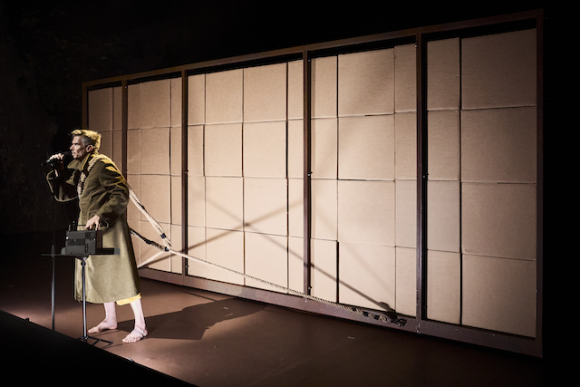
Before the lights come up in the alfresco performing space at the Cloître des Célestins at the Festival d’Avignon, an old transistor radio sits in a spotlight on an almost bare stage. Ben Duke, an actor playing himself, soon materializes, incongruously wearing a trenchcoat and no shoes. He attempts to reach the radio but is thwarted by a thick rope tethering him to a wall of cardboard boxes.
When the play proper begins, static crackles from the radio before a voice emerges: British director Katie Mitchell, speaking in an interview, announces that she and playwright Alice Birch are working on a show that will finally allow Ophelia to have her say. A victim of a depressive, profoundly misogynistic Hamlet who has become a role model for men over the centuries, the verdict is inescapable: Hamlet will be deleted from the annals of theater and literature. Effective immediately, the Royal Shakespeare Company and British theaters will no longer keep the play in their repertoires.
The announcement is a crushing blow to Duke, who hoped to perform the iconic role. With his heart’s desire dashed, he drags the wall of cardboard boxes behind him, attempting to silence the angry female voices on the radio. But when that proves futile, another possibility occurs to him: He will perform Hamlet—quite literally—one last time and impress the audience sufficiently to persuade them to grant the Prince of Denmark a pardon. His petition is accepted, although budget cuts will inevitably hamstring the staging.
Duke wastes no time, immediately diving into the famous “To be or not to be” soliloquy. He justifies his artistic choice by pointing out that when he recently watched The Bodyguard, he knew audiences expected to hear “I Will Always Love You” from the outset. So, he surmises, it is better to change things up. After tackling Romeo and Juliet and Medea, Duke trusts his instincts for subverting classic texts.
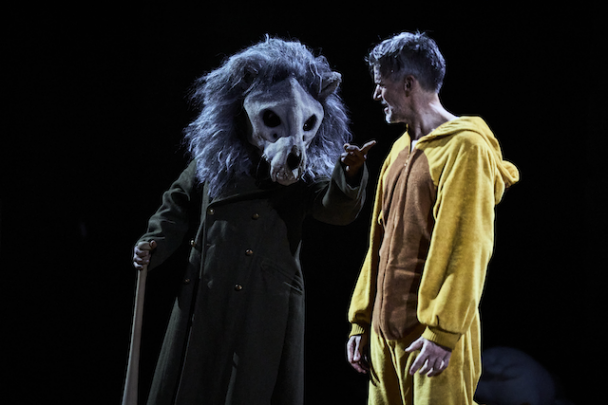
Comically expanding upon the notion that he is working on a shoestring budget, Duke uses stuffed animals—emerging from the wall of cardboard boxes—to portray the supporting characters: his best friend Horatio as a small green dragon; the statesman Polonius as a big brown bear; his mother Gertrude as a prepossessing goose; and his uncle Claudius as a snake. His father, however, is an outlier, with Duke pulling a brown urn from a cardboard box. If the play’s tone has been whimsical until this point, the urn suddenly makes death more tangible. Later, however, the Ghost (Miguel Altunaga) will resemble The Lion King’s Mufasa, while Duke dons a “onesie” Simba costume, driving home the notion that Hamlet is a wounded child.
The dance routines are the new material Hamlet brings to the stage to physically charm and persuade the audience into granting his story a reprieve from cancellation. As Duke dances alongside his excellent compatriots, Hannah Shepherd and Miguel Altunaga, Hamlet’s psychological paralysis is transformed into dynamic movement.
Duke masterfully balances his personas as actor, dancer, and stand-up comedian. His formal acting and dance training ground him as a performer, while his degree in English literature provides refreshing insights into classic texts. “Hamlet is the Mona Lisa of literature,” he tells the audience, citing T. S. Eliot.
Audience participation might be the bane of theatergoing for some, but Duke has no problem recruiting audience members to say a few lines or join him on stage. In this metatheatrical work, his charisma seems to win over the audience early on, perhaps because he makes Shakespeare’s monumental work accessible to everybody.

Duke’s final rendering of Hamlet hardly portrays the legendary character as a saint. He reminds us that Hamlet has the bloody distinction of precipitating more than twelve million deaths accumulated across four hundred years of performances. Though the protagonist is sharp as a tack when it comes to discovering his mother’s affair with Claudius, he missed his father’s funeral because he was on a retreat in Sudan as part of his ongoing humanitarian work. Hamlet seems better able to love people when they have been identified as needy by the global community than his girlfriend Ophelia, who must deal with an unwanted pregnancy in this retooled Hamlet. Their relationship is largely reduced to unrequited voice-mail messages. “I would love to see you,” he forlornly says in one. “I need to hear your voice.”
Presented in English with French surtitles, The Last Hamlet is a fitting offering for the 80th Festival d’Avignon, whose eight decades have been devoted to keeping theater alive through continual reinvention. In this exuberant production, Duke makes a persuasive case that even a 400-year-old play can still surprise us—perhaps proving that Hamlet deserves one more reprieve.
The Last Hamlet
At the Festival d’Avignon, Avignon, France
July 4 through 25.
Review based on July 20 performance at 22:00
For more information on Festival d’Avignon, visit www.festival-avignon.com
Running Time: 1 hour, 50 minutes, no intermission