The Winter’s Tale
More than four centuries after its first performance in 1611, The Winter’s Tale has lost none of its vigor or charm. Daniel Sullivan’s staging of Shakespeare’s tragicomedy makes the second offering of this season’s Free Shakespeare in the Park at the renovated Delacorte Theater a delight. With a star-studded cast led by Lily Rabe and Raúl Esparza, this Winter’s Tale pointedly—and profoundly—asks: Can a person recover from their worst mistakes?
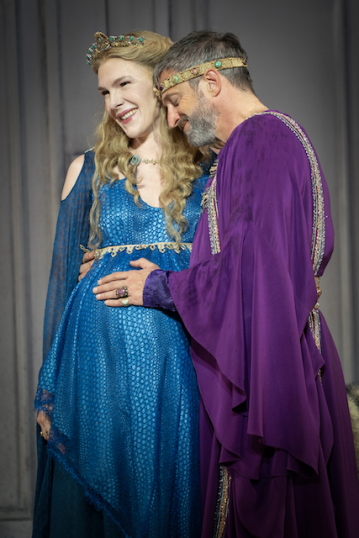
The plot: King Leontes of Sicilia falsely accuses his pregnant wife, Hermione, of having an affair with his childhood friend, King Polixenes of Bohemia, who has been their house guest. Despite the assurances of friends and the Delphic oracle, Leontes descends into a jealous rage, imprisoning Hermione, who gives birth to a daughter. He orders the infant burned, then, in a travesty of mercy, commands that she instead be abandoned in the wilderness. His young son Mamillius, separated from his mother, falls ill and dies. Hermione, on hearing the news, collapses and is presumed dead. Having destroyed his family, a remorseful Leontes spends 16 years visiting their grave. Meanwhile, his abandoned daughter, Perdita, grows up in Bohemia, unaware of her royal identity and falls in love with Florizel, Polixenes’ son. Their romance eventually brings Perdita back to Sicilia, setting the stage for Shakespeare’s astonishing theatrical miracle: in Act 5, a statue of Hermione comes miraculously to life, reuniting her with Leontes and the daughter he thought he had lost.
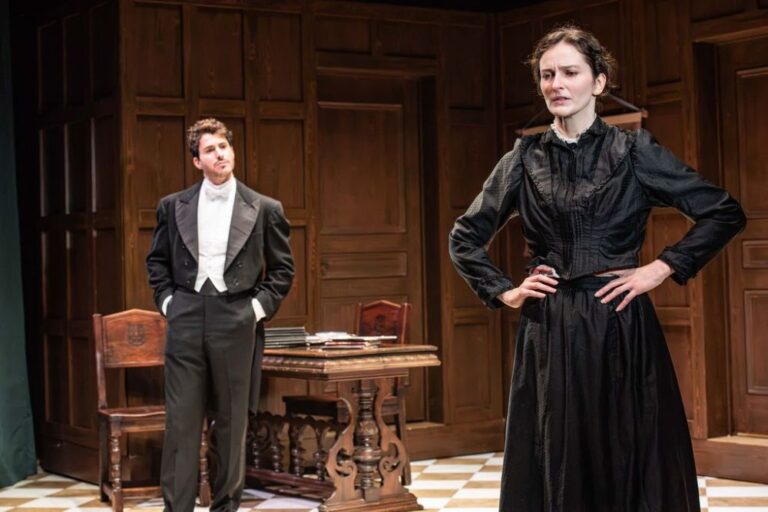
Tony Award winner Daniel Sullivan is no stranger to the Delacorte. The Winter’s Tale marks his 12th production there, and he once again demonstrates his ability to bring clarity to Shakespeare’s psychologically complex stories. Rather than radically reinterpreting the play, Sullivan allows Shakespeare’s text and characters to take center stage, setting the action in its historical period and dressing the cast in Linda Cho’s period costumes.
Sullivan wisely jettisons the opening conversation between Camillo and Archidamus, which establishes Leontes and Polixenes’ friendship and describes Mamillius as “a gallant child” who makes “old hearts fresh.” The exposition, however, would delay central action, so Sullivan plunges directly into Scene 2, quickly introducing the characters who will become entangled in the tragic action of the first half.
While Sullivan remains faithful to the play’s dark themes—groundless jealousy, tyranny and injustice, grief and loss, isolation and guilt—he also injects a touch of levity through ingenious stage business involving Leontes. In Act 1, Scene 2, Esparza’s Leontes turns his obsessive gaze from Hermione toward the audience, scanning the crowd before fixing on a male spectator and challenging him—and the other men watching—to consider Shakespeare’s cautionary tale about male suspicion and women’s fidelity:
Leontes: “Many a man there is, even at this present,
Now, while I speak this, holds his wife by th’arm,
That little thinks she has been sluiced in’s absence,
And his pond fished by his next neighbor,
by Sir Smile, his neighbor. . .”
The moment lands when the spectator appears caught in Leontes’ gaze, making the audience complicit in his paranoid worldview. And with the Delacorte’s Turtle Pond adjacent to the outdoor theater, Shakespeare’s metaphor — “And his pond fished by his next neighbor” — takes on an almost uncanny literalness.
Time is a central force in The Winter’s Tale, and Sullivan brings it vividly to life through the figure of Time, the Chorus who introduces Act 4. Rather than using the conventional Father Time with his hourglass, Sullivan has Matthew Eby, who plays Mamillius, deliver Time’s lines: “I that please some, try all; both joy and terror / Of good and bad; that makes and unfolds error… It is in my power / To o’erthrow law, and in one self-born hour / To plant and o’erwhelm custom.” The choice poignantly suggests Mamillius’s resurrection, even as his death remains a raw injustice untouched by the Act 5 reunions.

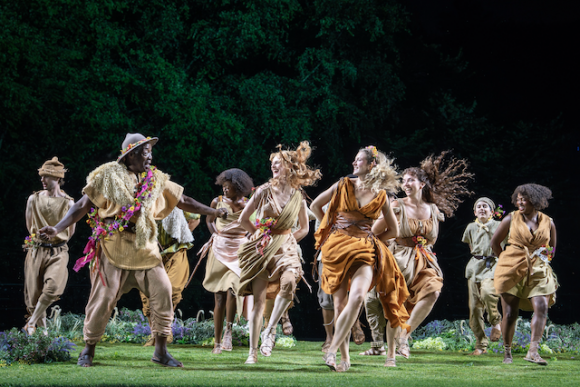
The play’s joyous second half sharply contrasts with the barrenness of the first, leaping 16 years to introduce the next generation: Perdita and Florizel, who have fallen in love in Bohemia. Rescued as an infant by the Old Shepherd (the reliable Chuck Cooper), Perdita has no idea she is a princess, even as Florizel crowns her “Queen of the Feast” at the sheep-shearing celebration. The scene is enchanting, thanks to Isabela Ferrer and Daniel Kyri as the young lovers, while Gilbert Owuor and Teagle F. Bougere bring comic energy to Polixenes and Camillo in disguise. Steven Skybell adds to the carnival spirit as Autolycus, the self-described “snapper-up of unconsidered trifles.”
If the sheep-shearing scene is awash with exuberance, the famous Act 5 statue scene invokes wonder—and hope. Sullivan does not disappoint with his almost religious staging of the miracle, nor do Lily Rabe and Esparza, who bring emotional conviction to the long-separated couple. Marsha Stephanie Blake infuses the feisty Paulina, who essentially stage-manages the resurrection, with a distinctly 21st-century sensibility.
Significantly, Leontes speaks the play’s final line: “Hastily, lead away!” The command comes not from the tyrant of Act 1, but from a man who has learned that even one’s worst mistakes can be redeemed.
The Winter’s Tale
At the Delacorte Theater, Central Park
Running time: 3 hours; 20 minutes with intermission
Through August 22, 2026