
Aftermath
In David Zax’s new play, Aftermath, a family struggles to regain its equilibrium when a son returns home after surviving a Taliban kidnapping in Afghanistan in 2011. Directed by Colton Pometta, this ambitious new play explores the difficult road to recovery from post-traumatic stress disorder (PTSD), but its dramatically unconvincing story and characters undermine its worthy intentions.
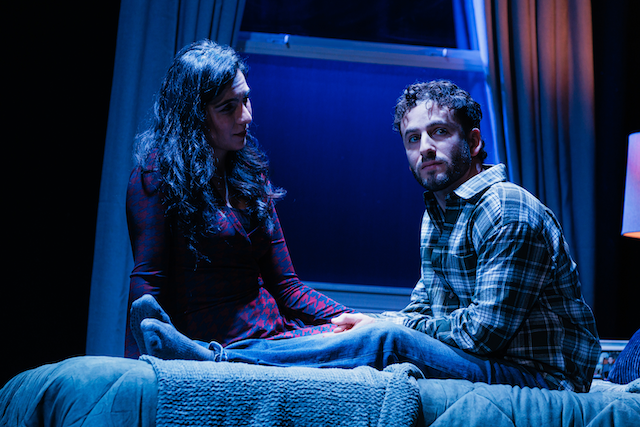
Set in September 2011 in the Goldman family home in Kalorama, an upscale neighborhood in Northwest Washington, D.C., the play centers on 28-year-old freelance journalist Josh Goldman, (Danny Kornfeld) who is recovering in his childhood home after from having been kidnapped by the Taliban in Afghanistan. His father, Allan, a lobbyist in his 60s, (Steven Skybell) and his mother, Linda (Jill Stern), a teacher in her 60s, are there to help him navigate the aftermath.
All the action unfolds on Chen-Wei Liao’s split-level set, whose chic contemporary design encompasses a living room, kitchen, hallway, and Josh’s bedroom. The versatile layout accommodates smooth transitions between scenes while establishing an affluent, comfortably appointed domestic world. Abetted by Lucrecia Briceño’s ambient lighting, the Goldman home looks ready for the cover of House Beautiful.
As the lights come up on Josh’s boyhood room, the stage reveals no physical reminders of the 18 years he spent there growing up. Instead, conversations throughout the play evoke the childhood relics that once filled the room, including a Lawrence of Arabia film poster. Although the poster is never actually seen onstage, it assumes particular significance when a character refers to it in a pivotal scene, drawing a connection between the film’s historical subject and Josh’s own captivity by the Taliban and his seemingly miraculous escape six weeks earlier.

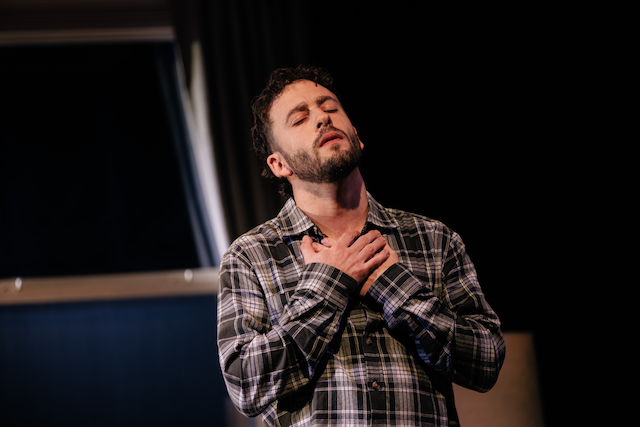
Josh enters his room with a glass of whiskey, his beard beginning to grow, and puts on traditional Afghan music. Gradually, he begins swaying, chanting along, and finally whirling with abandon, momentarily surrendering himself to the music. His private reverie is interrupted by his father, Allan, who enters carrying a manual for an espresso machine. Embarrassed, Josh hastily switches off the music.
Josh had expected to spend the weekend alone, believing his parents were going to their lake house before its impending sale. Instead, his mother, Linda, has insisted on returning home, unwilling to leave her son alone just six weeks after his release from Taliban captivity. Josh confronts his father:
Josh: “What are you doing here? I thought you guys were going to the Lake House.”
Allan: “We got halfway and your mother changed her mind.”
Josh: “I thought this was the last time you were gonna see the Lake House before you sell it.”
Allan: “She didn’t feel right leaving you here all alone.”
Josh struggles to contain his resentment at being treated like a child who needs constant supervision. When Linda enters and mentions her headache, he recognizes the excuse for what it is: she couldn’t bear to leave him alone. Their concern may be understandable, but Josh’s frustration underscores the difficulty of balancing a traumatized survivor’s need for independence with a family’s fear for his well-being.
The arrival of Mina Kharo (Awesta Zarif), an Afghan-British journalist and Josh’s close friend, further unsettles the household. Invited to spend the weekend without his parents’ knowledge, Mina arrives on what is supposedly a high-level journalism assignment, confronting everyone with an awkward surprise. Although she has previously met Linda over Skype, meeting both parents in person is unnerving. To them, Mina represents the dangers of Afghanistan from which they hope to shield their son. She also carries a painful connection to Josh’s ordeal: her late cousin Hamid was Josh’s friend, and the two men were drinking tea in a villager’s home when the Taliban stormed in. Hamid fled and was shot dead.
Zax has clearly researched his subject well, grounding the play in the historical and cultural realities of Afghanistan in 2011, when U.S. and international military involvement in the war was at its height. Yet despite this meticulously established backdrop, the central conflict shifts from the political to the domestic. Around the play’s midpoint, a family secret emerges that casts a shadow over Josh’s seemingly heroic escape from the Taliban. Its revelation unleashes devastating emotional consequences for the family, from which there is no turning back. Whether audiences find this pivotal plot twist convincing or too far-fetched may ultimately determine their response to the play.
To its credit, the production explores two contentious issues that profoundly affect the Goldman family: money and the ways Josh’s wealthy father handles—or mishandles—it; and the moral complexities of conduct in war zones, where the line between courage and recklessness can be perilously thin.
The acting is uniformly strong. As Josh, Danny Kornfeld convincingly conveys the emotional struggles of someone suffering from PTSD, although his character occasionally veers toward whininess. Steven Skybell brings psychological nuance to the role of Josh’s father, Allan, while Jill Stern is persuasive as his overprotective mother. Awesta Zarif rounds out the ensemble with a convincing portrayal of Josh’s British-Afghan friend, who shares his passion for journalism.
Zax’s Aftermath examines the devastating repercussions of war that extend far beyond the battlefield, reaching into the lives of those left to grapple with its psychological scars. While the drama’s pivotal revelation may strain credulity, its exploration of PTSD underscores the arduous road to recovery and the challenges faced by both survivors and the families struggling to help them heal.
Aftermath
At ART/NY’s Mezzanine Theatre
502 W. 53rd Street
Running time: 1 hour; 40 minutes, no intermission
Through November 8, 2026