In Honor of Jean-Michel Basquiat
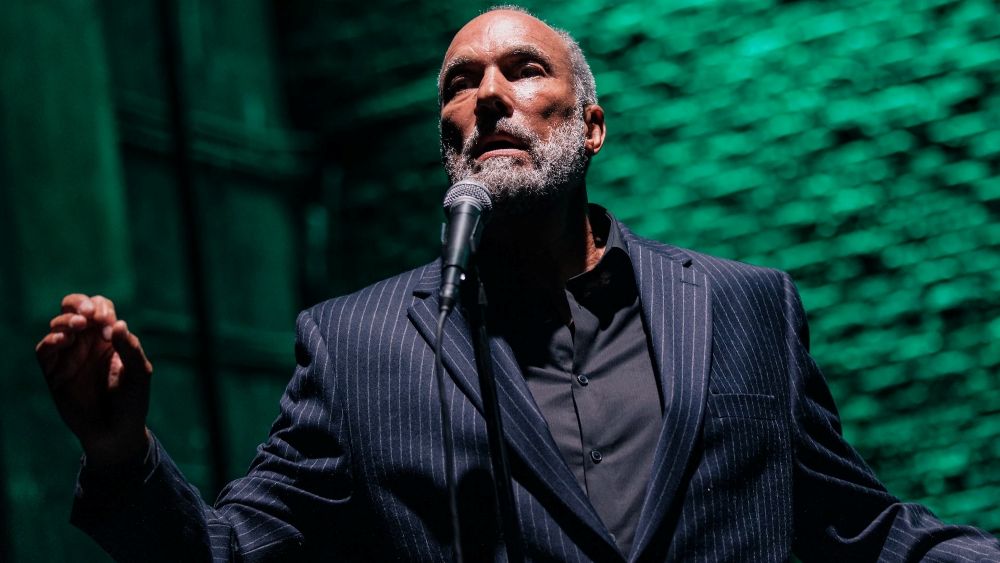
The profoundly felt connection between Neo-Expressionist artist Jean-Michel Basquiat and actor, director, and writer Roger Guenveur Smith is the basis of the outstanding solo show In Honor of Jean-Michel Basquiat. Created and performed by the multi-award-winning Smith, it’s now playing a limited engagement at New York Theatre Workshop, where it had a critically acclaimed sold-out run in the Under the Radar Festival in January. The unique tour-de-force tribute was initially presented as an improvised piece at exhibitions of Basquiat’s work at the Brooklyn Museum and MOCA LA. It combines Smith’s original free-form poetry with performance art and theater, expressive moves, segments of rap, brief bits of song and dance, and socio-historical insights.
Basquiat, born and based in NYC, was, as a teen, known for the graffiti art he created (with his friend Al Diaz) under the tag SAMO (short for “same old shit”). In Los Angeles in 1982, just as his brief but legendary career was beginning to skyrocket (his art eventually realized a record auction price of over $110.5 million), Basquiat did a stint painting in a studio in Venice Beach, CA. (That studio was below the home of esteemed art dealer Larry Gagosian, who was presenting an exhibition of Jean’s work in his gallery.)
While in LA, Basquiat frequented the club scene, where he encountered Smith (then rapping under the name Hollywatts). Basquiat really liked Smith’s “energy,” and invited him to go with him to see the Martin Scorsese film The King of Comedy. The two became fast friends who inspired and impacted each other’s art; Smith based his role of Smiley, the artist/arsonist he embodied in Spike Lee’s 1989 film Do the Right Thing, on Basquiat.
The mix of genres and interwoven elements in Smith’s show offers a stream-of-consciousness jazz-style reflection on his most affecting personal memories of Basquiat, who died of a heroin overdose at the age of 27, his era, and his backstory. He also addresses the extraordinary contributions and struggles of Black men through heinous maltreatment and injustices, recalling key figures (among them, Charlie Parker, Charles Mingus, and John Coltrane, Malcolm X and Martin Luther King) and incidents from our not-so-distant past, bringing his signature politically charged content to the compelling show.
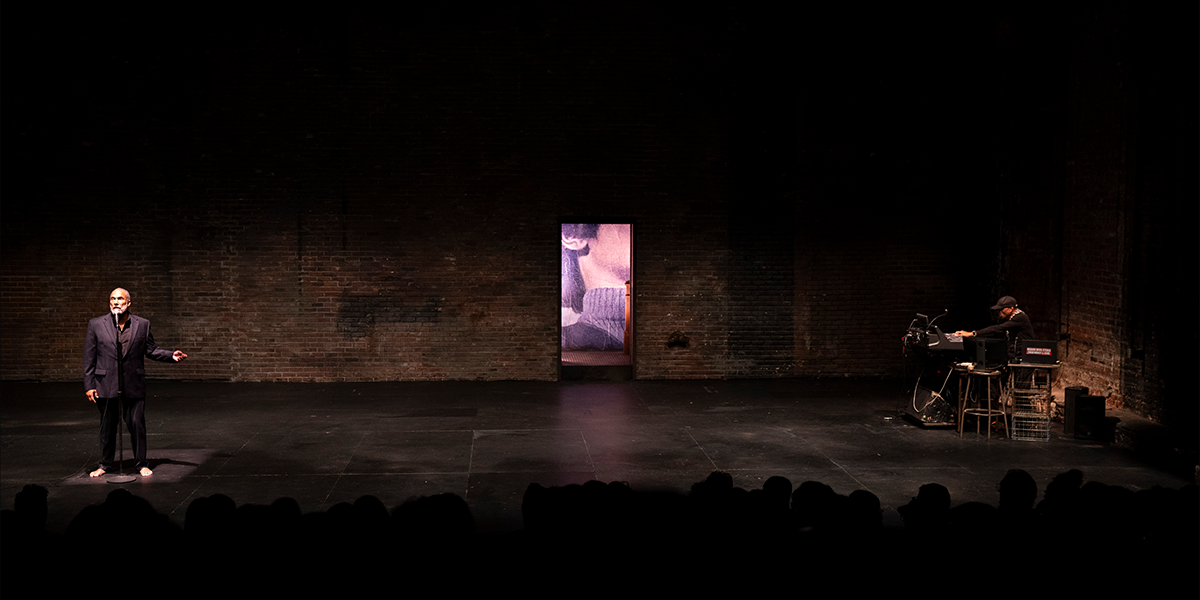
Dressed in a dark pinstripe suit and black shirt, Smith stands barefoot in the spotlight at a downstage microphone, from which he doesn’t move, but makes telling in-place movements that add a physical component to his captivating storytelling. Shifts in the color and tone of the lighting (by Arlo Sanders) enhance the look and moods of the performance, as does the live sound design (by Obie winner Marc Anthony Thompson, who joins him on stage, audience right), with significant music, sound effects, echoes, and other aural elements that range from intimate to earthy to otherworldly.
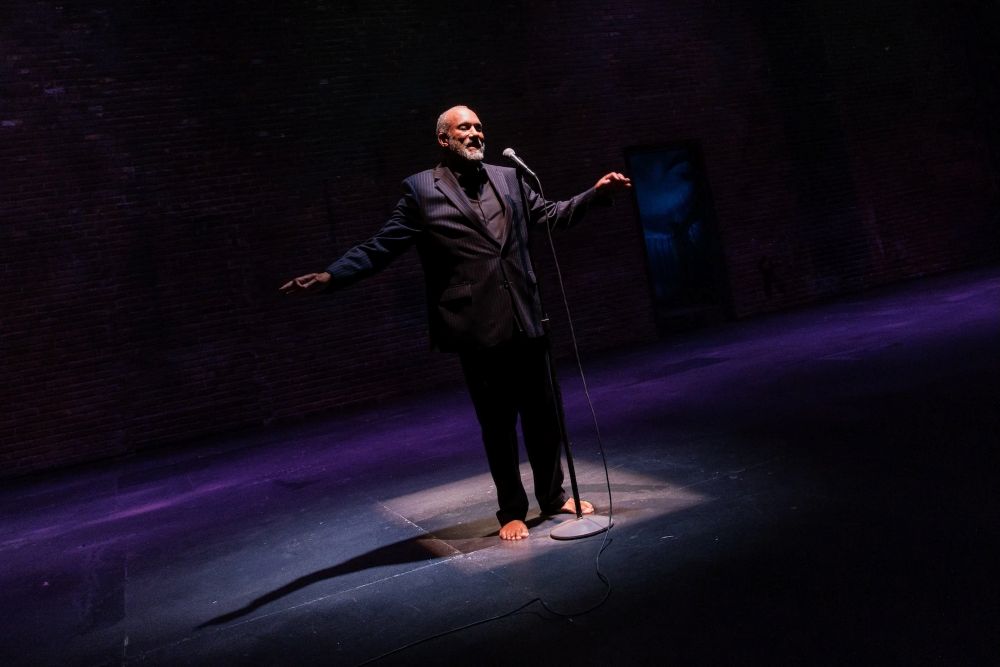
While no images of Basquiat’s famous art are seen on the largely bare stage, Smith describes the motifs of crowns, crossed-out words, and political content in the works he created in response to Smith, and the valuable one he gifted him. And there is a glimpse through a partially open door in the back wall to an adjacent space (scenic design by Raphael Mishler), suggestive of what lies beyond.
Smith assumes the voices and demeanors of several of the people in his flowing reminiscences, beginning with his father (an elevator operator, whose “Going up, going down” becomes a recurrent metaphor in the show) and the paternal warning he was given about his desire to become an “artiste.” He also imitates the auctioneer, Jean, and LA partyers swiffing weed, as well as orally recreating the sound of a sax and other instruments.
In addition to those vocal impersonations is that of the woman with a pronounced NY accent he later met next to Basquiat’s plot in the Brooklyn Green-Wood Cemetery, where a celebrity grave tour noted his association with Andy Warhol (for those unfamiliar with the friendship and collaboration of two of the most groundbreaking artists of the second half of the 20th century, whose work together brought renewed excitement and attention to both, you can see them in the permanent collection of The Warhol Museum in Pittsburgh). Another unsettling link Smith observes between Andy and Jean is the fact that both suffered the loss of their spleens, in his riff of flowing thoughts and interconnections.
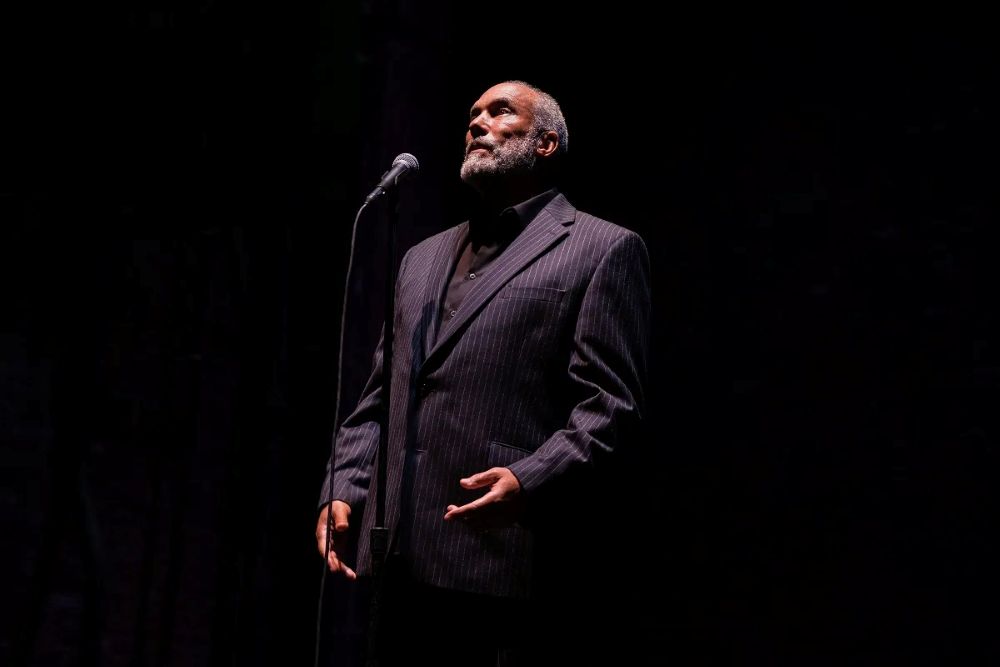
Roger Guenveur Smith’s homage to his late friend is moving and evocative, delivered in a singular style that streams snippets of nonstop memories into a revealing retrospective of their times, their time together, and their impact on one another and the world.
In Honor of Jean-Michel Basquiat
At New York Theatre Workshop
79 East 4th St.
Running time: 55 minutes, no intermission
Through October 10, 2026