

pre-existing condition
Marin Ireland’s well-intended play, pre-existing condition, has landed at The Greenwich House Theater. Running through January, the play brings awareness to struggles that victims of domestic abuse face.

pre-existing condition begins with us meeting an unnamed character (more about that later) who, six months earlier, was hit by her boyfriend. She’s not sure what she’s looking for – revenge, legal consequences, was it partly her fault? She just knows that the incident consumes her. She thinks about it nonstop. She is stuck. She doesn’t get support from lawyers, her mom, and all but one friend. She tries unsuccessfully to date again. She attends a support group and encouraged by them, sees an individual therapist.
As she goes through the multi-week group support program, she talks to the audience, sharing her angst. Less of a story with a beginning/middle/end, this play follows this character and her anguish for a period of time. It doesn’t wrap up neatly at the end, making the obvious point that the victim lives with this the rest of her life.
The lead character is played sequentially by different acclaimed actors during this limited run. (previous: Lupita Nyong’o and Phillipa Soo, upcoming, Hari Nef, Edie Falco, Whitney White) The performance I saw starred Susannah Flood. She has done lots of fabulous work off Broadway and has been spot on in every show I’ve seen her in (Liberation, The Counter). She has a soft spoken yet intense style with a very strong stage presence. Definitely, you could see this character go through the gamut of emotions.
Despite witnessing her pain, as it was her personal, internal struggle, I didn’t take the journey with her. Perhaps not giving her a name made her less easy to identify with; the program refers to her as A. We never even learn what she does for a living. All of the characters were similarly nameless, and all cast members played multiple characters. It was confusing and difficult to figure out who they were portraying.
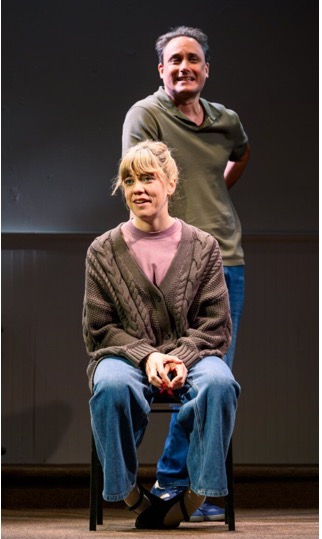
Greg Keller plays her friend, her mother, her father and a guy she dated. In each role, he doesn’t vary his voice or demeanor much. Dael Orlandersmith is very believable in her two roles as one of the group leaders and a personal therapist, although it was at least halfway through the show before I realized they were two different characters. Susannah Perkins, highly praised for a slew of Off-Broadway roles, differentiates her characters (a group leader and former friend) slightly better than the others. However, her appearance is confusing. Does she represent the trans community or why else she is she presented as she is? There was no reference in the script. Costume design from Enver Chakartash made no changes at all to their attire which might’ve helped a little.
Highly acclaimed, versatile actor Marin Ireland wrote pre-existing condition out of her lived experience. In 2012, Ireland was dating her co-star Scott Shephard; during an argument, he hit her. She’s talked about how unsupported she felt. After that experience, Ireland became a public advocate for victims. From her notes and further education, this play was born.
It’s written in a heavily academic, stream of consciousness style. She envisioned it as a reading, and it comes across as such, more an outline than a developed play. The structure of the play was choppy and chaotic. An encounter with her father shows up in a scene towards the end of the play. It came out of the blue as her father was never mentioned before, or after for that matter.
The script distances the physical violence by beginning the play six months after the incident happened. “I didn’t want the play to have violence within it,” Ireland has said. In fact, we never meet the antagonist (the ex-boyfriend). Every effort was made to soften the inherent brutality of domestic abuse. That may be a good strategy as therapy but pulls the drama out of the play.

Maria Dizzia, who played the lead character when pre-existing condition premiered in 2024, directed this offering, bolstering Marin Ireland’s conviction to keep the conversation in a safe space. All scenes are performed on a single set, an unremarkable meeting room with stackable chairs (scenic design, Cate McCrea) and harsh fluorescent lighting ((lighting design, Isabella Byrd).
While pre-existing condition makes many good points about both the immediate and residual aftermath of domestic abuse, it is short on story and lacks emotional connection. A miss.
pre-existing condition
At the Greenwich House Theater
27 Barrow Street
Running time: 75 minutes, no intermission
Through January 8, 2027