Shifters
Love stories often ask whether time heals old wounds; Benedict Lombe’s Shifters, directed by Lynette Linton, asks the more provocative question of whether memory ever allows those wounds to close. Following its 2024 West End run in London, this emotionally resonant drama intertwines romance with the elusive nature of recollection, proving as intoxicating as it is deeply affecting.
Shifters unfolds in five sections — “Allies,” “Friends,” “Fractures,” “Lovers,” and “Fugitives” — across 26 scenes that fluidly alternate between present and past. Benedict Lombe structures the play with remarkable elegance, allowing one scene to dissolve into the next until memory and reality become virtually inseparable.

At the center of the story are Des, a British woman of Congolese heritage, and Dre, a British man of Nigerian heritage. Both are 32 when the play opens at the funeral reception for Dre’s beloved grandmother, affectionately known as Nana. Delayed by a late flight and a canceled train, Des (short for Destiny) arrives after the service, but before she can apologize, Dre is transported by the simple sight of her standing in the doorway and softly saying, “Hi.” Time seems to collapse, and the space around him shifts, carrying both characters—and the audience—through the remembered milestones of a relationship that began when they were sixteen, in a philosophy classroom 158 miles northwest of London. There, under the guidance of their teacher, Mr. Harris, they learn the art of debate, a lesson that evolves into one of the play’s richest recurring motifs as Dre and Des repeatedly find themselves arguing opposite sides of life’s questions, only to discover that they have often been asking the wrong questions all along.
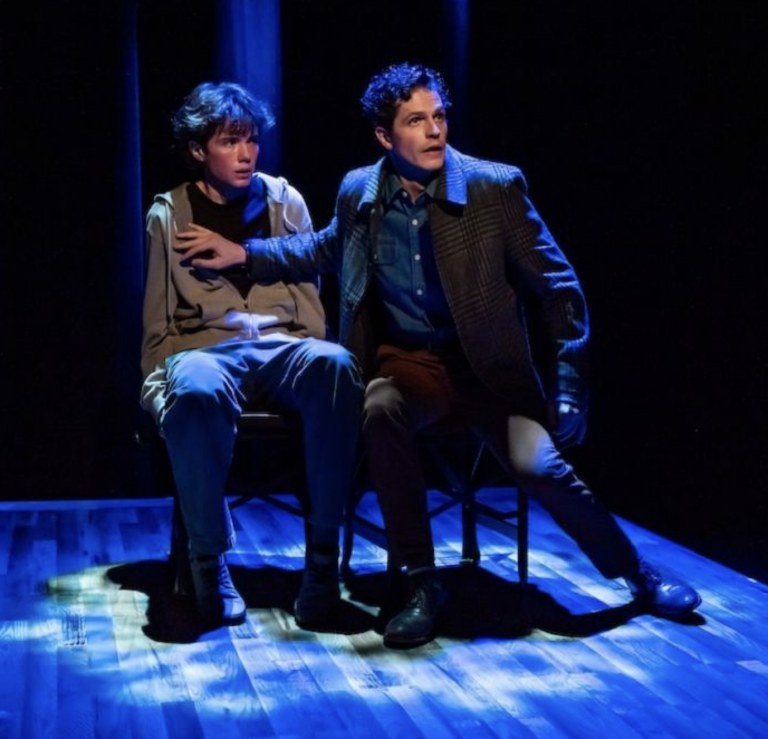
Shifters is an immersive production that never lets the audience forget it is an essential participant in the unfolding drama. Director Linton underscores that sense of immediacy by seating roughly a dozen audience members onstage in two rows flanking the action, allowing them to experience the play at remarkably close range.
The immersion extends well beyond the seating arrangement. Lombe repeatedly breaks the fourth wall, inviting the audience into Dre and Des’s inner lives throughout the play’s goings-on. Both characters confide directly in the audience, yet their asides are especially striking because they are almost always delivered in the second person, subtly collapsing the distance between speaker, listener, and memory. Dre establishes this conversational intimacy from the outset, joking that claiming leftovers after a melanated gathering is a fiercely competitive sport in which latecomers inevitably lose. Having first won the audience over with his humor, he gently shifts to a more vulnerable recollection, explaining how he came to live with his grandmother in Crewe: when he was 16:
Dre: Dre: You’re sixteen. You’re in Year 12.
It’s your first week, at a new school, in a new town
and you’re the living embodiment of
“I got in one little fight/ and my mom got scared /
and said you’re moving. . .” with your grandma. . .
To some place near Crewe.
Dre’s grandmother emerges as the “rock” of his life. Fierce-tempered and prone to scolding him and those in his social circle, she nonetheless provides him with a sense of family in the absence of his parents: his mother has returned to Nigeria, while his father, Dre says, “offed” himself, unable to cope with life’s harsh realities. His grandmother’s cooking also inspires Dre’s dream of owning a restaurant, which makes food, like the characters’ shared passion for debating, an important motif.
Although his grandmother’s memory looms large and her funeral reception frames the scenes unfolding in the present, it is Dre and Des’s relationship that remains at the heart of the drama. Lombe compellingly charts their mercurial journey from fellow school debaters to friends to lovers.

This is hardly a garden-variety love story. Lombe’s characters continually wrestle with memories of their Nigerian and Congolese cultures as they try to understand their feelings for each other and define their complicated relationship. Both are also ambitious: Dre dreams of opening a restaurant specializing in West African and Congolese cuisine, while Des, a gifted children’s writer and illustrator, finds early success that takes her abroad, eventually to New York. When she returns to England to visit her widowed father, a neurologist, reconnecting with Dre—now an unmarried father of a young son with special needs—is difficult. Des, who once professed an aversion to marriage, is now engaged to a touring jazz musician.
Happily, Heather Agyepong and Daniel Ezra bring these vibrant yet vulnerable characters fully to life. Agyepong imbues Des with a winning blend of sass and intelligence, while Ezra captures Dre’s confidence and charm.

Lombe smartly resists the temptation to “tidy up” her play at its conclusion, trusting the audience to draw its own conclusions about Dre and Des’s romantically ambiguous relationship in the final scene. With the theatrical magic of Alex Berry’s ultra-contemporary set, illuminated by Neil Austin’s intense lighting and complemented by Tony Gayle’s sensitive sound design, what remains unspoken proves eloquent.
Ultimately, Shifters is as much about the enduring power of memory as it is about love, identity, and the difficult choices that shape our lives. By trusting its audience to inhabit those uncertainties alongside Dre and Des, Lombe has created a poignant and deeply human drama that lingers long after the final scene.
Shifters
At the Cherry Lane Theatre
38 Commerce St.
Running time: 1 hour 40 minutes, no intermission
Through September 13, 2026