The Rat Trap
The Rat Trap
By Marc Miller
First, a bit of history.
It’s 1918, and young Noel Coward is
performing in other people’s plays while trying to write his own.
Under these busy circumstances he concocts The Rat Trap, which, it is
speculated, he conceives to star himself and his great friend, the celebrated
young actress Maggie Albanesi. Albanesi passes away a few years later, at 24,
probably of a botched abortion, and a grieving Coward delays The Rat Trap’s premiere until 1926, with other actors, outside the
West End. Amid several concurrently running Coward hits, critics and audiences
dismiss it, and it’s not heard from again until many
decades later. It’s had the occasional British
production since 2006, but at the Mint Theatre Co., dedicated to interesting
old plays you’ve never heard of, The Rat Trap is now
having its American premiere.
Don’t expect Private Lives or Present Laughter or Hay Fever.
This product of the teenage Coward’s imagination, while blessed with his
gift for language and samplings of his famous wit, is no boulevard comedy. It’s a “problem play,” an issues-laden
comedy-drama closer in spirit to George Bernard Shaw, whom Coward must have
been consciously trying to emulate. Neat it isn’t:
The Rat Trap toggles between sad and funny with little discipline, overplays
its characters’ conflicts, and has one of the most
abrupt endings you’ll ever see. But it’s the work of an 18-year-old whose skills are, to put it
very mildly, precocious.
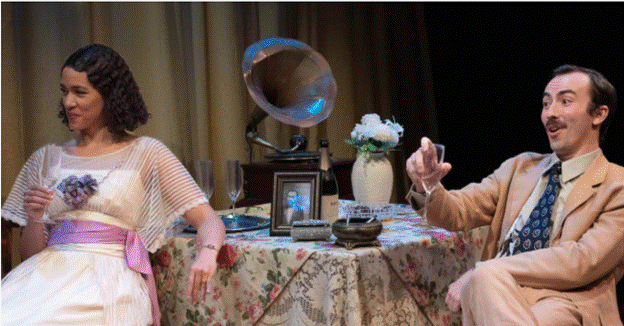
Sarin Monae West and James Evans. Photo by Todd Cerveris
We’re in Kensington, at the end of a merry dinner, where Olive (Elisabeth Gray) is celebrating the impending marriage of her good pal Sheila (Sarin Monae West) to Keld (James Evans). Olive and Sheila have been living together, nursing a friendship that, at least as directed by Alexander Lass, looks like it might have been something more than that. Keld and Sheila are both writers—he an aspiring playwright, she a successful author of short stories and novels—and, it’s not hard to gather, she’s the more talented of the two. With Olive’s unmarried, living-in-sin downstairs neighbors Naomi (Heloise Lowenthal) and Edmund (Ramzi Khalaf) quipping on the sidelines, Keld and Sheila pursue a rocky union, alternately cooing and screaming at each other, including a really knock-down-drag-out Act II (out of four acts) finale. Meanwhile, Keld, though he’s no literary genius, becomes the far more successful of the pair, while Sheila agrees to terminate her career for the sake of domestic tranquility. All while Keld is getting flirty with Ruby (Claire Saunders), the soubrette in one of his plays, and Burrage (a scene-stealing Cynthia Mace), the couple’s Cowardesque maid (she functions roughly as Edith does in Blithe Spirit), is interrupting them at awkward moments.
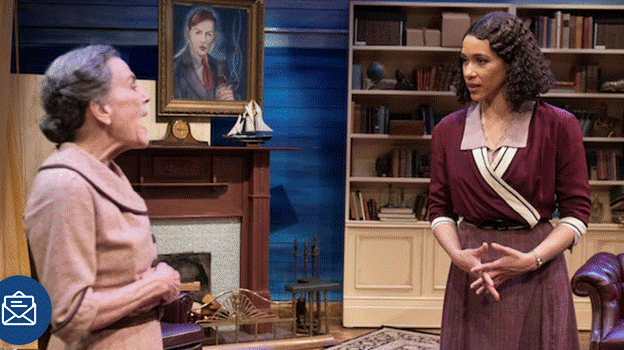
Cynthia Mace and Sarin Monae West. Photo by Todd Cerveris
Young Noel doesn’t lack for ripostes: “Marriage nowadays is nothing but a
temporary refuge for those who are uncomfortable at home.” “Publishers never touch
alcohol in any form; it might go to their heads and make them accept things.” But
he’s harder at work exploring societal
quandaries. How far must a wife defer to a husband, and why is she the one
subjugation is expected of? What is the proper wifely response to an
infidelity? Are some literary careers more honorable than others? He doesn’t necessarily answer these questions, but in 1918 it was
daring just to bring them up—not to mention illegitimacy, unwanted pregnancies,
gold-digging hussies, and other then-scandalous topics that pop up. It’s an unfiltered talent; Coward is verbose, and his
intended epigrams don’t always land with their customary
ease. But it’s unmistakably there.
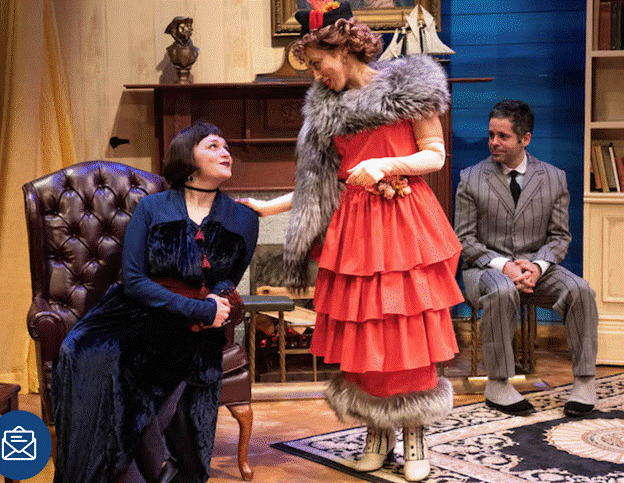
Heloise
Lowenthal, Claire Saunders, and Ramzi Khalaf. Photo by Todd Cerveris
It’s not the smoothest Mint production, either. The acting varies: Evans’s Keld doesn’t have the assurance of West’s Sheila, and Lowenthal and Khalaf don’t make huge impressions in what admittedly are almost extraneous characters. Gray and Saunders seem at home as Olive and Ruby. Vicki R. Davis’s set is unusually utilitarian by Mint standards, and Hunter Kaczorowski’s costumes are a mixed bag—would even a showboat like Ruby show up in flaming red? Lass’s direction has some savory moments: Get a load of Gray’s timing on, “I’ve nothing against him at all, really… [long pause] But somehow…”. But he can’t do much about the novice playwright’s abrupt changes of mood and tone, or the completely up-in-the-air way the Master chooses to leave us.
But which would you rather have, yet another competent production of a Coward chestnut you’ve seen many times before, or a fresh look at the youthful genius trying his hand at serious playwrighting, and revealing an aptitude and sophistication far beyond the range of any other 18-year-old you’ve ever met? Sheila, defending her husband’s output to Olive, says, “He has a wonderful sense of the dramatic, which of course is most important, and his dialogue is exceedingly witty. He may fail a little in construction, but that won’t matter a bit if he shows real sincerity.” And that’s a pretty good summing up of Coward at 18. The Rat Trap has some rough edges, but clearly this young man is headed for great things. The dude could write.
The Rat
Trap
Playing
at New York City Center Stage II, 131 W. 55th St.
Tickets:
nycitycenter.org, or 212 581-1212
Through
Dec. 10
Running
time: 2 hours 15 minutes